
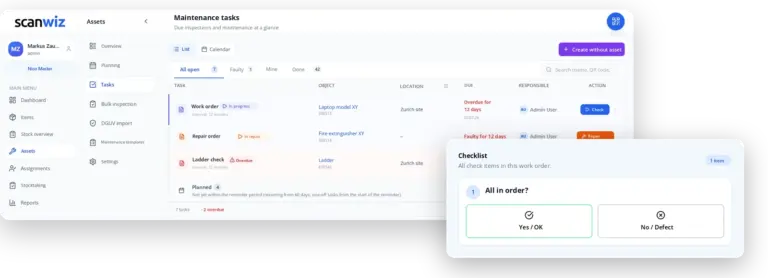
Equipment inspection intervals are scattered across folders, spreadsheets and people’s heads in many businesses: the electrician does the electrical testing, someone checks the ladders in spring, and for the forklift you hope the service contract remembers. That works – until the accident insurer asks, or an accident happens and the inspection record is missing.
This guide gives you an overview of the most important equipment inspection intervals, explains where they come from and who sets them, what applies in Switzerland and how to organise inspections in six steps so that no deadline slips through again. The legal details refer to Germany and Switzerland; other countries have their own rules, but the organisational principles are the same.
Key points at a glance
- In Germany, the employer sets the type, scope and intervals of inspections in the risk assessment (section 3 BetrSichV, the Industrial Safety Regulation). Fixed maximum intervals exist only for a few types of equipment.
- Most well-known intervals are guide values from accident insurance (DGUV) regulations, rules and standards – for example six months for portable electrical equipment, three months on construction sites.
- In Switzerland, work equipment must be maintained according to the manufacturer’s instructions under Art. 32b of the Accident Prevention Ordinance (VUV); intervals follow from the manufacturer and a risk assessment.
- Most missed inspections fail not because of knowledge but because of organisation: device can’t be found, responsibility unclear, no reminder.
Contents: Terms · Legal basis · Overview table · Switzerland · 6 steps · Fixed date or from inspection? · Common mistakes · Consequences · With Scanwiz · FAQ
What are equipment inspection intervals?
Work equipment means all tools, devices, machines and installations used in a business: from the cordless drill and the ladder to the forklift. The inspection interval is the maximum period after which a piece of equipment must be checked again for safe condition.
It’s worth distinguishing three kinds of inspection:
| Inspection | When? | Who? |
|---|---|---|
| Visual check before use | Before every use | The user |
| Periodic inspection | Within the set inspection interval | A competent person, e.g. a qualified electrician or an expert |
| Inspection after special events | After an accident, repair, fall or long idle period | A competent person |
This article is about the periodic inspection. It requires every piece of equipment subject to inspection to be recorded and findable – how to build that inventory is shown on the equipment management page.
Legal basis in Germany: who sets inspection intervals?
The most common misconception: that there is one central list of binding inspection intervals. In fact, the German Industrial Safety Regulation requires the employer to determine the type, scope and intervals of inspections themselves as part of the risk assessment (section 3 (6) BetrSichV). Inspections are carried out by a competent person and the results are recorded (section 14 BetrSichV).
Several sources provide guide values to help set them:
- DGUV regulations of the statutory accident insurers, for example DGUV Regulation 3 for electrical installations and equipment, DGUV Regulation 68 for industrial trucks and DGUV Regulation 70 for vehicles.
- DGUV rules and information, such as DGUV Information 208-016 for ladders and steps.
- Technical rules and standards such as TRBS 1201, EN 15635 for storage racking or DIN 14406-4 for fire extinguishers.
- Manufacturer’s instructions in the operating manual.
In practice: guide values are a good starting point, but not a free pass. If equipment is used heavily, in harsh conditions, or inspections keep finding defects, the interval has to be shorter.
Equipment inspection intervals: the overview table
The table shows proven inspection intervals for typical equipment in trades, construction, warehousing and workshops in Germany. It doesn’t replace a risk assessment, but gives you a solid basis for your inspection plan.
| Equipment | Typical interval | Basis | Who inspects? |
|---|---|---|---|
| Portable electrical equipment (drill, extension lead, charger) | Guide value 6 months, on construction sites 3 months; can be extended if the defect rate is below 2 % (workshop and site up to 1 year, office up to 2 years) | DGUV Regulation 3, table 1B | Qualified electrician or electrically instructed person with test equipment |
| Electrical installations and fixed equipment | 4 years | DGUV Regulation 3, table 1A | Qualified electrician |
| Residual current devices in non-stationary installations (site distribution boards) | Test button every working day | DGUV Regulation 3, table 1A | User |
| Ladders and steps | Per risk assessment, in practice usually annually | DGUV Information 208-016 | Competent person |
| Industrial trucks (forklifts, powered pallet trucks) | At least annually | DGUV Regulation 68 | Expert |
| Storage racking loaded by industrial trucks | At least annually (expert inspection) | EN 15635 | Technically competent person |
| Lifting accessories (slings, chains) | At least annually, more often depending on use | DGUV Rule 100-500, chapter 2.8 | Competent person |
| Portable fire extinguishers | At least every 2 years | DIN 14406-4, ASR A2.2 | Expert |
| Company vehicles | As needed, at least annually | DGUV Regulation 70 | Expert |
| Fall protection PPE (harnesses, lanyards) | As per manufacturer, at least annually | DGUV Rule 112-198 | Expert |
Sources: the implementation notes to DGUV Regulation 3, section 5 and the inspection interval overviews of the German accident insurance institutions. Always check your own insurer’s requirements and the manufacturer’s instructions too.
Special case electrical equipment: the 2 percent rule
For portable electrical equipment, DGUV Regulation 3 allows a flexible interval: if the defect rate found in inspections is below 2 percent, the interval can be extended. Conversely, if you don’t evaluate your inspection results, you can neither sensibly extend the interval nor justify it. Clean records with a result per device are therefore not just a duty – they save real money.
Example: inspection plan for a trade business with 15 employees
This is what an inspection plan can look like when equipment is organised in groups. The intervals are examples based on the guide values and must fit your risk assessment.
| Equipment group | Number | Interval | Inspected by | Scheduling logic |
|---|---|---|---|---|
| Power tools on site | 48 | 3 months (longer if defect rate below 2 %) | External electrical contractor | Fixed date, batch inspection |
| Electrical equipment workshop and office | 22 | 12 or 24 months | External electrical contractor | Fixed date |
| Ladders and steps | 14 | 12 months | Trained employee | Fixed date, batch inspection |
| Fire extinguishers | 6 | 24 months | External expert | Fixed date |
| Company vehicles | 7 | 12 months | Garage | Fixed date, plus mileage |
| Forklift | 1 | 12 months, service every 500 operating hours | External expert | Time and counter |
These six lines add up to around 150 inspection dates a year. With groups, fixed dates and batch inspections, they turn into a few plannable inspection days – instead of 150 individual dates someone has to remember.
Inspection intervals in Switzerland: what applies?
Switzerland has no DGUV tables. The basis is Art. 32b of the Accident Prevention Ordinance (VUV): work equipment must be maintained professionally according to the manufacturer’s instructions, and maintenance must be documented. How often inspections take place is decided by the employer based on the manufacturer’s instructions or a risk assessment.
- Electrical work equipment: Suva recommends setting intervals according to place of use and stress, and carrying out a visual check before every use. For repeat electrical testing, the Electrosuisse rule SNR 462638 is the practical reference. More on the Suva website (in German).
- Equipment in harsh conditions – heat, cold, moisture, dust – is inspected more often, as is equipment after falls or other unusual events.
- Lifting and lashing equipment is checked before each use and, in practice, inspected by an expert at least once a year.
Many Swiss businesses also use the German guide values as orientation, as they reflect the state of the art. In both countries, what matters is the same: set intervals, clear responsibility and a complete record.
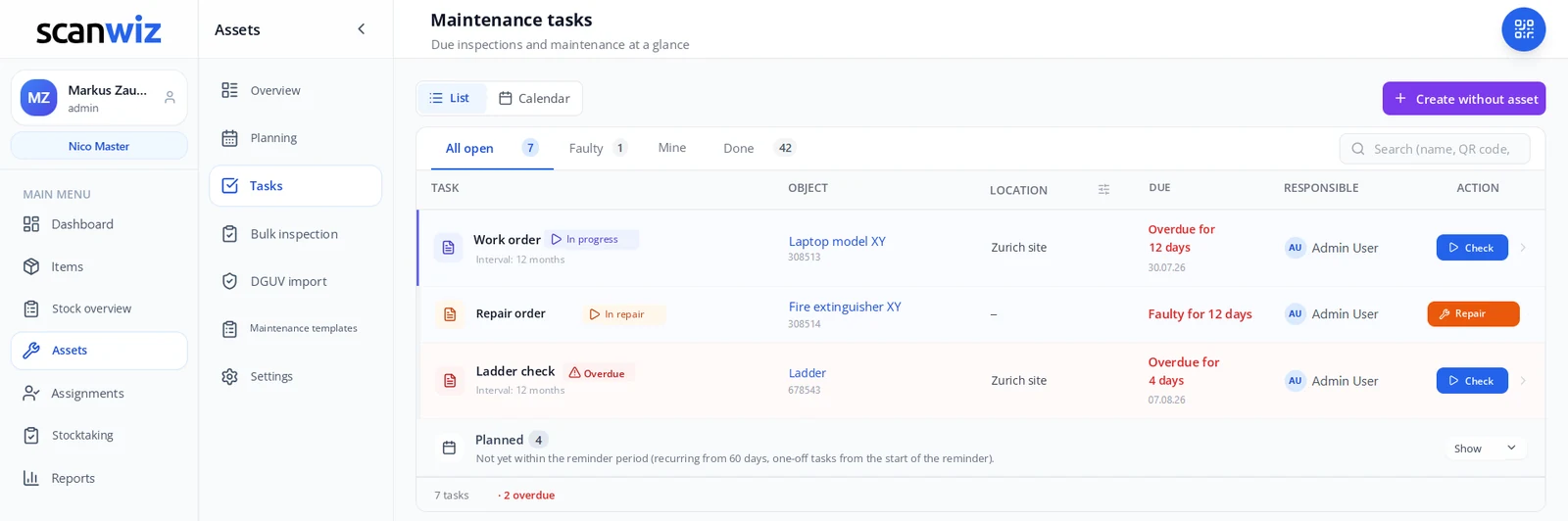
Organising inspection intervals in 6 steps
A working inspection plan doesn’t start from a list of regulations but from the equipment you actually have. Here’s how to build it:
1. Record all equipment subject to inspection
Ladders, electrical devices, extension leads, forklifts, racking, fire extinguishers, vehicles: every device is recorded individually with asset number, location and responsibility. Don’t forget what is currently on job sites, in vehicles or with employees – a device nobody can find doesn’t get inspected.
2. Set inspection type and interval per group
Form groups with the same inspection – “ladders”, “electrical equipment on site”, “electrical equipment office” – and set the inspection type, interval and checkpoints per group. The basis is your risk assessment, the manufacturer’s instructions and the guide values from the overview above.
3. Name the responsible and competent person
Every inspection needs a responsible person who is reminded and arranges it – and a competent person who carries it out. That can be internal, for example a trained employee for ladders, or external, such as the electrical contractor for DGUV V3 testing.
4. Set up reminders with lead time
A deadline someone has to remember will eventually be forgotten. Set up reminders with enough lead time – 30 days works for most inspections, more for external inspectors.
5. Inspect with a checklist and label
A standard checklist makes sure everyone checks the same things. After the inspection, the device is labelled – traditionally with an inspection sticker, digitally with a QR code that brings up the full inspection history. You can create labels with the QR code label generator.
6. Document and follow up on defects
Record the inspector, date, result and any defects. Under section 14 BetrSichV, records must be kept at least until the next inspection; in practice, keeping the full history pays off. A device with a defect is locked, repaired and only released again after a follow-up inspection.
Fixed date or from the inspection? An underrated detail
Say the annual ladder inspection is due on 7 February but only gets done on 20 February. When is the next one due?
- Fixed date: on 7 February again. The rhythm stays, and the inspection doesn’t drift later year after year. For mandatory inspections this is usually the right approach.
- From completion: on 20 February. The interval restarts. This suits ongoing maintenance such as oil changes or cleaning.
Machines and vehicles often add a counter, such as operating hours: then whichever comes first is due – 500 hours or 12 months. A spreadsheet can hardly handle this logic; maintenance software can.
6 common mistakes with inspection intervals
- The deadline list belongs to one person: if they’re ill, on holiday or have left, nobody knows what’s due.
- Devices can’t be found: the inspector arrives, but half the drills are on job sites. How to keep track of devices is covered in the guide Stop tool loss.
- New devices are missing from the plan: new purchases go into use, but not onto the inspection list.
- Defects without consequences: a device fails but stays in circulation because it wasn’t locked.
- Records are scattered: inspection reports sit in folders, emails and with the contractor – in an emergency it takes days to gather them.
- Intervals are never adjusted: the defect rate isn’t evaluated, so intervals are neither extended nor shortened.
What happens if inspection deadlines are missed?
In Germany, missed inspections can be fined as administrative offences under the Industrial Safety Regulation. The consequences after an accident usually weigh more: if the inspection record is missing, recourse claims by the accident insurer, problems with insurance cover and, in the worst case, personal liability of those responsible may follow. A complete record you can pull up quickly is the best protection.
Note: This article is a practical overview and does not replace advice from an occupational safety specialist, your accident insurer or Suva. What counts are the regulations that apply to your business, your risk assessment and the manufacturer’s instructions.
Managing equipment inspection intervals with Scanwiz
Scanwiz combines equipment management with maintenance and inspections. So you don’t just know when an inspection is due, but also where the device is and who has it:
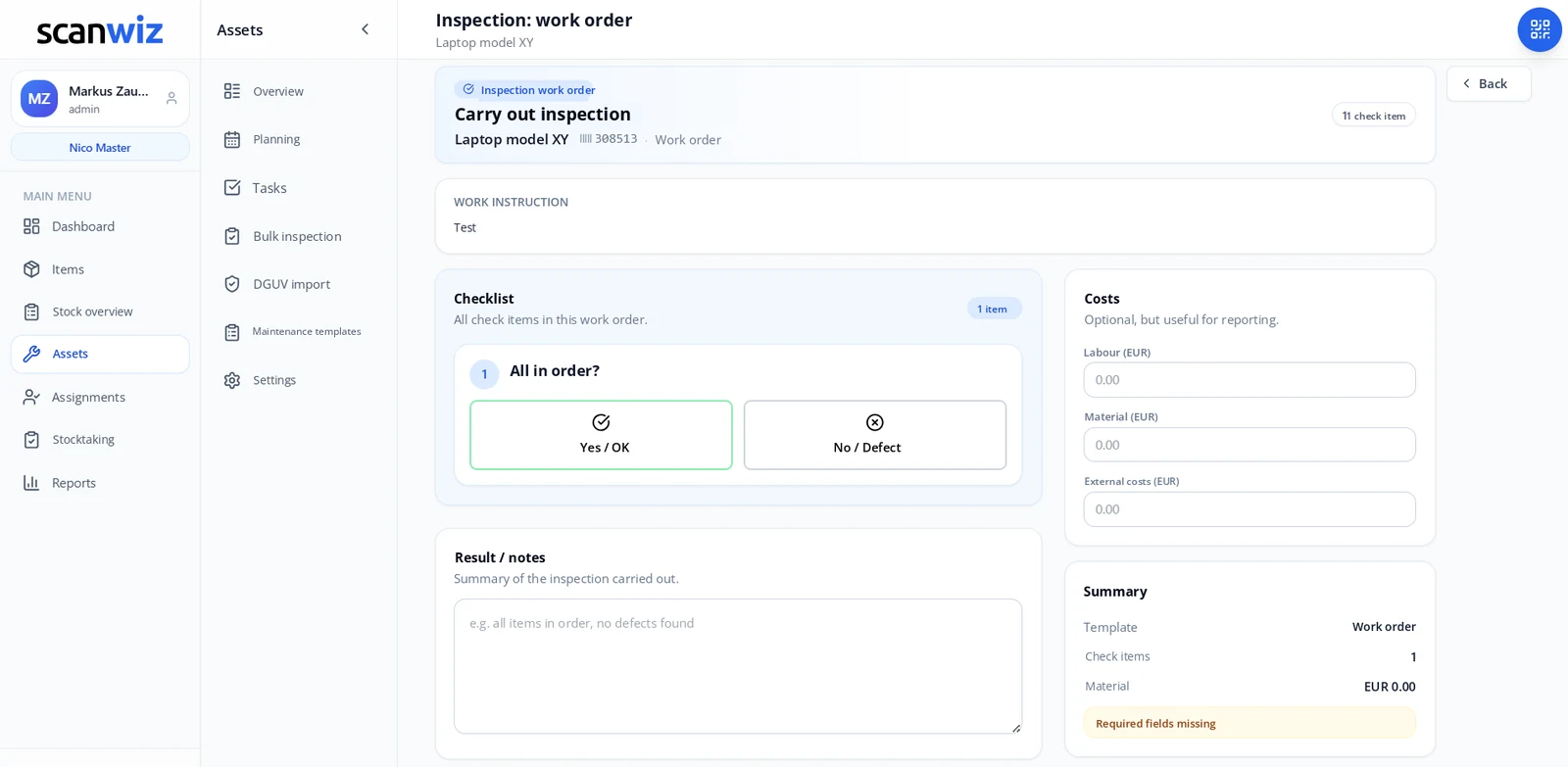
- Templates with interval and checklist: create once, apply to one device or all ladders at once.
- Fixed date or from completion, plus time and counter – whichever comes first is due.
- Reminders with lead time for the responsible person; the “Mine” filter shows everyone their open inspections.
- Batch inspection for ladders, fire extinguishers or small electrical devices – each result is still recorded on the individual item.
- Record defects, lock the device, order the repair – with photo, note and follow-up inspection.
- Logbook per device with every report, printable in full for audits and insurers.
- DGUV import for existing test data of electrical equipment, so your history doesn’t start from zero.
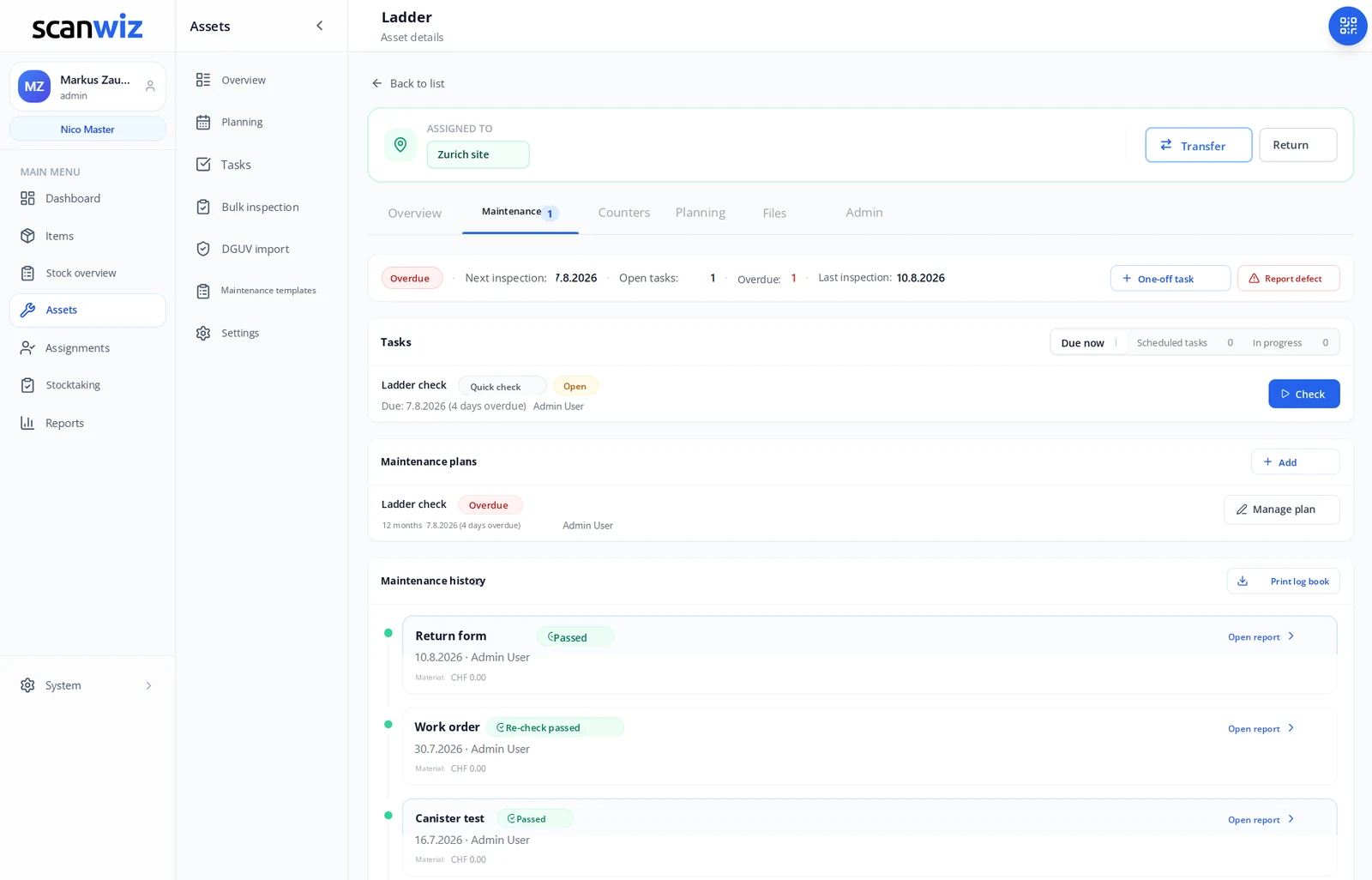
Scanwiz handles intervals, checklists and records – which inspection is mandatory in your business is decided by the regulations and the competent person. All details are on the maintenance and inspections page. More than 250 businesses use Scanwiz, rated 4.9 out of 5 stars from more than 120 reviews on Capterra, GetApp and G2.
Frequently asked questions about equipment inspection intervals
Who sets equipment inspection intervals?
In Germany, the employer, as part of the risk assessment under section 3 (6) BetrSichV. DGUV regulations and rules, technical rules, standards and manufacturer’s instructions serve as guidance. In Switzerland, the employer sets intervals based on the manufacturer’s instructions and a risk assessment (Art. 32b VUV).
How often does portable electrical equipment need to be tested?
Under DGUV Regulation 3, the guide value is six months, three months on construction sites. If the defect rate is below 2 percent, the interval can be extended – in workshops and on sites to a maximum of one year, in offices to a maximum of two years.
How often do ladders need to be inspected?
There is no fixed statutory interval. It depends on frequency of use, stress and previous defects. In practice, an annual inspection by a competent person has proven itself, plus a visual check before every use.
What is a competent person for inspections?
Someone who has the necessary expertise for the specific inspection through vocational training, professional experience and recent professional activity. For electrical equipment this is usually a qualified electrician; for ladders it can be a trained in-house employee.
How long do inspection records need to be kept?
Under section 14 BetrSichV, inspection records must be kept at least until the next inspection. In practice, keeping each device’s full history pays off – it proves regular inspections in the event of damage and helps evaluate the defect rate.
Is a visual check before use enough?
No. The visual check before each use doesn’t replace the periodic inspection by a competent person. It’s an additional check that catches obvious damage before someone works with a defective device.
Do I need software for inspection intervals?
For a few devices, a calendar is enough. Once dozens of devices with different intervals, several locations and job sites come together, maintenance software saves a lot of time: it calculates dates, reminds the responsible person, guides through the checklist and keeps every record on the device.
Conclusion: inspection intervals are an organisational topic, not a knowledge topic
Which equipment inspection intervals apply can be set well with the overview, the DGUV guide values and the manufacturer’s instructions. Day-to-day is where it gets hard: devices are on the move, responsibilities unclear, records scattered. If you record every device, set intervals per group, automate reminders and document every inspection on the device, you won’t miss another deadline – and you’ll have the record ready when it’s needed. A good first step: list your ten most-used devices today and note when each one was last inspected – the gaps usually show up immediately.
Updated October 2026.
More than 250 customers already trust Scanwiz
Inspection deadlines that flag themselves.
Set intervals, get reminded in time, inspect with a checklist and keep every record on the device. Start for free or let us show you in a personal demo how it would look in your business.


