
Tool loss is something every trade business knows: the laser level hasn’t been seen for weeks, only one battery is left in the drill case, and a new hammer drill gets bought in a hurry for tomorrow’s job. On its own, each case seems harmless. Over a year, though, replacement purchases, search time and wasted trips quickly add up to amounts that appear in no budget.
This guide shows you why tools really disappear, what tool loss costs, the nine measures that stop it and what to do if something does get stolen.
Key points at a glance
- Most tools aren’t stolen but forgotten: in a colleague’s van, on the last job site, with a subcontractor.
- More expensive than the tool itself are search time, duplicate purchases and downtime – twelve fitters searching ten minutes a day quickly add up to more than 400 working hours a year.
- The biggest lever: record every handover and give every tool a clear owner – a person, a vehicle or a job site.
- Against theft, secured containers and vehicles help – plus a list of asset and serial numbers for the police and your insurer.
Contents: What is tool loss? · 5 causes · Costs · 9 measures · Tool check-out · KPIs · Checklist · After a theft · With Scanwiz · FAQ
What is tool loss?
Tool loss – sometimes called tool shrinkage – is the ongoing, often unnoticed disappearance of tools, measuring devices and accessories in a business. It doesn’t just mean theft, but anything that means a device isn’t there when it’s needed: misplaced, forgotten, never returned, thrown away when broken or stolen.
Tool loss is typically gradual. There is rarely one big loss, but many small gaps that only show when a device is missing – or at the next stocktake, when the list no longer matches the shelf.
Why tools go missing: the 5 most common causes
| Cause | What it looks like day to day | How you spot it |
|---|---|---|
| Forgotten and misplaced | The laser stays on a finished job site or in the wrong van | Tools reappear weeks later |
| Passed on without a note | A colleague borrows the hammer drill “just for a moment” | Nobody knows who had it last |
| Never returned | Subcontractors, temps or former employees keep devices | Gaps after a project ends or someone leaves |
| Damage kept quiet | A broken device ends up in the skip instead of the workshop | Replacements without a damage report |
| Theft | Broken-open containers, loaded vans overnight, open sites | Several expensive devices gone at once |
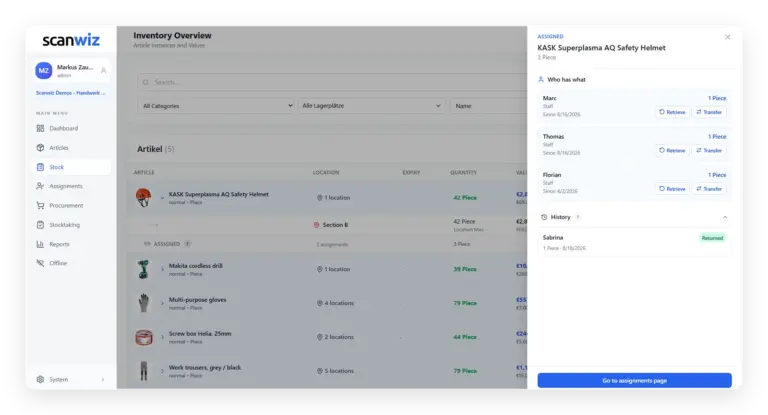
The first four causes have one thing in common: there is no answer to the question “Who has the tool right now?”. That’s exactly where most measures against tool loss start. Theft is real and expensive, but rarely the main reason for the many small gaps.
What does tool loss really cost?
The replacement value of a missing device is only the visible part. The bigger items never show up as a line of their own on any invoice:
- Search time: morning phone calls, searching the warehouse, asking around on site.
- Wasted trips: driving back to the workshop or the old job site to fetch a device.
- Duplicate purchases: a new laser is ordered while the old one sits in a colleague’s van.
- Downtime: work that can’t continue without the right device – often the most expensive item.
- Inspection risk: a power tool nobody can find can’t be inspected on time either.
Example: twelve fitters, ten minutes a day
| Employees using tools | 12 |
| Search time per person per day | 10 minutes |
| Working days per year | 220 |
| Search time per year | 440 hours |
| Internal hourly rate | EUR 55 |
| Cost of search time | EUR 24,200 |
| Replacement devices (4 × EUR 350) | EUR 1,400 |
| Total tool loss, estimated | EUR 25,600 per year |
These numbers are an example. You can run your own figures in the tool loss calculator on the tool management page. Theft comes on top: according to the Chamber of Industry and Commerce in Baden-Württemberg, practically every construction company is hit by job-site theft once or twice a year, as Stuttgarter Zeitung reports. And there too, the real damage often comes from jobs that can’t be completed, stalled workflows and lost earnings, as the Deutsche Handwerks Zeitung describes.
Stop tool loss: 9 measures that work
The following measures build on each other. The first four solve most of the problem; the rest close the remaining gaps.
1. Record your tool inventory once, completely
No list, no visible loss. Record every tool above a sensible value (for example from EUR 100, or everything with a battery) as an individual item with name, manufacturer, serial number, purchase date and value. Once captured properly, this is the basis for everything else.
2. Label every device clearly
Every tool gets an asset number and a durable label with a QR code or barcode – so even five identical cordless drills can be told apart. You can create labels with the free QR code label generator. Engraving your company name also helps in case of theft.
3. Book check-out and return by scan
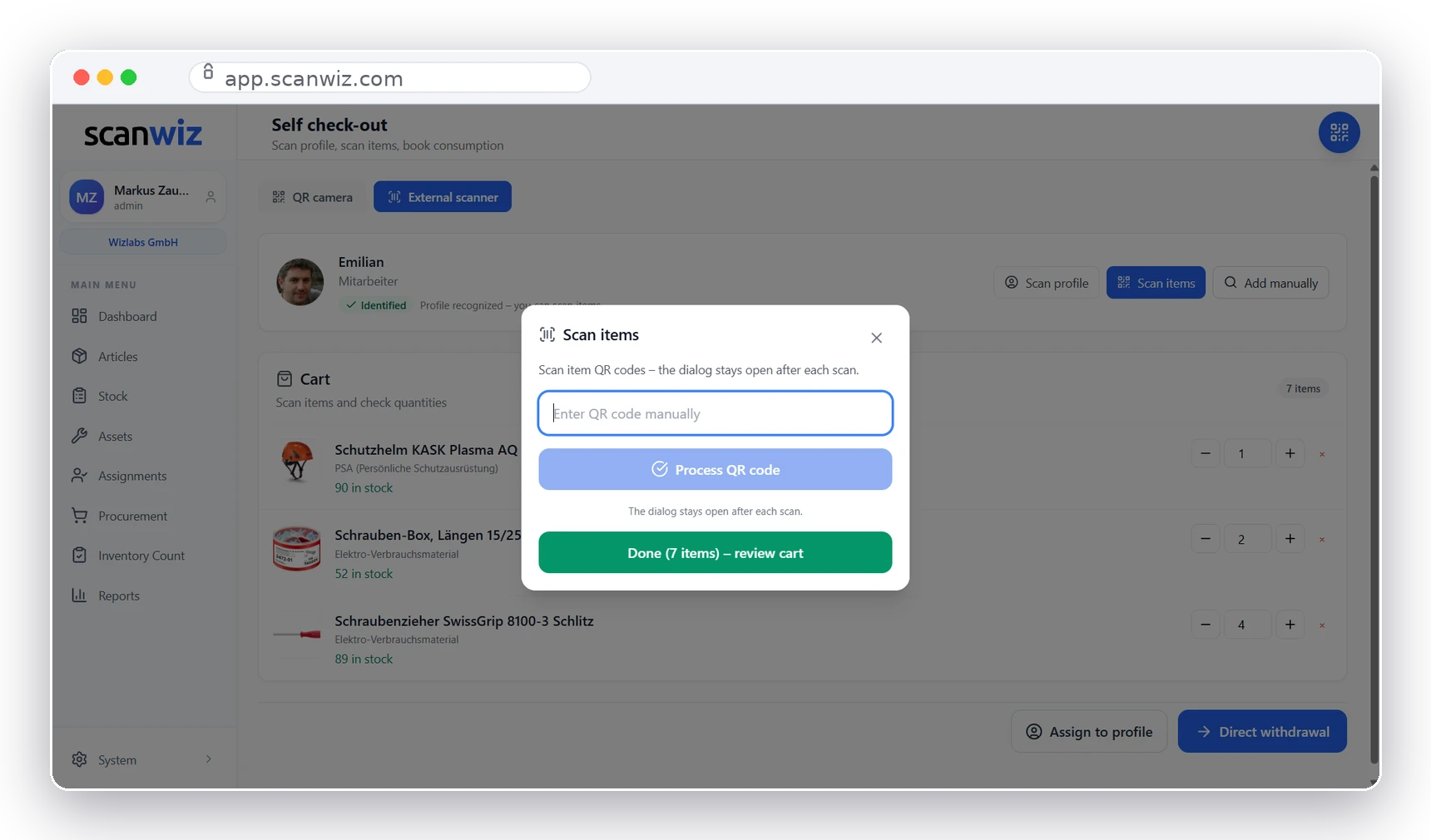
A sign-out sheet at the workshop door doesn’t get filled in under time pressure. What matters is that booking is faster than the paper: scan the tool, choose the recipient, done. Then it actually happens – in the morning at the tool crib just as much as at lunchtime on site.
4. Give every tool an owner
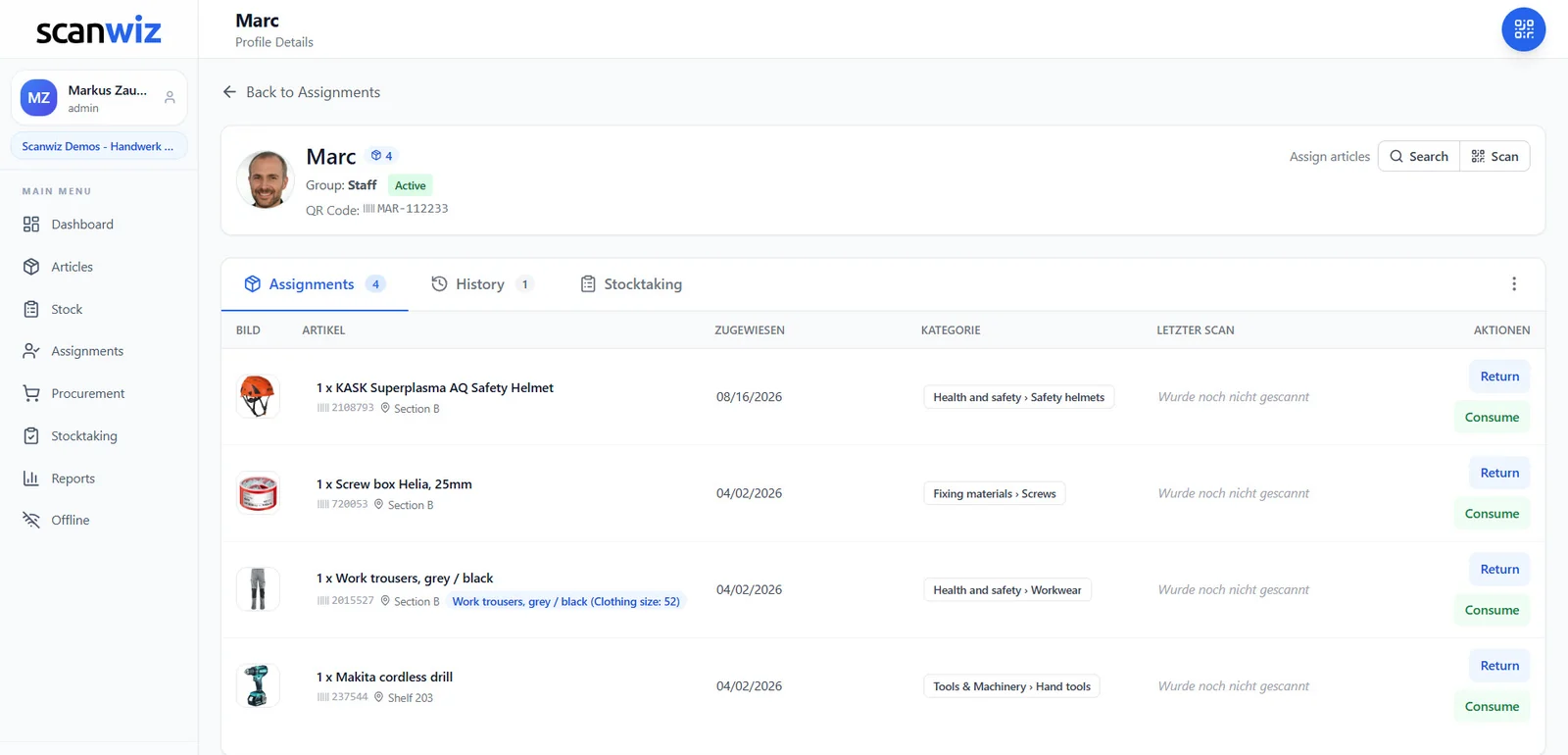
A tool without an owner belongs to nobody – and disappears first. Assign every device to a person, a vehicle, a job site or a crew. Handovers between colleagues get booked too, so responsibility moves with the tool. You can see how that works on the tool management page.
5. Have expensive devices signed for
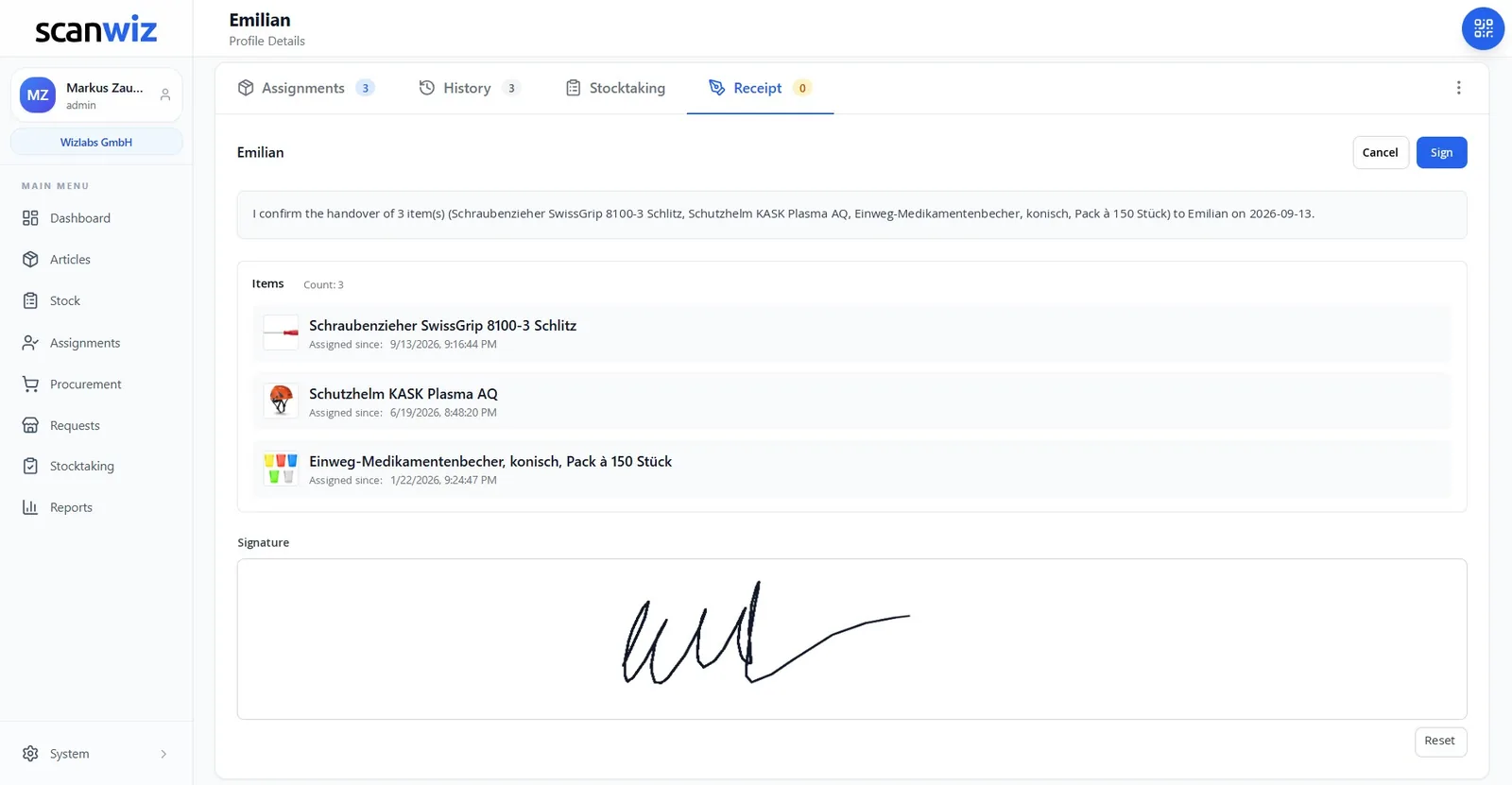
For the combi hammer, the measuring device or a new employee’s tool kit, a handover with a signature pays off. An equipment handover form makes clear who received what – and makes returns easier when someone leaves.
6. Fixed places and cases with a contents list
What comes back needs a fixed place on the shelf, in the cabinet or in the van. For tool cases and sets, a contents list in the lid helps: if a battery, charger or bit set is missing, it shows at return – not on the next job.
7. Run short, regular checks
A weekly look at “What has been out for more than two weeks?” uncovers forgotten devices before they’re lost. Add spot checks in vehicles and, at the end of each project, a check that everything has come back from site. Once a year, the stocktake confirms the full inventory.
8. Report damage instead of hiding it
Anyone who reports a damaged device must not get into trouble for it – otherwise it ends up in the skip. Make reporting as easy as possible: scan the device, take a photo, add a note. At the same time, the device is locked until repaired. Power tools that need regular testing are best managed with due dates in maintenance and inspection software. Which intervals apply is covered in the guide Equipment inspection intervals.
9. Secure physically – and check your insurance
Classic measures help against real theft: lockable, well-secured containers, no fully loaded vans parked outside overnight, lighting and access control on larger sites. GPS trackers can make sense for large machines. Also check your insurance: many policies only pay if tools were demonstrably secured.
Organising tool check-out: paper, Excel or app?
Tool check-out is the point where tool loss either happens or is prevented. The three common approaches compared:
| Paper sign-out sheet | Excel spreadsheet | App with scanning | |
|---|---|---|---|
| Effort per check-out | Write name, device, date | Enter it on the PC | Two scans |
| “Who has what?” | Leaf through the sheet | Only as current as the last entry | Live on the tool and the profile |
| On the job site | Sheet is in the workshop | Usually no access | On the phone, even offline |
| Handover between colleagues | Almost never noted | Rarely updated | Transfer by scan |
| History | Loose sheets | Overwritten cells | Complete per device |
| When someone leaves | Search and hope | Filter, if maintained | List of all open assignments |
For a small business with few devices, a list can be enough. As soon as several teams, vehicles and sites are involved, it becomes a source of errors. The comparison Excel inventory management vs. Scanwiz shows where spreadsheets hit their limits. Businesses with a lot of Hilti equipment will also find a comparison with Hilti ON!Track.
Measuring tool loss: 4 KPIs for your business
What you don’t measure, you can’t improve. For tool loss, four simple KPIs reviewed once a quarter are enough:
| KPI | How to get it | What it tells you |
|---|---|---|
| Missing at stocktake | Number and value of devices that can’t be found | How big your tool loss really is |
| Replacements without damage | Devices bought again without a documented damage report | How much loss hides in purchase orders |
| Overdue assignments | Tools out for longer than, say, 14 days | Where devices are currently getting “lost” |
| Open devices when leaving | Assignments still open when someone leaves | Whether returns work during offboarding |
The trend matters more than the absolute value: if missing stock and replacements fall after introducing documented check-out, your measures are working. If overdue assignments rise, the weekly check is missing.
Checklist against tool loss
Use this checklist to see in a few minutes where your business stands. Every open point is a gap through which tools can disappear.
- ☐ Every tool above a set value is recorded with serial number and value
- ☐ Every device carries an asset number with QR code or barcode
- ☐ Check-out, return and handover are booked – on site too
- ☐ Every tool has an owner: person, vehicle, job site or storage location
- ☐ Expensive devices are handed over with a signature
- ☐ Cases and sets have a contents list
- ☐ Once a week, someone checks what has been out for too long
- ☐ At project end, it’s checked that everything has come back from site
- ☐ Damage is reported and devices are locked until repaired
- ☐ All open assignments are returned when someone leaves
- ☐ Containers and vehicles are secured, and the insurer knows the measures
Tools stolen? Here’s what to do now
- Take stock: What exactly is missing? With an up-to-date tool list this takes minutes; without it, days.
- Report it to the police: with manufacturer, model, serial number and – if available – photos and engravings.
- Notify your insurer: report quickly, document the loss with receipts and values, and show how the container or vehicle was secured.
- Replace selectively: first check whether identical devices are available in the business – replacements are often in another vehicle.
- Close the gap: How did the thieves get in? Upgrade the container, vehicle or warehouse access afterwards.
Preventing tool loss with Scanwiz
Scanwiz is inventory and tool management for businesses that manage materials and tools in their own warehouse, in vehicles and on job sites. What helps most against tool loss is that every handover costs just one scan:
- A QR code on every tool: asset number, serial number and value on the device; identical devices stay distinguishable.
- Check-out, return and transfer by scan: on the phone on site or at the tool crib – even without reception.
- Clear owners: tools can be assigned to people, vehicles, job sites, crews and subcontractors, each with its own tool list.
- Self-checkout at the counter: employees book themselves, from the Growth plan.
- Handover with signature: a receipt with item list, kept permanently on the profile.
- Report damage and lock: with a photo; inspection due dates sit right on the device and send reminders in time.
- History that stays: even after someone leaves, it remains traceable who had what and when.
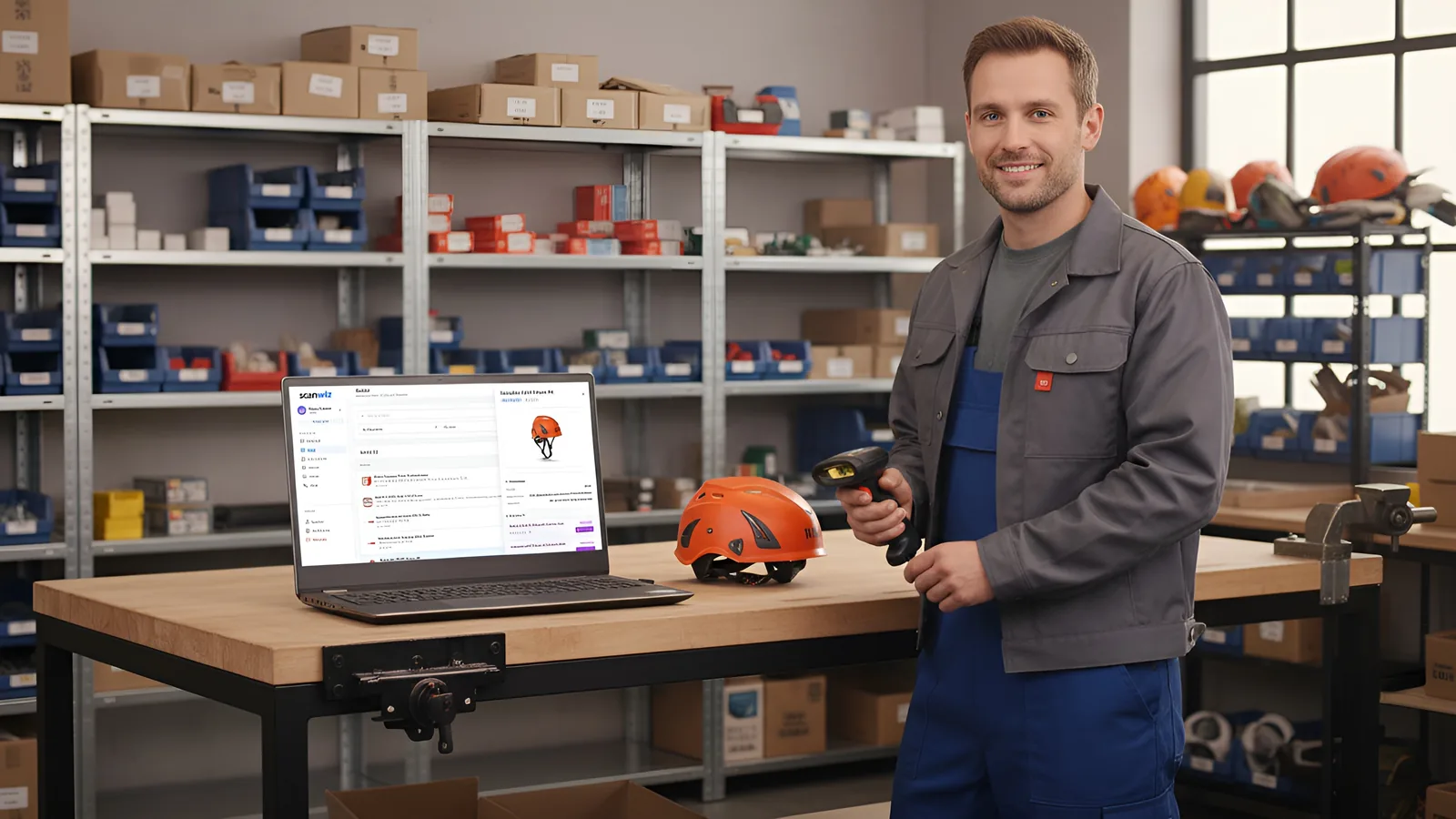
Your existing tool list comes in via Excel import. Users are unlimited in every plan, so everyone on site really does book for themselves. All features are on the tool management page; if you also manage IT, PPE or vehicles alongside tools, see equipment management. More than 250 businesses use Scanwiz, rated 4.9 out of 5 stars from more than 120 reviews on Capterra, GetApp and G2.
Frequently asked questions about tool loss
What is tool loss?
Tool loss is the ongoing disappearance of tools, measuring devices and accessories in a business – through misplacing, forgetting them on job sites, devices that are never returned, damage that goes unreported or theft. It typically happens gradually and only shows when a device is needed or missing at the stocktake.
How much tool loss is normal?
There is no reliable industry benchmark, because most businesses don’t measure their tool loss at all. A good start: for one year, count how many devices were bought again without a documented defect and how many are missing at the stocktake. That number is your baseline to measure improvements against.
How do I prevent tool theft on job sites?
With secured, locked containers, vans that aren’t left fully loaded outside overnight, lighting and access control on larger sites, and labelled tools with asset and serial numbers. GPS trackers can make sense for large machines. It’s also important that your security measures meet your insurer’s requirements.
Are GPS trackers worth it against tool loss?
For excavators, plate compactors or expensive large equipment, often yes. For many smaller tools, trackers are usually too expensive and too much maintenance. There, documented check-out by QR code is more economical, because it directly solves the most common cause – missing responsibility.
Are employees liable for lost tools?
Only to a limited extent. In Germany, the principles of employee liability apply: for slight negligence employees are generally not liable, for medium negligence partly, and for gross negligence or intent usually in full. In Switzerland, liability is governed by Art. 321e of the Code of Obligations and takes occupational risk into account. Other countries have their own rules. A documented handover creates clarity in any case; for individual cases, employment law advice is worthwhile.
What is the easiest way to document tool check-out?
An app in which the tool and the recipient are scanned via QR code. Every check-out, return and handover is booked with a date, and each person’s profile shows what they currently have. For expensive devices, a handover with signature is added.
What does tool management against tool loss cost?
With Scanwiz you start from EUR 45 per month for up to 500 items; the Growth plan with self-checkout costs EUR 145 per month for up to 2,000 items. Users are unlimited in every plan, and you can test free for 14 days without a credit card.
Conclusion: tool loss is an organisational problem – and solvable
Tool loss rarely comes from the big break-in, but from many small gaps: tools without an owner, handovers without a note, damage without a report. If you record your inventory once, label every device and book every handover by scan, you close most of these gaps. Physical security and the right insurance take care of the rest. The result: less searching, fewer repeat purchases and fitters who set off in the morning with the right tools.
Updated October 2026. Notes on liability and insurance do not replace legal advice.
More than 250 customers already trust Scanwiz
No more “Who has the laser?”
Check tools out, take them back and pass them on by scan – on site, in the van and even offline. Start for free or let us show you in a personal demo how it would look in your business.


