
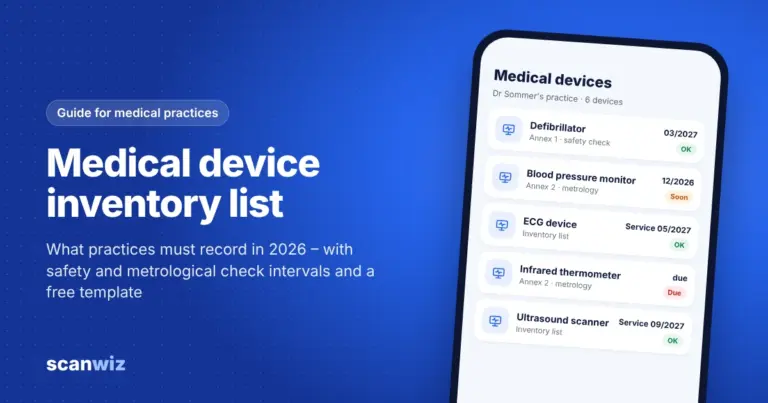
Almost every practice keeps a medical device inventory list in some form: a binder in the staff room, a spreadsheet from the day the practice opened, or simply the practice manager’s memory. It only becomes a real question when the authority comes for an inspection or the service technician asks which devices are due. That is when you find out whether the list is complete, whether the safety and metrological check dates are right, and whether the defibrillator has a device log.
In Germany, the rules for this are set by the Medical Devices Operator Ordinance, the Medizinprodukte-Betreiberverordnung or MPBetreibV. It was completely rewritten in 2025: the new MPBetreibV has applied since 20 February 2025, the sections have new numbers, and the inventory list (Bestandsverzeichnis) now needs fewer details than before. Many templates still in circulation ask for fields that are no longer mandatory and cite the old sections.
This guide explains which devices belong on the inventory list, when you also need a medical device log (Medizinproduktebuch), which intervals apply to safety checks (STK) and metrological checks (MTK), and how to sort it all out in one afternoon. At the end you will find a free Excel template that is already up to date with the 2025 rules. If your practice is in France or Switzerland, see the note at the end.
Key points at a glance
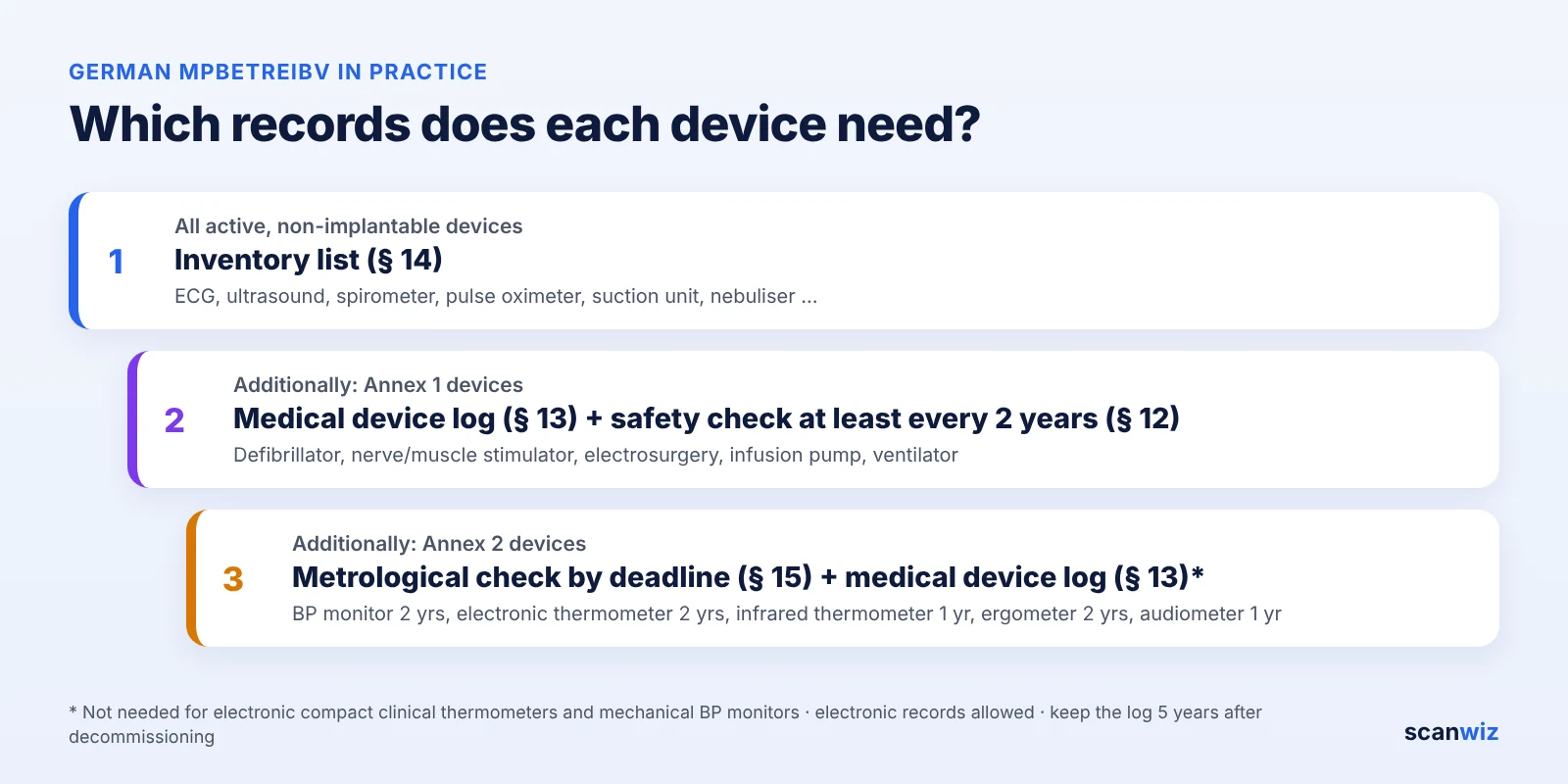
- Inventory list (§ 14): required for all active, non-implantable medical devices, i.e. anything with a plug or battery. Since 2025, four details per device are enough.
- Medical device log (§ 13): also required for Annex 1 devices (e.g. defibrillator, nerve stimulator, electrosurgery) and Annex 2 devices (e.g. blood pressure monitor, ear thermometer, ergometer). Keep it for 5 years after decommissioning.
- Safety checks for Annex 1 devices at least every 2 years; metrological checks for Annex 2 devices every year or every 2 years, depending on the device.
- Both may be kept electronically. What matters is that they are complete, up to date and quick to read during an inspection.
Contents: Inventory list vs. device log · Required details · Device log · Safety and metrological checks · Training records · 6 steps · Template · Common mistakes · With Scanwiz · FAQ
Inventory list vs. medical device log: what is the difference?
The two terms are often mixed up, but they have clearly separate roles. The inventory list is the list of all active devices at one site. The medical device log is the file for a single device, recording everything that has happened to it: function test, instructions, checks and malfunctions.
| Inventory list (Bestandsverzeichnis) | Medical device log (Medizinproduktebuch) | |
|---|---|---|
| Legal basis | § 14 MPBetreibV | § 13 MPBetreibV |
| Which devices? | All active, non-implantable medical devices | Annex 1 and Annex 2 devices (with a few exceptions) |
| Form | One list for the whole practice | One log or file per device |
| Content | Four sets of master data per device | Master data plus all checks, instructions, malfunctions and reports |
| Medium | Paper or electronic | Paper or electronic, accessible during working hours |
| Retention | Keep it up to date | 5 years after decommissioning |
As the practice owner, you are the operator and therefore responsible, even if you delegate the work to a medical assistant or the practice manager. Failing to keep an inventory list or device log, or keeping it incorrectly, is an administrative offence (§ 19 MPBetreibV).
What belongs on the inventory list
The inventory list covers all active medical devices, meaning devices powered by mains or battery. In a typical GP or specialist practice, that includes the ECG, ultrasound scanner, spirometer, pulse oximeter, electronic blood pressure monitors, thermometers, suction unit, nebuliser, defibrillator, nerve stimulator, ergometer and steriliser. A stethoscope, reflex hammer or purely mechanical blood pressure monitor does not belong on it, because these are not active devices.
Since the 2025 revision, § 14(2) only requires the following details:
- Name, kind and type, plus batch code or serial number and the year of purchase
- Name or company and address of the manufacturer or its authorised representative, or of the importer if the manufacturer is based outside the EU
- the internal identification number, if you assign one (e.g. your asset number)
- Location and operational assignment, i.e. room and department
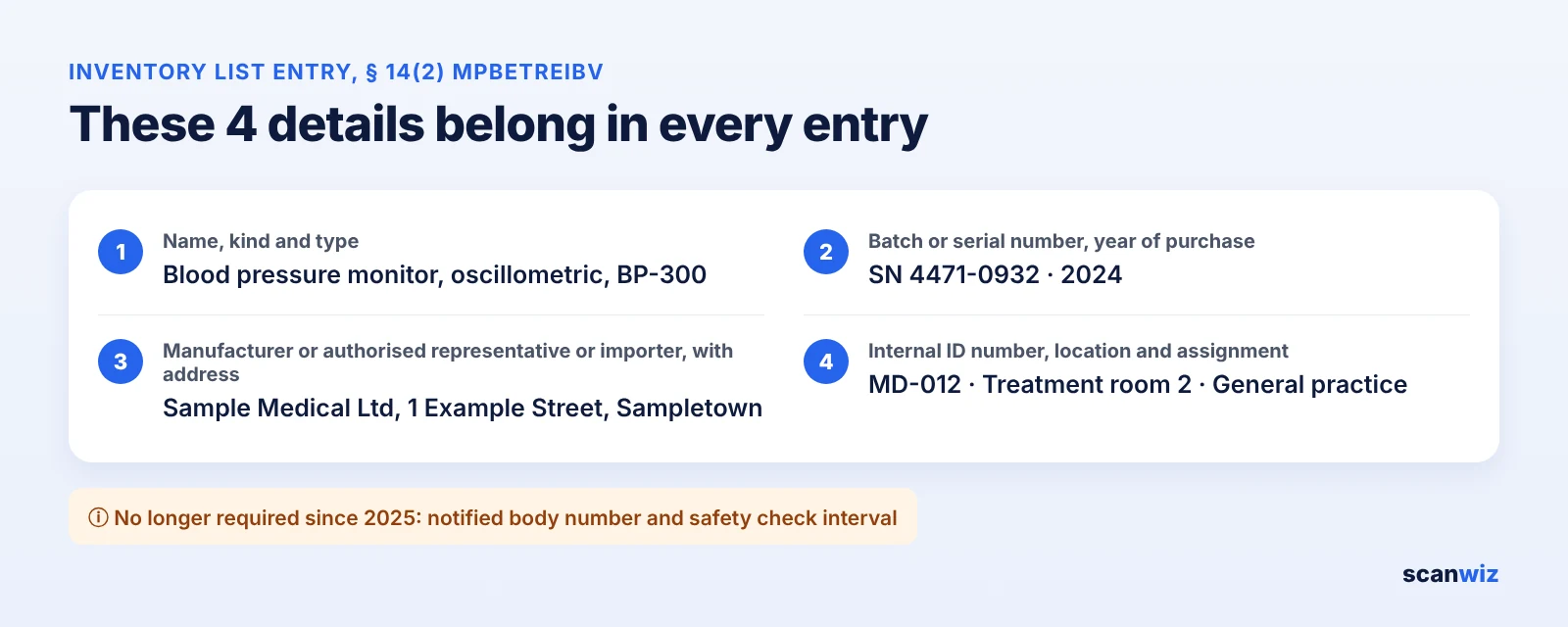
Compared with the old version, the notified body number from the CE marking and the safety check interval are no longer required. You still need to know and meet the intervals, of course, but they now belong in your inspection plan and device log rather than in the list itself. Keeping them there anyway is not wrong.
Two practical points make life easier: the list may be kept on any medium, as long as the details can be made readable within a reasonable time (§ 14(3)). And you may include the details in a register you already keep, such as your asset inventory. So there is no need for a separate, additional list.
Medical device log: which devices and what goes in it
You need a medical device log for every device listed in Annex 1 or Annex 2 of the MPBetreibV. For a practice, that mainly means:
- Annex 1: devices that use electrical energy to affect nerves, muscles or the heart (defibrillators, nerve and muscle stimulators, TENS), electrosurgery and other devices for coagulation or tissue destruction, infusion pumps and ventilators (excluding sleep apnoea devices).
- Annex 2: devices with a measuring function, such as non-invasive blood pressure monitors, medical electronic thermometers, infrared thermometers, eye tonometers, audiometers and ergometers.
Exceptions: electronic compact clinical thermometers and blood pressure monitors with mercury or aneroid manometers do not need a device log (§ 13(1)). If the device is listed in Annex 2, the metrological check is still mandatory.
Under § 13(2), the device log must contain:
- the details needed to uniquely identify the device
- proof of the function test and instruction before first use (§ 11)
- the name of the designated person, the date of instruction and the names of the people instructed
- intervals, dates and results of safety, metrological and IT security checks, plus the dates of maintenance and who carried it out
- date, type and consequences of malfunctions and repeated operating errors of the same kind
- incident reports to authorities and manufacturers
The device log must be accessible to users during working hours and kept for five years after the device is taken out of service. So do not throw away the binder together with the old defibrillator.
Safety and metrological checks: intervals, labels and who may test
Safety checks (STK) are mandatory for Annex 1 devices at least every two years (§ 12). Shorter intervals apply if the manufacturer specifies them or if defects can be expected sooner. The interval ends at the end of the month in which the device was put into service or last checked. New since 2025: after the check, the device must be labelled with the year and month of the next check and the person who carried it out, in practice with an inspection sticker.
Metrological checks (MTK) are mandatory for Annex 2 devices (§ 15). They verify that measurements are still within the permitted error limits. The interval starts at the end of the year in which the device was put into service or last checked. A blood pressure monitor checked in March 2025 is therefore due by the end of 2027.
| Device (Annex 2) | Metrological check interval |
|---|---|
| Non-invasive blood pressure monitors | 2 years |
| Medical electronic thermometers | 2 years |
| Infrared radiation thermometers (e.g. ear thermometers) | 1 year |
| Eye tonometers | 2 years |
| Pure-tone and speech audiometers | 1 year |
| Ergometers for defined physical exercise | 2 years |
Safety and metrological checks may only be carried out by persons or companies that meet the requirements of § 5 MPBetreibV, usually the manufacturer’s service or a specialised inspection company. Each check produces a report that you keep until the next check. For an AED intended for use by laypersons, the safety check can be omitted if the device tests itself and regular visual inspections are carried out (§ 12(2)). The manufacturer’s information tells you whether this applies to your device.
On top of these checks, almost every device has service intervals in its instructions for use. Our guide to equipment inspection intervals shows how to plan all deadlines in one place, including for equipment outside medical technology.
Documenting training and instructions
Medical devices may only be used by people who have been instructed in their proper handling (§ 4(3)). For active devices, the instruction must be documented in a suitable form. For software, a new instruction is needed whenever an update changes operation more than slightly.
Annex 1 devices come with an extra step: before first use, the manufacturer or its representative tests the device on site and instructs a designated person appointed by the operator (§ 11). That person then instructs the team. Both steps go into the device log.
The most common gap is not a missing form, but the new colleague who has known the defibrillator in the emergency kit for three months but was never formally instructed. Make device instruction a fixed part of onboarding.
A complete inventory list in 6 steps
If your list is out of date or does not exist, you can rebuild it in one quiet afternoon:
- Walk through room by room: include the lab, diagnostics room, emergency kit and home visit bag. Everything with a plug or battery that is used on patients goes on the list.
- Photograph the rating plate: one photo per device gives you name, type, serial number, manufacturer and often the year of manufacture, so you do not have to copy it all by hand.
- Assign an ID number and label the device: give each device a number such as MD-001. With a QR code label, a quick scan later takes you straight to the device’s file.
- Classify: Annex 1, Annex 2 or inventory list only. Create a device log for Annex 1 and Annex 2 devices.
- Enter the dates: take the dates of the last safety check, metrological check and service from the stickers and reports. Anything without proof goes straight onto the list for the next inspection.
- Catch up on instructions and assign responsibility: who maintains the list, who gets reminded of deadlines, who checks once a year that everything is still correct? The annual practice stocktake is a good moment for this.
Free template: medical device inventory list and device log
So you do not have to start from scratch, we have built an Excel template based on the 2025 MPBetreibV. It includes an inventory list with all required details, an inspection plan that calculates safety and metrological check due dates according to the ordinance, a device log to copy for each device, a training record and an overview of Annexes 1 and 2.
Free Excel template: medical device inventory list and device log
Inventory list under § 14, inspection plan with automatic due dates for safety and metrological checks, device log under § 13, training records and interval overview. No sign-up needed.
Common mistakes that show up during inspections
- The list dates from the practice opening: new devices are missing, retired ones are still on it. Record every purchase and every disposal straight away.
- No device log for the defibrillator: the AED in the hallway is an Annex 1 device. Even if it is rarely used, it needs a device log.
- The ear thermometer is forgotten: infrared thermometers have a metrological check interval of just one year, so they slip through particularly often.
- Stickers without reports: the sticker on the device is not enough. The report with results and measured values must be easy to find.
- Instructions only given verbally: for active medical devices, instruction must be documented, including for temporary staff and new team members.
- Deadlines in one person’s head: if only one assistant knows when the inspection service is due, the system collapses during the first holiday. Deadlines belong in a system with reminders.
Inventory list and inspection dates with Scanwiz
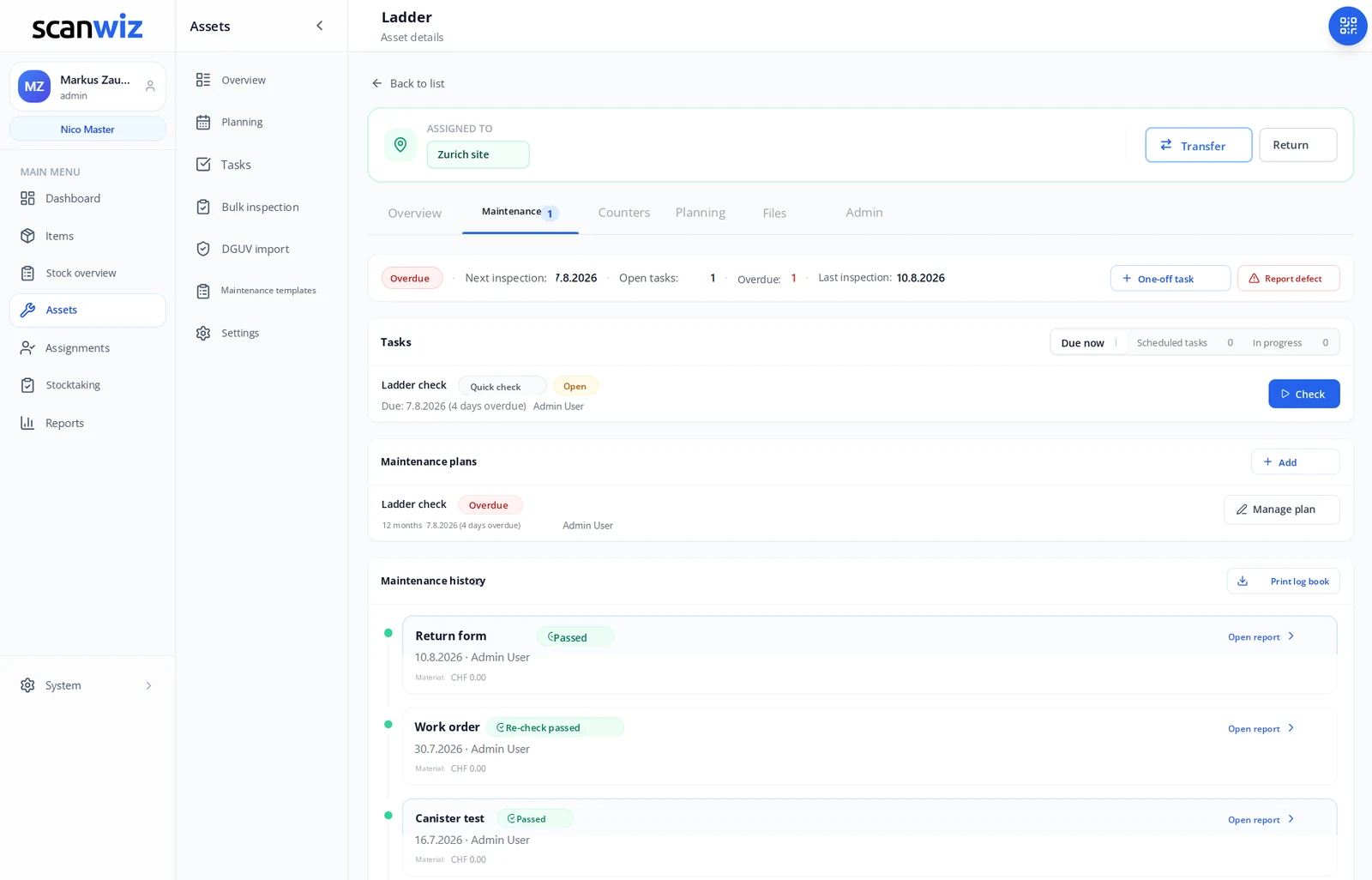
A spreadsheet is a good start. It gets tedious when several people maintain it, reports sit in binders and nobody gets a reminder before the next metrological check. With Scanwiz you manage your medical devices digitally, right at the device by scanning:
- A file for every device: name, type, serial number, manufacturer, ID number, location and custom fields. This covers the inventory list details, and you can export the list at any time.
- QR code or NFC on the device: a scan with your phone opens the file with all documents, instructions for use and inspection history.
- Inspection dates with reminders: with the maintenance and inspections module you set intervals for safety checks, metrological checks and servicing. Scanwiz reminds you in good time, and you can see overdue checks at a glance.
- Inspection reports and log: results, checklists with signatures, reports as files and a complete history for each device.
- For the whole practice: the same app also manages consumables, expiry dates and stocktakes. Find out more about medical inventory management.
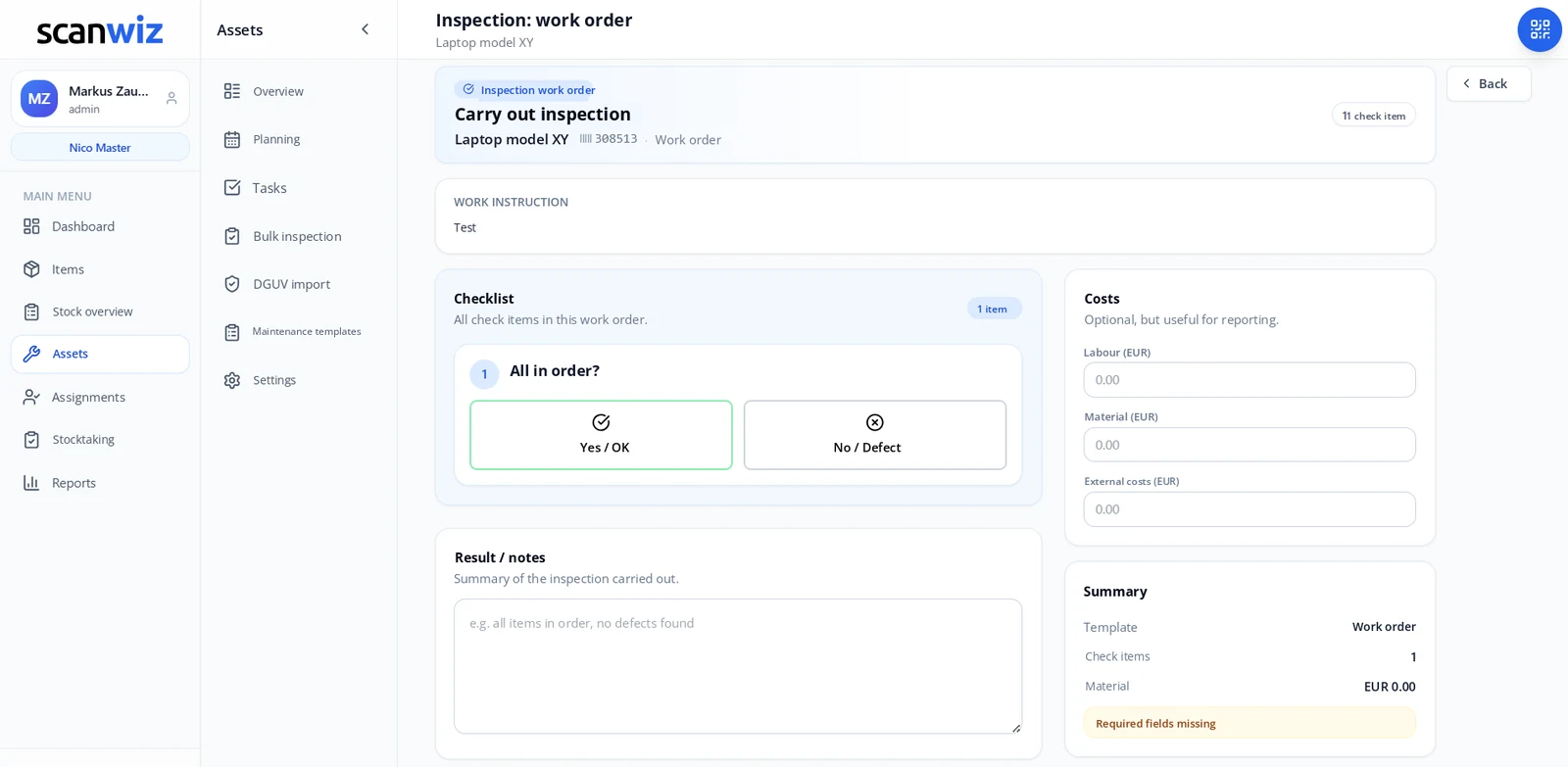
What Scanwiz does not replace: the safety and metrological checks themselves are still carried out by a qualified inspection service, and you should check against the ordinance and the manufacturer’s information whether your digital records meet all requirements for your device. Scanwiz makes sure nothing is forgotten and everything is in one place.
Outside Germany?
In France, operators must keep an up-to-date inventory and a maintenance log for devices subject to mandatory maintenance (Art. R5212-28 of the Public Health Code); the log is kept for five years after the device is taken out of service. In Switzerland, Art. 71 of the Medical Devices Ordinance (MedDO) requires professional users to ensure their devices are maintained and tested. The details differ from Germany, but the core idea is the same: know your devices, plan your checks and document them.
FAQ: medical device inventory list
What is a medical device inventory list?
A medical device inventory list (in Germany: Bestandsverzeichnis) lists all active, non-implantable medical devices at one site, such as a medical practice. It is required by § 14 of the German Medical Devices Operator Ordinance (MPBetreibV) and records, for each device, its name, type, serial number, year of purchase, manufacturer with address, the internal ID number if there is one, and its location and assignment.
Which devices belong on the inventory list?
All active medical devices, i.e. devices powered by mains or battery that are not implanted. In a medical practice these include the ECG, ultrasound scanner, spirometer, electronic blood pressure monitors, thermometers, suction unit, defibrillator, nerve stimulator and ergometer. Non-active products such as a stethoscope or a mechanical blood pressure monitor do not belong on it.
What is the difference between the inventory list and the medical device log?
The inventory list is a list of all active devices in the practice. The medical device log (Medizinproduktebuch) is the file for a single Annex 1 or Annex 2 device, documenting the function test, instructions, safety and metrological checks, maintenance, malfunctions and incident reports.
Can I keep the inventory list electronically?
Yes. Under § 14(3) MPBetreibV, any medium is allowed as long as the details can be made readable within a reasonable time. The device log may also be kept electronically, but it must be accessible to users during working hours.
How often is a safety check (STK) required?
For Annex 1 devices, at least every two years, counted to the end of the month in which the device was put into service or last checked. Shorter intervals apply if the manufacturer specifies them or defects can be expected sooner.
How often does a blood pressure monitor need a metrological check?
Non-invasive blood pressure monitors are listed in Annex 2 of the MPBetreibV and need a metrological check every two years. The interval starts at the end of the year in which the device was put into service or last checked. Monitors with mercury or aneroid manometers do not need a device log, but they still need the metrological check.
How long must the medical device log be kept?
For five years after the device is taken out of service (§ 13(3) MPBetreibV). Safety and metrological check reports are kept at least until the next check.
What changed for the inventory list in 2025?
With the revised MPBetreibV, in force since 20 February 2025, the inventory list moved from § 13 to § 14 and fewer details are required. The notified body number and the safety check interval no longer have to be on the list. In return, devices must now be labelled after a safety check with the year and month of the next check.
Conclusion
A clean inventory list is less work than it sounds: since 2025, four details per device are enough, and everything may be kept digitally. The real work is keeping the list up to date and never losing sight of safety checks, metrological checks and servicing. If you give every device a number, separate Annex 1 and Annex 2 devices clearly and plan deadlines with reminders, your next inspection will be relaxed.
Updated in November 2026. This article is not legal advice. The current text of the MPBetreibV is authoritative.
Over 250 customers already trust Scanwiz
Your practice stock, always up to date. No paper.
Book practice supplies by scanning, keep an eye on expiry dates and count room by room on your phone. Start for free or let us show you in a personal demo how it works in your practice.


