
Glossary · Stock & replenishment
What is the economic order quantity (EOQ)?
Order often and store little – or order rarely and store a lot? The EOQ formula, known in German-speaking countries as the Andler formula, works out where costs are lowest. Here you will learn how it works, when it applies and why you can safely round its result.
In brief
The economic order quantity (EOQ), called the Andler formula in German-speaking countries, is the quantity per order at which the sum of ordering costs and holding costs per year is lowest. Large quantities save ordering effort but tie up capital; small quantities save holding costs but cause more orders. The formula is: square root of 2 × annual demand × cost per order, divided by the holding cost per unit and year.
Economic order quantity: definition
Every order costs time and money – comparing quotes, ordering, receiving goods, checking invoices. Ordering rarely saves this effort. But then a lot of material sits in the warehouse after each delivery, and that costs money too: tied-up capital, space, insurance, shrinkage. The EOQ formula balances both costs.
In German-speaking countries it is named after Kurt Andler, who made it popular there in 1929. Internationally it is called the economic order quantity (EOQ) and goes back to Ford W. Harris, who published the model as early as 1913. At its core, it is the same calculation.
The economic order quantity formula
Economic order quantity (EOQ)
Q = √(2 × D × S ÷ (P × H))
- Q
- Optimal order quantity in units
- D
- Annual demand in units
- S
- Fixed cost per order – labor, shipping, goods receipt
- P
- Unit cost
- H
- Carrying cost rate per year, for example 0.20 for 20%
The denominator is the holding cost per unit and year. How to determine the rate is explained under carrying cost rate.
Economic order quantity calculator
Enter annual demand, ordering cost, price and carrying cost rate. The calculator shows the optimal quantity, how often you order and what ordering and storing cost together per year. The example below is pre-filled.
The calculator needs JavaScript. Please enable JavaScript in your browser.
Example: press fittings at a plumbing and heating business
An order costs the business around €30 in labor and shipping. One fitting costs €3.20, and the carrying cost rate is 20% per year.
- Holding cost per unit and year: €3.20 × 20%
€0.64 - Q = √(2 × 7,200 × 30 ÷ 0.64)
822 units - Orders per year: 7,200 ÷ 822
≈ 8.8 - Ordering and holding costs per year
≈ €526
For comparison: ordering 138 units every week costs around €1,600 a year – almost all of it ordering effort. Buying all 7,200 once a year costs around €2,330 – almost all of it holding costs. The EOQ costs about a third of that.
Assumptions and limits of the EOQ formula
The formula is a model. It assumes that demand is spread evenly over the year, prices and costs are fixed, there are no volume discounts, and storage space and budget are unlimited. In practice, this is rarely entirely true.
The good news: the cost curve is very flat at its lowest point. If you order 20% more or less than the optimal quantity, costs rise by just under 2%. So you can round the result to the next pack size or adjust it to the shelf space with a clear conscience.
- Volume discounts: calculate the total costs for the EOQ and for the discount tier and compare.
- Seasonal goods: with strongly fluctuating demand, plan with monthly figures rather than annual demand.
- Perishables: the quantity must never be larger than what will be used before it expires.
4 typical mistakes with the EOQ formula
- Setting ordering costs too low. It is not just postage that counts, but also the labor for ordering, goods receipt and checking the invoice.
- Using only interest as holding costs. Space, insurance, shrinkage and obsolescence belong in the carrying cost rate.
- Applying the result to the exact unit. Rounding to pack sizes costs almost nothing – see the flat curve.
- Calculating for every single item. For C items it is not worth the effort. The ABC analysis shows where the calculation pays off.
Order quantities in Scanwiz
If an item falls below its minimum stock, Scanwiz puts it on the shopping list and suggests an order quantity. You adjust it – for example to the EOQ, the pack size or the shelf space. Other items from the same supplier go on the same order, which saves ordering costs.
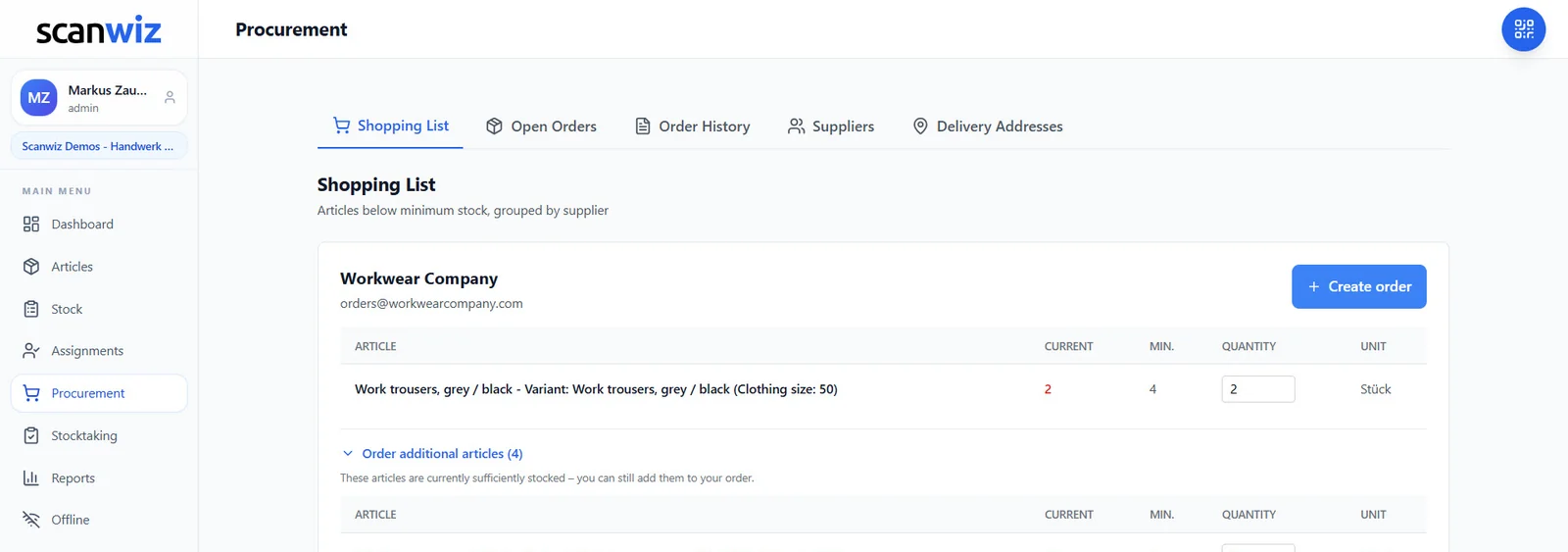
- Shopping list by supplier with order suggestions
- Add other items from the same supplier to the order
- After goods receipt, stock is correct automatically
Frequently asked questions about the economic order quantity
What does the EOQ formula calculate?
It calculates the optimal order quantity – the quantity per order at which the sum of ordering costs and holding costs per year is lowest.
What is the EOQ formula?
Optimal order quantity = square root of (2 × annual demand × fixed cost per order) ÷ (unit cost × carrying cost rate).
What is the difference between the Andler formula and EOQ?
In substance, none. EOQ stands for economic order quantity and goes back to Ford W. Harris (1913); in German-speaking countries the model is known as the Andler formula after Kurt Andler (1929).
When is the EOQ formula not suitable?
With strongly fluctuating or seasonal demand, with volume discounts that are not factored in, with limited storage space and with perishable goods. There it is a starting value, not a rule.
Sources & methodology
- Wikipedia: Economic order quantity – formula, assumptions and origin. en.wikipedia.org, accessed 10 November 2026.
- Cost deviation at ±20%: own calculation from the EOQ model, total costs = (k + 1/k) ÷ 2 times the optimum.
- Worked example: Scanwiz’s own calculation with realistic figures from a plumbing and heating business.
Updated November 2026 · Scanwiz editorial team
More from the glossary
Related to the economic order quantity.
Over 250 customers already trust Scanwiz
From the glossary to your warehouse – Scanwiz does the rest.
Minimum stock, stocktakes, inspection intervals and batches run automatically in Scanwiz as part of your daily work. Try it free for 14 days with your whole team – no credit card required. Or let us show you everything in a personal demo.


