
Glossary · Stocktaking
What is a stock discrepancy?
The system says 24 units, the shelf holds 22. The gap between them is the stock discrepancy. Here you will learn how to calculate it, what level of deviation is still normal – and how to find out where the two units went.
In brief
A stock discrepancy (also inventory variance) is the difference between the physical stock counted during the stocktake and the book stock according to accounting or the inventory system. If there is less than expected, it is a shortage; if there is more, a surplus. Common causes are unrecorded withdrawals, mix-ups, counting errors and shrinkage.
Stock discrepancy: definition
Every inventory system keeps a book stock: receipts are added, withdrawals subtracted. During the stocktake, this book stock is compared with reality. If the two do not match, there is a stock discrepancy – for each individual item and in total for the whole warehouse.
A discrepancy is not automatically a loss. A surplus is also an error: somewhere something was recorded that did not happen that way – or a goods receipt was forgotten.
Calculating the stock discrepancy
Quantity and value
Discrepancy = physical stock − book stock
- Value
- Discrepancy in units × unit cost
- Deviation in %
- Discrepancy ÷ book stock × 100
For the whole warehouse, it is also worth looking at the sum of discrepancies relative to inventory value. Watch the absolute amounts: shortages and surpluses can cancel each other out on paper, even though both point to errors.
Stock discrepancy calculator
Enter book stock, physical stock, price and your tolerance. The calculator shows the discrepancy in units, euros and percent and tells you whether you should recount. The example below is pre-filled.
The calculator needs JavaScript. Please enable JavaScript in your browser.
Example: brake discs at a car repair shop
At the annual stocktake, the system shows 24 units of a common brake disc, but 22 are counted. Unit cost: €38.
- Discrepancy: 22 − 24
−2 units - Value: −2 × €38
−€76 - Deviation: −2 ÷ 24
−8.3% - 2% tolerance exceeded
recount
The recount confirms 22 units. A look at the workshop orders shows the cause: a set of brake discs was fitted and invoiced to the customer, but never booked out of stock. The discrepancy is not a loss – it is a missing entry.
The most common causes
| Cause | Typical pattern | Remedy |
|---|---|---|
| Unrecorded withdrawal | Shortage of material that is needed quickly | Record withdrawals right at the shelf by scan |
| Mix-up | Shortage of item A, surplus of similar item B | Unique labels with codes, clear storage locations |
| Forgotten goods receipt | Surplus shortly after a delivery | Record goods receipts immediately, not in batches |
| Counting or typing error | Transposed digits, deviation by a factor of 10 | Capture directly instead of typing up paper lists, recount |
| Wrong unit | Pack instead of piece, meters instead of roll | Define one stock unit per item |
| Material off-site | Shortage that is actually in a van or on a site | Include assignments in the count |
| Shrinkage | Recurring shortages with no pattern | Control access, compare causes across several counts |
How to deal with discrepancies
- RecountIdeally by a second person, before anything is corrected.
- Find the causeCheck recent movements, orders and similar items.
- CorrectSet stock in the system to the confirmed physical value.
- DocumentRecord the discrepancy, cause and approval.
- PreventChange the process that caused the error.
What level of deviation is still normal?
Hardly any warehouse is completely free of discrepancies. A sensible approach is a tolerance above which you recount – in two dimensions:
- Percent: a deviation of 2 units is not critical with 300 disposable gloves, but with 10 cordless drills it is 20%.
- Units or value: 1% of 5,000 screws is 50 units – little in percentage terms, but perhaps too much in absolute terms.
For expensive A items set a tighter tolerance, for cheap small material a more generous one. That way recounting focuses on the positions where it really matters.
4 typical mistakes in dealing with discrepancies
- Writing off immediately. Without a recount, you may be correcting a counting error into your stock.
- Only looking at the total. Shortages and surpluses cancel each other out on paper. Look at the amounts per item.
- Ignoring surpluses. They also point to a process error – often a mix-up with another item.
- Not recording causes. Patterns only become visible across several stocktakes.
Discrepancies under control with Scanwiz
In a stocktake in Scanwiz, every counted quantity is compared with the book stock immediately. You set a tolerance in percent and in units for each stocktake: positions within both limits go through, anything above goes to approval. In blind count mode, the expected quantity is hidden while counting – so people count instead of just confirming.
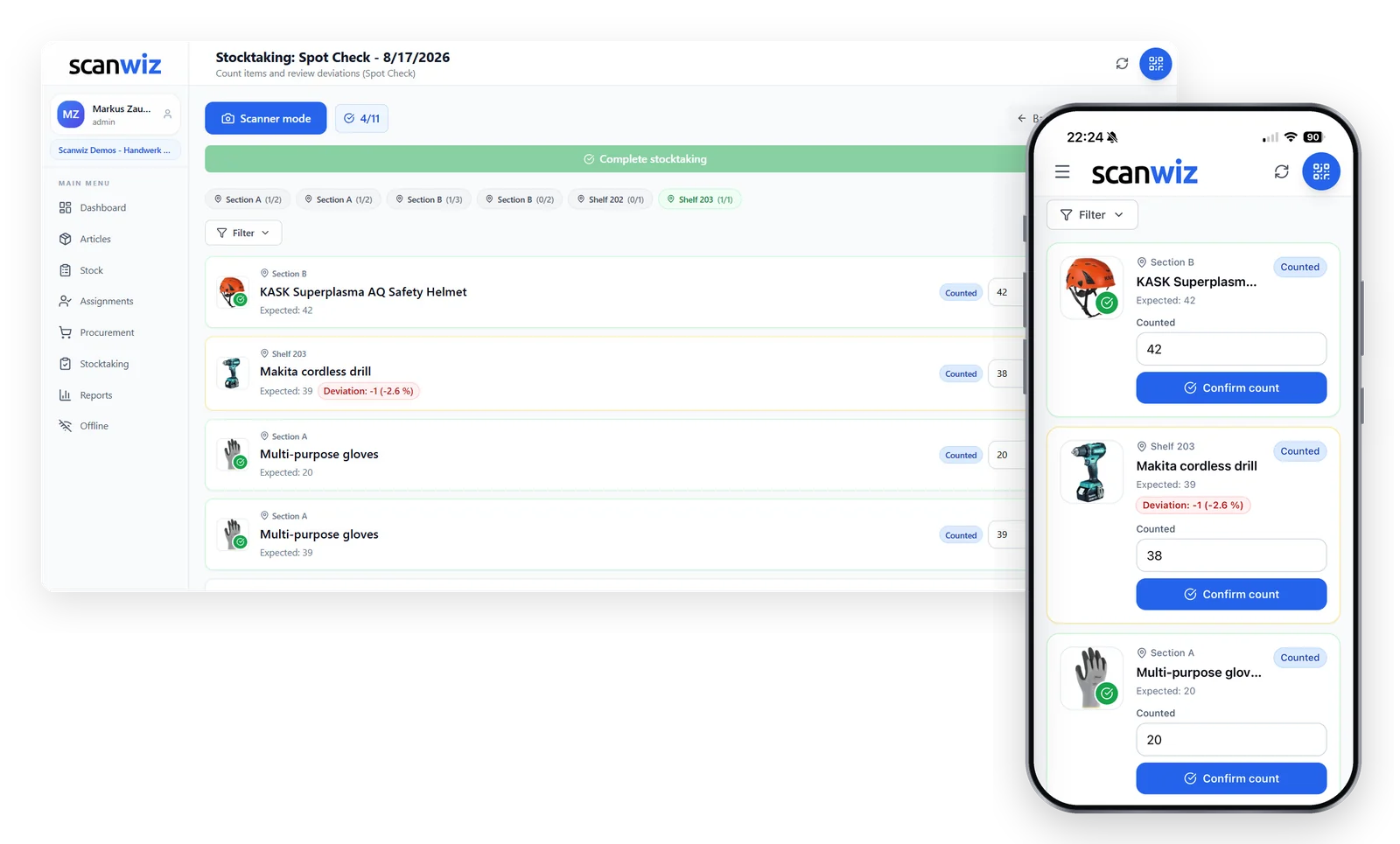
- Tolerance in percent and units per stocktake
- Approval only for deviations above the tolerance
- Discrepancy list with number, period and participants
Frequently asked questions about stock discrepancies
What is a stock discrepancy?
The difference between the counted physical stock and the book stock in the system. Less than expected is a shortage, more than expected a surplus.
How do you calculate a stock discrepancy?
Physical stock minus book stock. You get the value by multiplying the discrepancy in units by the unit cost, and the percentage deviation by dividing it by the book stock.
What are the most common causes?
Unrecorded withdrawals, mix-ups of similar items, forgotten goods receipts, counting and typing errors, wrong units, material off-site and shrinkage.
What stock discrepancy is normal?
There is no fixed limit. A sensible approach is a tolerance in percent and in units above which you recount – tighter for expensive items, more generous for cheap small material.
Sources & methodology
- Wikipedia: Inventory control – stock discrepancies and their causes. en.wikipedia.org, accessed 10 November 2026.
- Worked example: Scanwiz’s own calculation with realistic figures from a car repair shop.
Updated November 2026 · Scanwiz editorial team
Over 250 customers already trust Scanwiz
From the glossary to your warehouse – Scanwiz does the rest.
Minimum stock, stocktakes, inspection intervals and batches run automatically in Scanwiz as part of your daily work. Try it free for 14 days with your whole team – no credit card required. Or let us show you everything in a personal demo.


