
Glossary · Stocktaking
What is perpetual inventory?
Instead of counting the whole warehouse on 31 December, a small part is counted every week. By the end of the year everything has been counted once – without a state of emergency. Here you will learn how it works and what you need for it.
In brief
With perpetual inventory, stock is continuously updated in the inventory system and physically counted across the financial year instead of all on one reporting date. Every item must be counted at least once a year. Stock on the balance sheet date results from the running records. In Germany, the legal basis is § 241 (2) HGB.
Perpetual inventory: definition
Perpetual inventory is a simplified stocktaking method. German law does not require a physical count on the balance sheet date if stock can be determined reliably without it. That is the case when every movement in the warehouse is recorded continuously – and these book stocks are checked regularly by counts.
The term is a little misleading: “perpetual” does not mean that counting never stops. It means that stock is recorded all the time and the counts are spread across the year.
Requirements
- Continuous stock records: all receipts and withdrawals are recorded individually by date, type and quantity.
- Every item once a year: every stock is physically counted at least once per financial year – exactly when is up to you.
- Record: every count is documented with the date and the people involved.
- Correction: discrepancies found are corrected in the system.
Not suitable for everything: for German tax purposes, the method is generally not permitted for stock with uncontrolled shrinkage, such as highly perishable goods, or for particularly valuable assets. These are counted on the reporting date. If in doubt, check with your tax advisor.
Example: count plan in facility management
Until now, the warehouse shut down for three days between the holidays every year. Now counting is to be spread over the year.
- Counting weeks per year (excluding holidays)
48 - Items per week: 1,200 ÷ 48
25 - Effort per week
≈ 45 minutes - A items additionally every quarter
+ 80 items
Counting is done shelf by shelf every Tuesday morning. Because discrepancies now show up a few weeks after they arise instead of after a year, their causes can still be traced. The year-end shutdown is gone – only cleaning agents with a high shrinkage risk are still counted on the reporting date.
Perpetual inventory and year-end stocktake
| Criterion | Year-end stocktake | Perpetual inventory |
|---|---|---|
| When counting happens | Once, around the balance sheet date | Spread across the year |
| Operations | Often a warehouse shutdown | Business as usual |
| Errors detected | Up to a year later | A few weeks later |
| Requirement | None in particular | Continuous, clean stock recording |
| Suits | Small warehouses, little recording discipline | Medium to large warehouses with an inventory system |
How to plan your count rounds
- Create sectionsDivide shelves, locations or categories into packages of equal size.
- Set a rhythmA fixed day per week or month so it becomes routine.
- A items more oftenCount expensive items more than once a year.
- Choose quiet timesCount when little is being taken out.
- Check coverageBefore year end, check that every item has been counted.
4 typical mistakes with perpetual inventory
- Gaps in the count plan. An item that was never counted during the year breaks the requirement. Coverage must be provable.
- Sloppy recording. The running records are the basis for the reporting-date stock. Unrecorded withdrawals make them worthless.
- Not documenting counts. Without date and participants, the count may not be provable if challenged.
- Slacking off towards year end. The plan has to be followed through to the end – otherwise you end up with a reporting-date count after all.
Perpetual inventory with Scanwiz
In Scanwiz the regular partial stocktake is called a cycle count: you define the scope by locations and categories, count on your phone, and every round is documented with number, period, participants and a discrepancy list. Because withdrawals are recorded instantly by scan, the running records stay up to date between rounds. Several stocktakes can run in parallel.
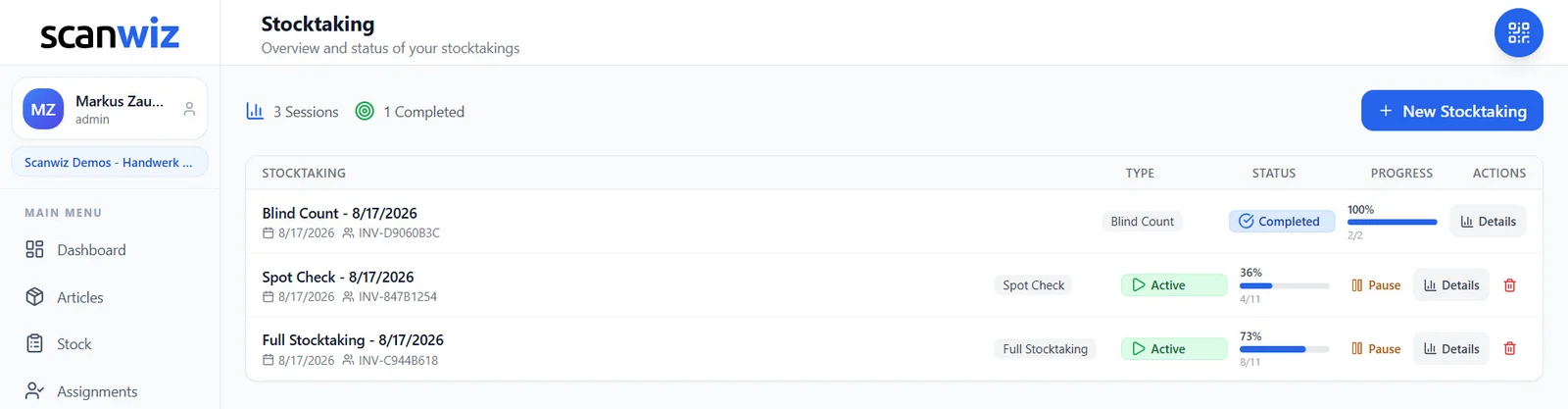
- Cycle counts by location and category
- Every round documented with number, period and participants
- Withdrawals by scan keep book stock up to date
Frequently asked questions about perpetual inventory
What is perpetual inventory?
A stocktaking method in which stock is continuously updated in the inventory system and counted across the year. Every item must be physically counted at least once a year.
Is perpetual inventory legally permitted?
In Germany, yes, under § 241 (2) HGB, provided stock records are kept continuously and properly. For tax purposes it is generally not permitted for stock with uncontrolled shrinkage or particularly valuable goods.
How often do you need to count with perpetual inventory?
Every item at least once per financial year. Exactly when is up to you. Expensive items or those at risk of shrinkage are worth counting more often.
What is the difference from a year-end stocktake?
With a year-end stocktake, everything is counted around the balance sheet date. With perpetual inventory, counting is spread across the year and the reporting-date stock results from the running records.
Sources & methodology
- § 241 HGB – Simplified stocktaking methods (German Commercial Code). gesetze-im-internet.de, accessed 10 November 2026.
- R 5.3 EStR – Counting of inventories (requirements and exclusions for perpetual inventory under German income tax guidelines).
- Count plan: Scanwiz’s own sample calculation.
Updated November 2026 · Scanwiz editorial team · not legal or tax advice
More from the glossary
Related to perpetual inventory.
Over 250 customers already trust Scanwiz
From the glossary to your warehouse – Scanwiz does the rest.
Minimum stock, stocktakes, inspection intervals and batches run automatically in Scanwiz as part of your daily work. Try it free for 14 days with your whole team – no credit card required. Or let us show you everything in a personal demo.


