
Glossary · Stocktaking
What is a year-end stocktake?
The classic at the end of the year: all stock is counted in one go, usually between the holidays. Here you will learn how much leeway you have, how to roll movements forward correctly to the reporting date and when another method pays off.
In brief
With a year-end stocktake, all stock is physically counted close to the balance sheet date – usually at the end of the financial year on 31 December. For German tax purposes, “close” usually means within ten days before or after the reporting date. Movements between count day and reporting date are rolled forward or back using records.
Year-end stocktake: definition
The year-end stocktake is the basic form of the stocktake: at a fixed point in time, the entire warehouse is counted, measured and weighed. Because everything happens at once, the method is easy to understand and needs no special stock accounting – but it ties up a lot of staff for several days.
How much leeway do you have?
Hardly any business manages to count the whole warehouse exactly on 31 December. That is why German tax rules say: the count must take place close to the date, usually within ten days before or after the reporting date. All receipts and withdrawals between count day and reporting date are taken into account using records.
| Counted on | Calculation to the reporting date |
|---|---|
| Before the reporting date | Counted stock + receipts − withdrawals up to the reporting date (roll-forward) |
| After the reporting date | Counted stock − receipts + withdrawals since the reporting date (roll-back) |
If you need more leeway, you can switch to a shifted stocktake: up to three months before or two months after the reporting date, with value-based roll-forward (§ 241 (3) HGB). Or to perpetual inventory, where counting is spread across the year.
Example: panel store at a joinery
The joinery counts on 28 December, because the company holidays start on the 29th. On the 29th, material is still taken out for an emergency job.
- Counted on 28 Dec: 19 mm chipboard
42 boards - Receipts 29–31 Dec
0 - Withdrawals 29–31 Dec per withdrawal slip
−6 - Stock on reporting date 31 Dec
36 boards
The inventory list gets 36 boards, not 42. The withdrawal slip from 29 December belongs to the stocktake documentation so the roll-forward stays traceable.
How to prepare the year-end stocktake
- Set the dateWithin the time window, ideally without ongoing operations.
- Tidy the warehouseSort out third-party goods, rejects and empties.
- Divide into sectionsEach section has a counting team; nothing is counted twice.
- Plan for external stockDo not forget vans, sites and employees.
- Freeze movementsOr cut them off cleanly with records.
You will find a detailed checklist in the guide How to do a stocktake.
Pros and cons
Advantages
- Easy to organize and understand
- No continuous stock accounting needed
- All stock at the same point in time
Disadvantages
- High effort on a few days, often a shutdown
- Time pressure leads to counting errors
- Discrepancies only show up after a year
4 typical mistakes with a year-end stocktake
- Forgetting movements after the count. What comes in or goes out between count day and reporting date must be included.
- Exceeding the time window. If you only count in mid-January, you need a different method.
- Counting twice or not at all. Without clear sections and markings, shelves are overlooked or recorded twice.
- Estimating under time pressure. “About 50” is not a count. Better to plan more time.
Year-end stocktake with Scanwiz
For the annual stocktake, choose the full stocktake in Scanwiz: all locations, all categories and, if you like, everything assigned to employees, vehicles or sites. Several teams count at the same time on their phones, even in a basement without signal. Deviations above your tolerance go to approval, and at the end you get a record with period, participants and discrepancy list.
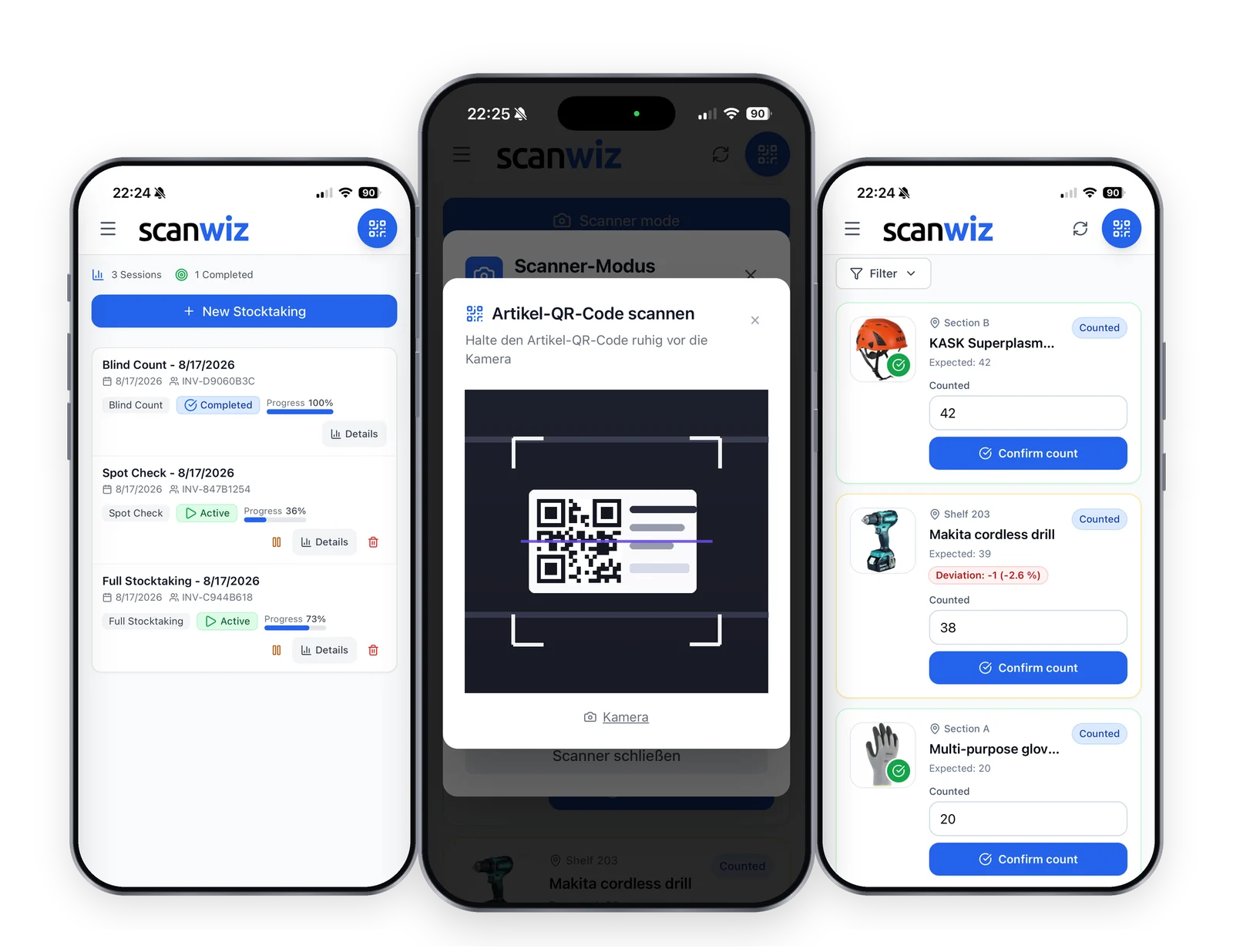
- Full stocktake across locations, categories and assignments
- Several people in parallel, even offline
- Record with number, period and discrepancy list
Frequently asked questions about the year-end stocktake
What is a year-end stocktake?
A stocktake in which all stock is physically counted close to the balance sheet date – usually 31 December.
Does the stocktake have to take place exactly on 31 December?
No. For German tax purposes, a count is usually considered close enough if it takes place within ten days before or after the reporting date. Movements in between are rolled forward or back using records.
What is the difference from a shifted stocktake?
With a shifted stocktake, you may count up to three months before or two months after the reporting date. Stock is then rolled forward or back in value to the reporting date (§ 241 (3) HGB).
Who is the year-end stocktake suitable for?
Mainly for small and medium-sized warehouses and for businesses without continuous stock recording. If you keep an inventory system clean, you can avoid the year-end shutdown with perpetual inventory.
Sources & methodology
- § 240 HGB – Inventory list (German Commercial Code). gesetze-im-internet.de, accessed 10 November 2026.
- § 241 HGB – Simplified stocktaking methods (shifted stocktake). gesetze-im-internet.de, accessed 10 November 2026.
- R 5.3 EStR – Counting of inventories (timely stocktake, German income tax guidelines).
- Worked example: Scanwiz’s own calculation.
Updated November 2026 · Scanwiz editorial team · not legal or tax advice
More from the glossary
Related to the year-end stocktake.
Over 250 customers already trust Scanwiz
From the glossary to your warehouse – Scanwiz does the rest.
Minimum stock, stocktakes, inspection intervals and batches run automatically in Scanwiz as part of your daily work. Try it free for 14 days with your whole team – no credit card required. Or let us show you everything in a personal demo.


