
Glossary · Stocktaking
What is an inventory list?
After the count comes the list: the inventory list records what a business owns and what it owes – by type, quantity and value. Here you will learn how it is structured, what goes into it and why the word “inventory” often means something else in everyday use.
In brief
The inventory list (German: Inventar) is a detailed list of all assets and liabilities of a business by type, quantity and value on a specific reporting date. It is the result of the stocktake and is divided into assets, liabilities and net assets. Under § 240 of the German Commercial Code (HGB), merchants must draw it up when they start trading and at the end of every financial year.
Inventory list: definition
During the stocktake, things are counted, measured and recorded. The inventory list is what comes out of it: a complete, valued statement. It names every item with quantity and value – from the company car and the material in stock to the bank balance and the outstanding loan.
The balance sheet is then derived from the inventory list. It combines the many individual items into a few groups and sets assets against capital in account form.
Structure of an inventory list
Assets
- Fixed assets: stay in the business long term
- Current assets: are used up or sold
- Ordered by increasing liquidity
Liabilities
- Long-term: e.g. loans
- Short-term: e.g. supplier invoices
- Ordered by maturity
Net assets
- Assets minus liabilities
- Equals equity
Example: inventory list of a painting business
| Item | Value |
|---|---|
| A. Assets | |
| Vehicles (3 vans) | €48,000 |
| Scaffolding, machines, tools | €22,000 |
| Office and business equipment | €6,000 |
| Paints, varnishes, material as per stock list | €14,000 |
| Receivables from customers | €31,000 |
| Bank balance | €19,000 |
| Total assets | €140,000 |
| B. Liabilities | |
| Vehicle loans | €45,000 |
| Trade payables | €12,000 |
| Total liabilities | €57,000 |
| C. Net assets | €83,000 |
The line “material as per stock list” is the result of the warehouse count. Behind it is a separate list with every paint bucket, every roll of masking film and every pack of filler – with quantity and unit cost.
Simplifications for the inventory list
- Fixed value (§ 240 (3) HGB): property, plant and equipment as well as raw materials and supplies that are replaced regularly and are of minor importance may be recognized at a constant quantity and value. A physical count is then usually only needed every three years. Typical: scaffolding parts, formwork material.
- Group valuation (§ 240 (4) HGB): similar inventories may be combined into a group and valued at the weighted average.
Inventory in everyday use: fixtures and equipment
In everyday language, “inventory” often means something else: the fixtures and equipment of a business – furniture, devices, tools, IT. Anyone who “manages their inventory” wants to know which items exist, where they are and who is using them. Each item gets a unique asset number for this.
This is closely linked to the accounting inventory list: a well-maintained asset list is the best basis for the fixed assets section and for the year-end stocktake.
4 typical mistakes with the inventory list
- Treating stocktake and inventory list as the same. The count alone is not enough – only with valuation and a complete statement does the inventory list come into being.
- Forgetting items off-site. Tools on a construction site or a laptop in a home office count just as much.
- Keeping retired items on the list. Broken or sold devices must be removed, otherwise assets are overstated.
- Not keeping records. Inventory lists and count sheets are accounting records and must be kept for ten years in Germany.
Maintaining your inventory with Scanwiz
In Scanwiz you manage work equipment as individual instances with asset number, location and current assignment to employees, vehicles or sites – and consumables with quantity and value per storage location. For the year-end close, you count both in one stocktake and export the results to Excel for your tax advisor.
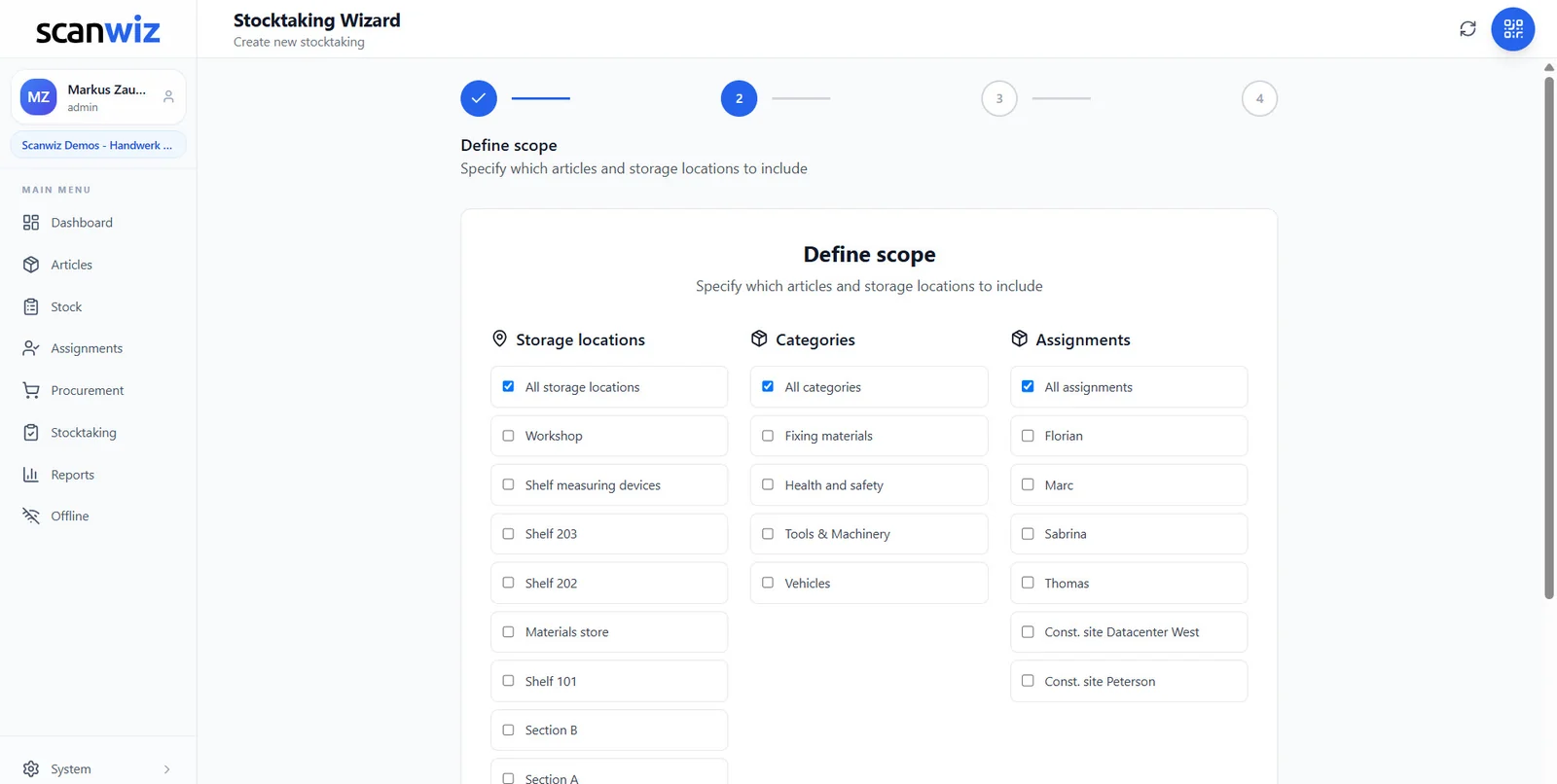
- Work equipment with asset number and assignment
- Material with quantity and value per storage location
- Excel export for your tax advisor
Learn more: Asset inventory with Scanwiz.
Frequently asked questions about the inventory list
What is an inventory list?
A detailed list of all assets and liabilities of a business by type, quantity and value on a reporting date. It is the result of the stocktake.
How is an inventory list structured?
In three parts: A. assets, divided into fixed and current assets, B. liabilities, divided by maturity, and C. net assets as the difference between assets and liabilities.
What is the difference between an inventory list and a balance sheet?
The inventory list lists every item individually with quantity and value, one below the other. The balance sheet combines the items into groups and sets assets against capital in account form.
How long must an inventory list be kept?
In Germany, inventory lists are among the records that must be kept for ten years under § 257 HGB and § 147 AO.
Sources & methodology
- § 240 HGB – Inventory list (German Commercial Code). gesetze-im-internet.de, accessed 10 November 2026.
- § 257 HGB – Retention of records (German Commercial Code). gesetze-im-internet.de, accessed 10 November 2026.
- Example: simplified, fictitious inventory list of a painting business, created by Scanwiz.
Updated November 2026 · Scanwiz editorial team · not legal or tax advice
More from the glossary
Related to the inventory list.
Over 250 customers already trust Scanwiz
From the glossary to your warehouse – Scanwiz does the rest.
Minimum stock, stocktakes, inspection intervals and batches run automatically in Scanwiz as part of your daily work. Try it free for 14 days with your whole team – no credit card required. Or let us show you everything in a personal demo.


