
Glossary · Equipment & inspections
What is work equipment?
Rotary hammer, van, laptop, ladder: everything a business works with without using it up. Here you will learn what exactly is included, which work equipment needs to be inspected and how to keep track when it is constantly on the move.
In brief
Work equipment is every item a business uses to deliver its services without using it up: tools, devices, machines, vehicles, installations and fixtures. In occupational safety, these are called work equipment (Arbeitsmittel) and, depending on the type, must be inspected regularly. They differ from consumables in that they are used many times.
Work equipment: definition
Depending on the perspective, the term has a slightly different focus:
- In business management, equipment is one of the classic factors of production alongside labor and materials: everything that enables the output but does not become part of the product – from machines to buildings.
- In occupational safety, the German Ordinance on Industrial Safety and Health speaks of work equipment: tools, devices, machines and installations used for work. Inspection obligations apply to them.
- In electrical engineering, “electrical equipment” means all devices and installation parts that use or conduct electrical energy – the subject of the DGUV V3 inspection.
In day-to-day business, the distinction is simpler: work equipment is used and comes back. Consumables are used up.
Examples of work equipment
| Group | Examples | Typical inspection |
|---|---|---|
| Power tools | Rotary hammers, cordless drills, angle grinders, chargers | DGUV V3, on construction sites every 3 months (guide value) |
| Access and lifting equipment | Ladders, step stools, scaffolding, slings | Annually by a competent person (common practice) |
| Measuring and test equipment | Lasers, multimeters, torque wrenches | Calibration according to the manufacturer |
| Machines | Circular saw, compressor, plate compactor | According to the risk assessment |
| Vehicles | Vans, forklifts, trailers | UVV annually, plus roadworthiness test |
| IT and office | Laptops, tablets, printers, furniture | Electrical inspection for mains-powered devices |
| Safety and PPE | Fire extinguishers, safety harnesses, respiratory protection | According to regulations and the manufacturer |
What every piece of equipment needs
To find, inspect and account for a device, each individual item should have these details:
- Unique asset number, on the device as a QR code or NFC tag
- Name, manufacturer, model, serial number
- Location or current holder: person, vehicle, site
- Inspection intervals and date of the last inspection
- Purchase date and value
- Condition and history: issues, defects, repairs
Example: work equipment at a landscaping business
Until now there was an Excel list maintained in the office. The audit shows:
- Equipment according to the list
118 - Actually present, including vehicles and crews
141 - Of which without documented inspection
27 - Cannot be found
6
The business gives every device an asset number with a QR code, assigns it to the crew that uses it and records the inspection intervals. The 27 uninspected devices are caught up in a bulk inspection.
Inspection interval finder
Which interval applies to which equipment? Choose a device and the date of the last inspection – the finder shows the guide value, legal basis and who may inspect, and creates a calendar entry with a reminder.
The inspection interval finder needs JavaScript. Please enable JavaScript in your browser.
4 typical mistakes with work equipment
- Only recording what is in the warehouse. Most devices are on the move: on sites, in vehicles, with employees.
- Grouping identical devices. “5 cordless drills” is not enough. Each device has its own inspection dates and its own history.
- Inspection intervals in a separate list. Keeping stock and inspections separate means inspecting devices that no longer exist and forgetting new ones.
- Issuing without a record. Without issue and return records, nobody knows who last had a device.
Managing work equipment with Scanwiz
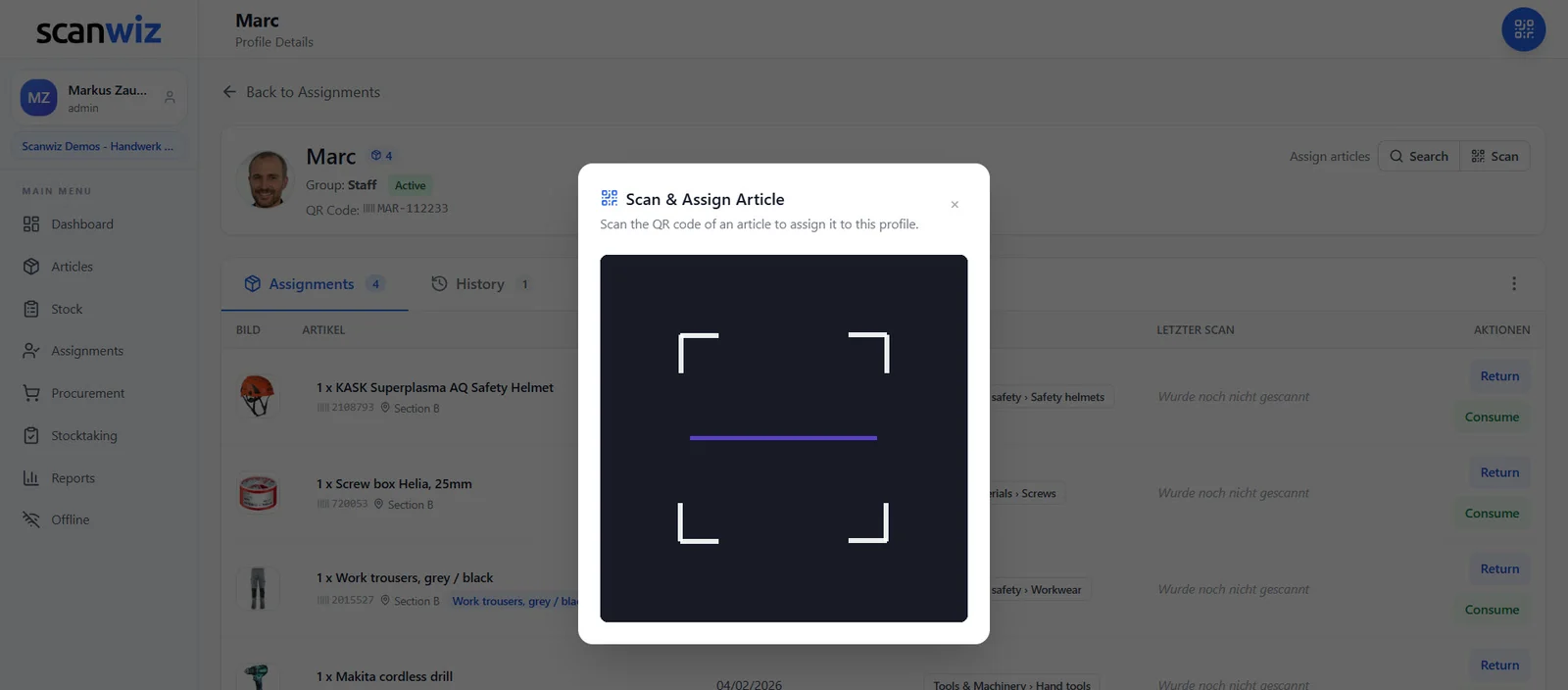
In Scanwiz every piece of work equipment gets a QR code or NFC tag. Issue, return and handover run by scan on your phone – even without signal. Each person, vehicle and site profile shows what is there right now, and each device holds its inspection intervals, logbook and history. At handover, the recipient can sign.
- Assignment to people, vehicles and sites
- Inspection intervals and logbook right on the device
- Handover with signature
- Unlimited users
Learn more: Equipment management with Scanwiz · Tool management.
Frequently asked questions about work equipment
What is work equipment?
Every item a business uses to deliver its services without using it up: tools, devices, machines, vehicles, installations and fixtures.
What is the difference between Betriebsmittel and Arbeitsmittel?
In everyday use, both mean the same thing. Arbeitsmittel is the term used in the German Ordinance on Industrial Safety and Health, to which the inspection obligations are tied. Betriebsmittel is the more common term in business management and electrical engineering.
Are consumables work equipment?
No. Consumables such as screws, gloves or cable ties are used up at work. Work equipment is used many times.
Which work equipment must be inspected?
All work equipment whose safety depends on installation, condition or wear. The employer sets the type, scope and intervals in the risk assessment. Typical examples are electrical devices, ladders, slings, vehicles and fire extinguishers.
Sources & methodology
- § 2 BetrSichV – Definitions (work equipment). gesetze-im-internet.de, accessed 10 November 2026.
- § 3 BetrSichV – Risk assessment. gesetze-im-internet.de, accessed 10 November 2026.
- Example: model business, created by Scanwiz.
Updated November 2026 · Scanwiz editorial team
More from the glossary
Related to work equipment.
Over 250 customers already trust Scanwiz
From the glossary to your warehouse – Scanwiz does the rest.
Minimum stock, stocktakes, inspection intervals and batches run automatically in Scanwiz as part of your daily work. Try it free for 14 days with your whole team – no credit card required. Or let us show you everything in a personal demo.


