
Glossary · Equipment & inspections
What is the DGUV V3 inspection?
Drill, extension cable, coffee machine: anything electrical used in a business has to be inspected regularly in Germany. Here you’ll learn what the DGUV V3 inspection covers, who may carry it out and which intervals apply – and the inspection interval finder works out your next due date.
In brief
The DGUV V3 inspection is the recurring inspection of electrical installations and equipment under the German accident prevention regulation DGUV Regulation 3 “Electrical installations and equipment”. It ensures that devices and installations are in proper condition. For portable equipment, the guide value is six months, three months on job sites; fixed installations are inspected every four years.
DGUV V3 inspection: what exactly is inspected?
DGUV Regulation 3 is an accident prevention regulation of the German statutory accident insurance. It requires businesses to have electrical installations and equipment inspected for proper condition before first use and at set intervals thereafter (Section 5). Together with the German Ordinance on Industrial Safety and Health (BetrSichV), it forms the basis for electrical testing in the workplace.
A distinction is made between two groups, each with different intervals:
Portable
Anything with a plug that gets moved around.
Drill, angle grinder, extension cable, cable reel, charger, laptop power supply, coffee machine, kettle.
Fixed
Anything that is permanently installed.
Electrical wiring, sub-distribution boards, instantaneous water heaters, hard-wired machines and lighting.
DGUV V3 inspection intervals: the table
The intervals are set out in the implementation guidance for Section 5 of DGUV Regulation 3. For portable equipment, they are guide values that can be extended if the inspection record is good.
| Item inspected | Interval | Who inspects |
|---|---|---|
| Portable equipment, guide value | 6 months, 3 months on job sites | Qualified electrician, or with a suitable tester also an electrically instructed person |
| … workshop, production, job site with a failure rate below 2% | max. 1 year | as above |
| … office and similar areas with a failure rate below 2% | max. 2 years | as above |
| Electrical installations and fixed equipment | 4 years | Qualified electrician |
| Special installations (DIN VDE 0100 group 700) | 1 year | Qualified electrician |
| RCDs in non-stationary installations | Test button every working day, effectiveness monthly | User; effectiveness by qualified electrician or instructed person with tester |
| RCDs in stationary installations | Test button every 6 months | User |
The 2 percent rule
The failure rate is the share of devices that fail an inspection. If it is below 2%, the chosen interval is considered sufficient – and may be extended up to the maximum values. Conversely, if you don’t evaluate your inspection results per device group, you can neither justify nor use a longer interval.
Guide values are not a free pass. The employer sets the actual intervals in its risk assessment (Section 3(6) BetrSichV). If devices are heavily used or many defects are found during inspections, the interval must be shortened.
Inspection interval finder: calculate the next due date
Choose the equipment, enter the date of the last inspection and read off the interval, next due date and legal basis. With one click, you add the date to your calendar with a reminder 14 days in advance. Besides electrical equipment, the finder also covers ladders, racking, forklifts, vehicles and fire extinguishers.
The inspection interval finder needs JavaScript. Please enable JavaScript in your browser.
How a DGUV V3 inspection works
For portable equipment, the repeat inspection follows the standard DIN EN 50699 (VDE 0702), formerly DIN VDE 0701-0702. The procedure is always the same:
- IdentifyRecord the device with its asset number and assign it to the inspection register.
- Visual inspectionCheck housing, cable, plug and strain relief for damage.
- MeasureMeasure protective conductor and insulation resistance as well as leakage current with the tester.
- FunctionSwitch on the device and check that it works safely.
- DocumentRecord the result and attach an inspection sticker with the next due date.
If a device fails, it is locked out immediately and only released again after repair and re-inspection. Records must be kept at least until the next inspection (Section 14 BetrSichV) – in practice, keeping the full history per device pays off.
Who may carry out the DGUV V3 inspection?
Inspections are carried out by a qualified electrician (Elektrofachkraft): a person who, based on training, knowledge and experience, can assess the work and recognise possible hazards. For portable equipment, an electrically instructed person may also inspect, provided they use suitable measuring and test equipment and work under the direction and supervision of a qualified electrician.
Many businesses hire an electrical contractor who works through all due devices in a batch inspection once a quarter or every six months. Larger businesses train their own staff. Either way, the employer remains responsible for making sure inspections happen.
Example: inspection effort at a construction company
In the first year, the company inspects all devices at the guide-value interval:
- 60 devices on job sites, every 3 months
240 inspections - 25 devices in the workshop, every 6 months
50 inspections - 30 devices in the office, every 6 months
60 inspections
After two years, it evaluates the results per area. In the workshop, 1.2% of devices fail, in the office 0.8%, on job sites 4.8%. The workshop and office may therefore extend to 12 and 24 months, while job sites stay at 3 months:
- Job sites unchanged
240 inspections - Workshop annually
25 inspections - Office every 2 years
15 inspections
This requires documentation with results per device and area. Without it, you’re left with the guide value – or an extension nobody can prove if something goes wrong.
5 common DGUV V3 inspection mistakes
- Forgetting private devices. Someone’s own kettle or phone charger in the break room must be included in the inspection – or not be allowed in the workplace.
- Devices aren’t there on inspection day. The inspector arrives, but half the drills are on job sites. If you know where every device is, you can plan inspection days without gaps. More on this in the guide Stop tool loss.
- The failure rate isn’t evaluated. Then you’re stuck with the shortest interval, even though longer ones would be possible.
- Failed devices stay in circulation. A defect without a lockout is worse than no inspection, because it is documented.
- New devices are missing from the inspection register. For new devices, the manufacturer’s test counts – but the repeat inspection still has to be scheduled from day one.
And in Switzerland? The DGUV does not apply there. The basis is Art. 32b of the Ordinance on Accident Prevention (VUV): work equipment must be maintained according to the manufacturer’s instructions, and intervals follow from the manufacturer and the risk assessment. For electrical work equipment, businesses follow the recommendations of Suva and Electrosuisse rule SNR 462638.
Organise DGUV V3 inspections with Scanwiz
With the Maintenance & Inspections module, inspection intervals are attached directly to the device. Scanwiz reminds the responsible person in good time, guides them through the inspection with a checklist and files every report in the device’s log. And because you can see in Scanwiz who has which device right now, it’s also there on inspection day.
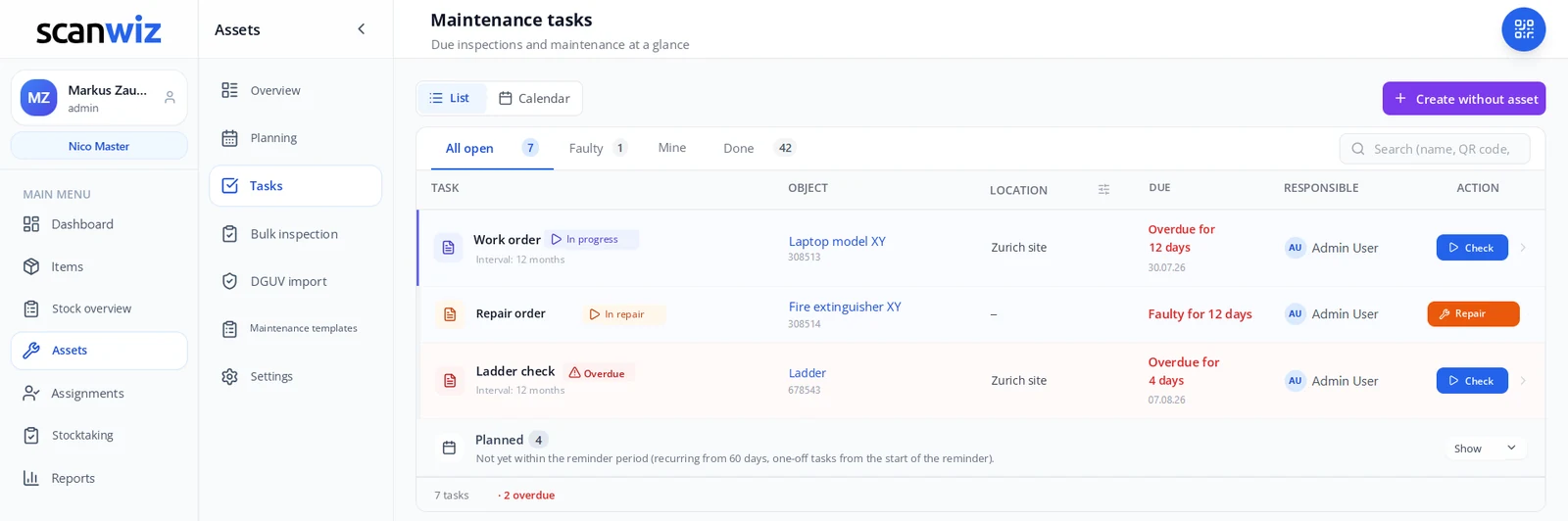
- Templates with interval and checklist – create once, apply to all electrical devices
- Bulk inspection for many devices in one pass, every result goes to the device
- Record defects with a photo, lock out the device, order the repair
- DGUV import for existing inspection data, so your history doesn’t start from zero
All details on the page Maintenance and inspections. Intervals for ladders, racking, forklifts and vehicles are in the guide Inspection intervals for work equipment.
Frequently asked questions about the DGUV V3 inspection
What is a DGUV V3 inspection?
The DGUV V3 inspection is the regular inspection of electrical installations and equipment under the German accident prevention regulation DGUV Regulation 3. It checks whether devices and installations are in proper condition – through visual inspection, measurement and function testing, with a report and inspection sticker.
How often do you have to inspect under DGUV V3?
Portable equipment every 6 months as a guide value, every 3 months on job sites. If the failure rate is below 2%, the interval may be extended to a maximum of 1 year in workshops and on job sites and a maximum of 2 years in offices. Electrical installations and fixed equipment are inspected every 4 years.
Who may carry out the DGUV V3 inspection?
A qualified electrician. Portable equipment may also be inspected by an electrically instructed person, provided they use suitable measuring and test equipment and work under the direction and supervision of a qualified electrician.
Is the DGUV V3 inspection mandatory?
Yes. As an accident prevention regulation, DGUV Regulation 3 is binding for the member businesses of the accident insurance institutions, and the Ordinance on Industrial Safety and Health requires work equipment to be inspected. If proof is missing after an accident, recourse claims and problems with insurance cover may follow.
What is the difference between DGUV V3 and E-Check?
The E-Check is an inspection service offered by the German electrical trades and can include the DGUV V3 inspection. What matters is that inspection and documentation follow DGUV Regulation 3 and the relevant VDE standards – the name doesn’t matter.
Do new devices have to be inspected?
For new devices, the manufacturer’s test counts as the initial inspection if the manufacturer confirms that they comply with the regulations. They still belong in the inspection register from day one, so the repeat inspection isn’t forgotten.
Sources & methodology
- DGUV Regulation 3, Section 5 with implementation guidance, Tables 1A and 1B. BGN Branchenwissen (German), accessed 10 Nov 2026.
- German Ordinance on Industrial Safety and Health (BetrSichV), Section 14 Inspection of work equipment. gesetze-im-internet.de, accessed 10 Nov 2026.
- Suva: Inspecting electrical work equipment correctly. suva.ch, accessed 10 Nov 2026.
- Worked example: Scanwiz’s own calculation with realistic values from a construction company.
Note: This page provides a practical overview and does not replace advice from an occupational safety specialist, the employers’ liability insurance association or Suva. Updated November 2026 · Scanwiz editorial team
More from the glossary
Related to the DGUV V3 inspection.
Equipment inspection intervals
→Ladders, forklifts, racking, fire extinguishers, vehicles: all intervals with legal basis for Germany and Switzerland.
Equipment management
→Record tools, machines and devices with a QR code and always know who has what.
All terms
→The whole glossary with search, topic filter and free calculators.
Over 250 customers already trust Scanwiz
Inspection deadlines that announce themselves.
Set intervals, get reminded in time, inspect with a checklist and file every record on the device. Try Scanwiz free for 14 days – no credit card required. Or let us show you everything in a personal demo.


