
Glossary · Warehouse organisation
What is chaotic storage?
It sounds like disorder, but it’s the opposite: goods go wherever there is space right now – and the system knows exactly where. That way you use your space far better. Here you’ll learn how it works, when it pays off and what you need for it.
In brief
Chaotic storage – also called dynamic slotting or random-location storage – means that items have no fixed storage location; when put away, they go to the next suitable free slot. A warehouse management system records what is in each slot. This saves space but requires every put-away and relocation to be booked.
Chaotic storage: definition
In the classic fixed-location system, every item has its home slot: the wall plugs are always in bin B3. That’s easy to remember, but the slot must be big enough for the maximum stock – and it sits empty when stock is low.
With chaotic storage, the only thing that matters when putting away is where there is space right now. The same wall plugs might be in B3 today and additionally in D7 next week. Nobody has to remember that – the system shows where they are.
Fixed or chaotic?
| Criterion | Fixed-location system | Chaotic storage |
|---|---|---|
| Space required | For the maximum stock of every item | Roughly for the average total stock |
| Finding without a system | Yes, with experience | No |
| Onboarding new staff | Learn the slots | Use the scanner |
| System outage | Hardly any impact | Goods are hard to find |
| Suits | Small stores, few items, workshop shelving | Larger warehouses, fluctuating quantities, limited space |
In practice, a hybrid is often best: fast movers and small parts get fixed slots near the issue point, while pallets, bulk packs and seasonal goods are stored freely.
Example: pallets in the builder’s yard
In the fixed-location system, each of the 80 items gets a pallet slot – some get two because their maximum stock is larger. On average, though, only half of the slots are occupied.
- Fixed location: slots for maximum stock
104 slots - Occupied on average
≈ 52 slots - Chaotic: avg. occupancy plus 20% buffer
≈ 63 slots - Rack slots freed up
≈ 41
Instead of buying a second rack, the company switches to free slot allocation. Every rack slot gets a QR code; when putting away, pallet and slot are scanned. Mortar and sheeting, which are needed daily, keep fixed slots at the front.
What you need for chaotic storage
- Unique slotsEvery bin and pallet slot with an ID and code.
- Booking on put-awayScan item and slot, otherwise the goods are lost.
- Booking on relocationEven a quick move has to be recorded.
- Stock per slotThe system shows quantity per item and per storage slot.
- Count regularlySpot checks keep the slot data up to date.
4 common mistakes with chaotic storage
- Starting without codes on the slots. If slots have to be typed in, they get mixed up. One code per bin is a must.
- “Just moved it” without booking. That is exactly how goods get lost in a chaotic warehouse.
- Making everything chaotic. For small parts needed every day, fixed slots are faster.
- Spreading hazardous materials freely. Hazardous materials, refrigerated goods and heavy loads are subject to their own storage rules – they need fixed, suitable zones.
Chaotic storage with Scanwiz
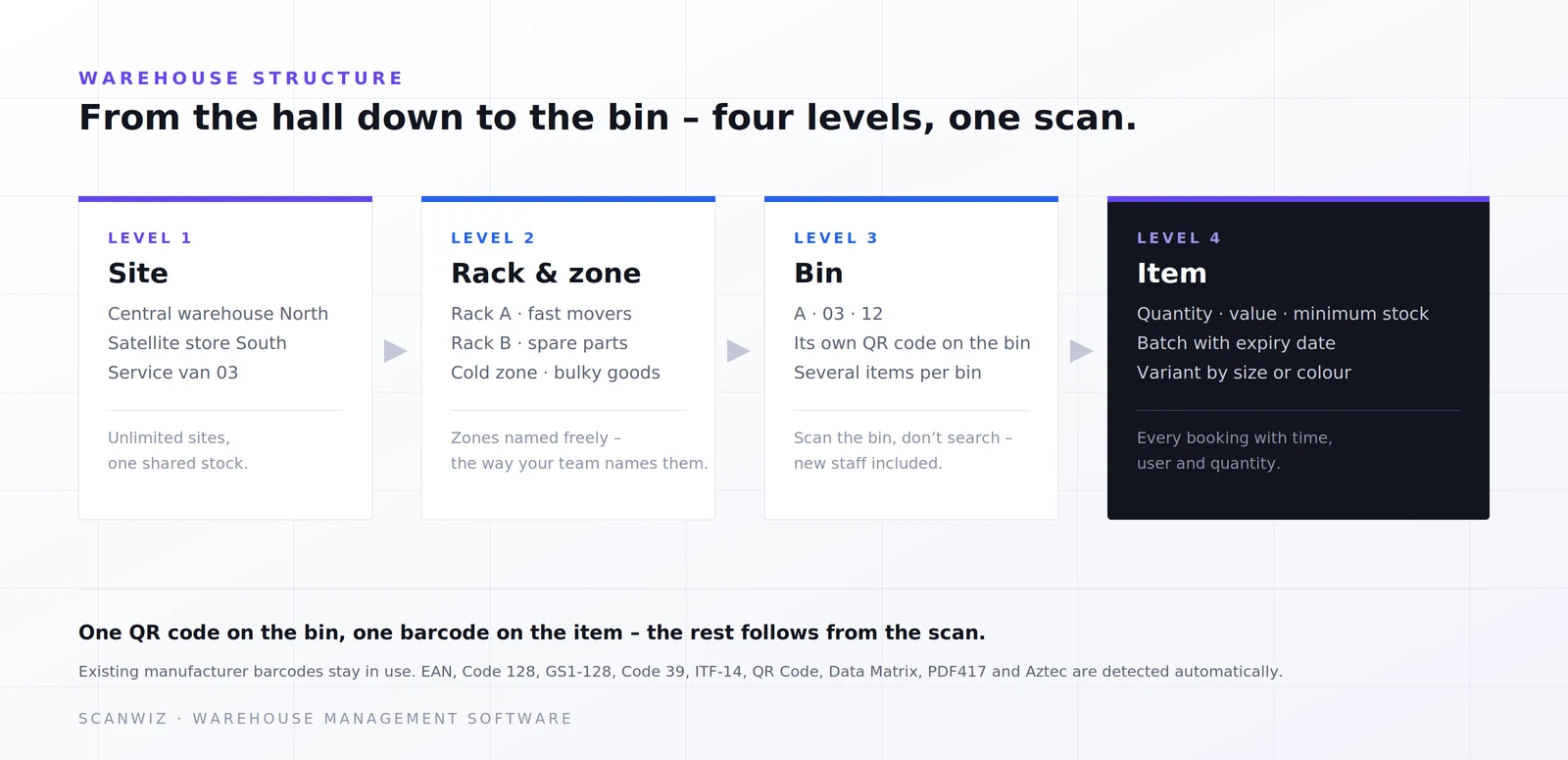
In Scanwiz, you create unlimited locations with sub-locations – such as “Builder’s yard” and “Rack slot B3” – each with its own QR code. Stock is tracked per item and per storage slot, and the same item can be in several slots. When putting away, you scan item and slot, and the app always shows where everything is – even offline.
- Unlimited storage slots with their own code
- Stock per item and storage slot
- Minimum stock per storage slot, too
- Spot checks for individual areas
More tips on warehouse organisation in the guide Organise your stores in 10 steps.
Frequently asked questions about chaotic storage
What is chaotic storage?
A storage principle in which items have no fixed slot but go to the next suitable free slot. A system records what is where.
What are the advantages?
Better use of space, because no slots are reserved for goods that aren’t there, more flexible put-away and easier onboarding, because nobody has to learn home slots.
What are the disadvantages?
Without a working system and consistent booking, goods are hard to find. Every put-away and relocation has to be recorded.
Who is chaotic storage worth it for?
For warehouses with limited space, fluctuating quantities and many bulk packs. Small workshop stores with few items often do better with fixed slots – or with a hybrid.
Sources & methodology
- Wikipedia (German): Dynamische Lagerhaltung – alternative to the fixed-location system. de.wikipedia.org, accessed 10 Nov 2026.
- Space example: Scanwiz’s own sample calculation.
Updated November 2026 · Scanwiz editorial team
More from the glossary
Related to chaotic storage.
Over 250 customers already trust Scanwiz
From the glossary to your warehouse – Scanwiz does the rest.
Minimum stock, stocktakes, inspection intervals and batches run automatically in Scanwiz as part of your daily work. Try it free for 14 days with your whole team – no credit card required. Or let us show you everything in a personal demo.


