
Glossary · KPIs & analysis
What is inventory turnover?
How often does your warehouse turn over in a year – and how long does a euro of material sit on the shelf before it is used? Inventory turnover answers both with a single number. Here you will learn how to calculate it, read it correctly and improve it.
In brief
Inventory turnover (also stock turnover or inventory turns) shows how often average stock is used up and replaced within a year. It is calculated as annual consumption divided by average stock. From it follows the average storage period: 365 days divided by turnover. High turnover means little tied-up capital.
Inventory turnover: definition
Inventory turnover describes how fast material flows through the warehouse. A turnover of 6 means: average stock is completely used up and bought again six times a year – so each part sits on the shelf for around two months on average.
The KPI can be calculated for the whole warehouse, for item groups or for individual items. For the whole warehouse, use values in euros; for a single item, unit quantities work just as well.
Calculating inventory turnover
Turnover rate
Turnover = annual consumption ÷ avg. stock
- Annual consumption
- What was taken out of stock in a year – in euros at cost or in units
- Avg. stock
- (opening stock + closing stock) ÷ 2, more precisely: (opening stock + 12 month-end stocks) ÷ 13
Average storage period
Storage period = 365 ÷ turnover
Inventory turnover calculator
Enter annual consumption and average stock – in euros or units. The calculator shows turnover, storage period and also how many working days your current stock will last. The example below in euros is pre-filled.
The calculator needs JavaScript. Please enable JavaScript in your browser.
Example: material store at an electrical contractor
Last year the business used €180,000 of material from stock. On average, material worth €45,000 was in stock.
- Turnover: 180,000 ÷ 45,000
4.0 - Avg. storage period: 365 ÷ 4
≈ 91 days - After clearing slow movers: avg. stock €30,000
Turnover 6 - Capital freed up
€15,000
With a carrying cost rate of 20%, the business saves around €3,000 a year – without anything missing on site, because what was cleared had hardly moved anyway.
Reading inventory turnover correctly
- Only compare like with like: a store of consumables turns faster than one of spare parts. Compare item groups and your own development over the years.
- High is not automatically good: very high turnover can also mean constant just-in-time ordering and missing material. Good turnover is high turnover without stockouts.
- Look for outliers: the average hides slow movers. Calculating turnover per item finds them.
- Tools do not count: work equipment is not used up. For it, location, holder and inspection dates matter.
Increasing inventory turnover
Clear slow movers
- Review items with no movement for 12 months
- Return, use up or write off
Order smaller quantities
- For A items, order more often but less
- Check order quantity with the EOQ formula
Adjust reserves
- Tier safety stock by value and risk
- Review reorder points every year
4 typical mistakes with inventory turnover
- Calculating with selling prices. Consumption and stock must be valued at the same prices – usually at cost.
- Only using reporting-date stock. Stock on 31 December is often untypically low. Monthly figures give a more honest picture.
- Unrecorded withdrawals. What is not recorded is missing from consumption – turnover looks worse than it is.
- Only looking at the overall figure. A good average can hide many slow movers.
Keeping an eye on inventory turnover with Scanwiz
For a reliable inventory turnover figure you need two things: stock that is correct and consumption that is fully recorded. In Scanwiz every withdrawal is captured by scan, the inventory overview shows quantity and value per item, and the Excel export lets you pull out the figures for your own analyses.
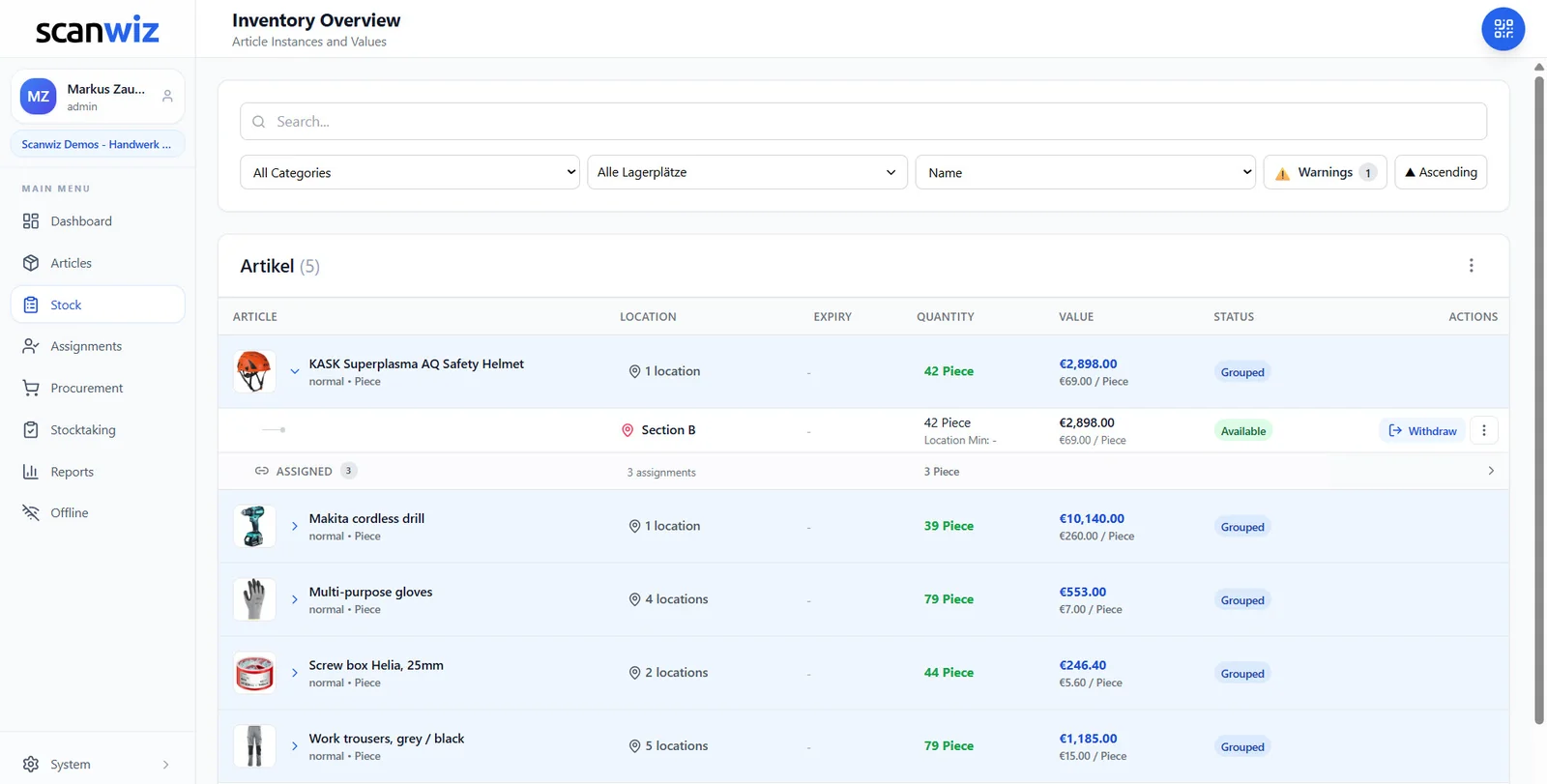
- Inventory overview with quantity and value
- Withdrawals by scan – complete and immediate
- Excel export for analyses
Frequently asked questions about inventory turnover
What is inventory turnover?
Inventory turnover shows how often average stock is used up and replaced within a year. It is calculated as annual consumption divided by average stock.
How do you calculate the storage period?
365 days divided by inventory turnover. With a turnover of 4, material sits in stock for around 91 days on average.
What is a good inventory turnover?
That depends heavily on the industry and the item. Consumables turn faster than spare parts. The most meaningful comparison is with your own previous year and between similar item groups – and whether stockouts occur.
How can I increase inventory turnover?
Clear slow movers, order expensive items more often in smaller quantities, and tier safety stock by value and risk instead of setting it high across the board.
Sources & methodology
- Wikipedia: Inventory turnover – formula and storage period. en.wikipedia.org, accessed 10 November 2026.
- Worked example: Scanwiz’s own calculation with realistic figures from an electrical contractor; carrying cost rate as an assumption.
Updated November 2026 · Scanwiz editorial team
More from the glossary
Related to inventory turnover.
Over 250 customers already trust Scanwiz
From the glossary to your warehouse – Scanwiz does the rest.
Minimum stock, stocktakes, inspection intervals and batches run automatically in Scanwiz as part of your daily work. Try it free for 14 days with your whole team – no credit card required. Or let us show you everything in a personal demo.


