
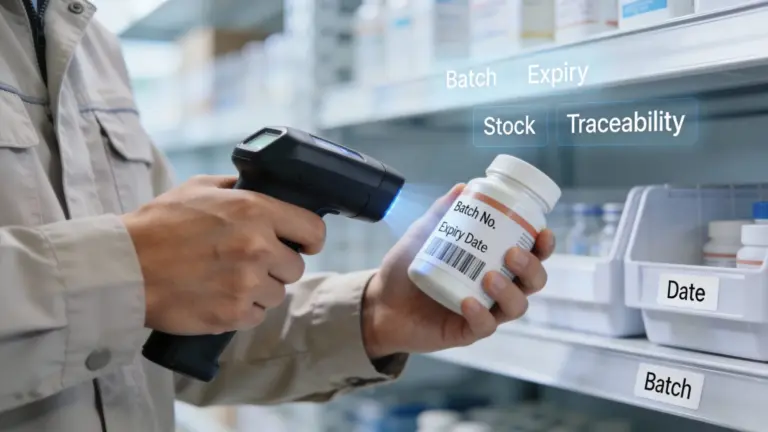
Batch management means recording every delivery or production lot of an item under its own batch number – with expiry date, quantity and location – and assigning every withdrawal to that batch. In an emergency it answers the crucial question in minutes: where is batch 24-0815 still on the shelf, and who has already received it?
Key takeaways
- Without batches you have to block everything in a recall – with batches only what’s affected.
- Batch number and expiry date are captured at goods receipt, not later.
- FEFO (first expired, first out): what expires first goes out first.
- Traceability doesn’t end at the shelf but at the person, project or patient who received the goods.
Contents: Why it matters · Batch, expiry, FEFO · Industries · 7 must-haves · Recall workflow · Rollout · With Scanwiz · FAQ
Why batch management matters today
Batch management – also called lot tracking – is the basis for finding affected products quickly in case of quality issues or recalls and removing them from circulation in a targeted way, instead of blocking entire stocks “blindly”.
In many sectors traceability is also required: in the EU, food business operators must be able to show from whom they received goods and to whom they supplied them (Regulation (EC) No 178/2002, Art. 18). For medical devices, the EU Medical Device Regulation (MDR) requires a unique device identification (UDI) including lot or serial number. In pharma and laboratories, lot-level documentation and expiry dates are standard anyway.
Batch, expiry date and FEFO explained
| Term | Meaning |
|---|---|
| Batch / lot | Quantity of an item produced or delivered under the same conditions; identified by the batch or LOT number. |
| Expiry / best-before date | Date until which the batch may or should be used. |
| FEFO | First Expired, First Out – the batch with the earliest expiry date is used first. |
| FIFO | First In, First Out – the batch stored first goes out first; for goods without expiry. |
| Traceability | Proof of where a batch came from and where it went – backwards to the supplier, forwards to the recipient. |
| Variant | Version of an item (size, pack size) – independent of the batch. See variant management. |
Where batch management is needed every day
- Medical practices, clinics and care: medicines, vaccines, sterile goods and supplies with expiry dates – see medical inventory management.
- Laboratories: reagents and kits in different concentrations and lots; if a test series looks odd, you need to know which lot was used.
- Production and industry: adhesives, resins, lubricants or chemicals with shelf life; components whose lot is needed for root-cause analysis – see craft and industry.
- Hospitality: food and drinks with best-before dates, where FEFO noticeably reduces waste – see hospitality inventory.
7 must-haves of modern batch management
- Batch number and expiry per delivery – plus quantity, purchase price and supplier.
- Capture at goods receipt, ideally by scan (many manufacturers encode lot and expiry in Data Matrix codes).
- Lot-level withdrawals – also on mobile, without a detour via the PC.
- Stock per location, so blocks and withdrawals are precise.
- Expiry alerts – before goods expire, not after.
- Forward traceability to the recipient: person, project, vehicle or department.
- Reports and export for audits, inspectors and internal reviews.
How a recall works with clean batch data
- Filter by batch: search the reported batch number.
- Block remaining stock at every location where it still sits.
- Trace issues: list of who received which quantity and when.
- Inform recipients and book returns.
- Document: export for supplier, authority or quality management.
With Excel and paper this takes hours or days – with lot-level bookings it takes minutes.
Rolling out batch management in 5 steps
- Choose a critical product group – medicines, reagents, chemicals or food.
- Create items and locations, import existing data from Excel.
- Record opening stock by batch: count once, capture lot and expiry per pack.
- Set the rule: no receipt without a batch, no withdrawal without a scan.
- Review monthly: what expires in the next 30 days? Where are discrepancies?
Batch management with Scanwiz
- Per batch: number, expiry date, quantity, price, supplier.
- When booking: withdrawals are always lot-level, also on mobile – phone camera scan including Data Matrix.
- In a recall: remaining stock and issues of the batch in one list.
- Plus: variants for sizes and versions, minimum stock, mobile stocktaking and reports.
- Ask instead of filter: with Scanwiz AI Connect, e.g. “Which batches expire in November?” – read-only by default.
Batches are included from the Growth plan; data is stored GDPR-compliant on servers in the EU. All details are on the batch management feature page, plans under pricing. More than 250 businesses use Scanwiz – rated 4.9 out of 5 from over 120 reviews.
FAQ on batch management
What is batch management?
Batch management is recording every delivery or production lot of an item under its own batch number with expiry date, quantity and location – and assigning every withdrawal to that batch.
What does FEFO mean?
FEFO stands for First Expired, First Out: the batch with the earliest expiry date is used first, which reduces waste and write-offs.
Is batch management mandatory?
In many areas, yes: EU food businesses must be traceable under Regulation 178/2002, and medical devices carry a UDI with lot or serial number under the MDR. Even where it isn’t required, it saves a lot of time and money in a recall.
What is the difference between a batch and a variant?
A variant describes what an item is (size, pack size). A batch describes which delivery it came from and when it expires. Both can be combined.
Which Scanwiz plan includes batch management?
Batches are included from the Growth plan. Scanwiz can be tested free for 14 days without a credit card.
Conclusion
Batch management pays off on the day of your first recall at the latest – and every day through less expired stock. What matters is capturing batch and expiry at goods receipt and booking every withdrawal at lot level. With a scan instead of a spreadsheet, that becomes a routine nobody notices.
Updated October 2026. This article does not replace legal advice on industry-specific documentation duties.
Over 250 customers already trust Scanwiz
Your next recall takes minutes.
Batches, expiry dates and issues documented by scan. Start for free with one critical product group – or see in a demo how it works in your practice or lab.


