
Glossary · Stock & replenishment
What is safety stock?
Safety stock is your reserve for when things don’t go to plan: higher usage, a late delivery. Here you’ll learn how to calculate it – from the rule of thumb to statistics – and how much reserve really makes sense.
In brief
Safety stock – also called buffer stock or reserve stock – is the quantity of an item kept in the store as a buffer that is not used under normal circumstances. It absorbs usage peaks and delivery delays. Together with the usage during the lead time, it makes up the reorder point at which you reorder.
Safety stock: definition
Safety stock is the quantity that remains in the store when everything goes to plan. It is there for the cases when things don’t go to plan: a large order draws more material than usual, the supplier ships a week late, a delivery is incomplete. Without a reserve, the job site, workshop or treatment room comes to a standstill.
At the same time, every reserve costs money: the material is paid for but sits on the shelf, takes up space and can become obsolete or expire. Finding the right safety stock therefore means weighing two risks against each other – the risk of running out and the risk of tying up too much money in stock.
Older terms are buffer stock and reserve stock. Minimum stock is also often used to mean the same thing – with a catch, explained in the next section.
Safety stock, reorder point, maximum stock – how they differ
Four terms that belong together and are constantly mixed up. The values in the right-hand column come from the example further down.
| Term | What it means | In the example |
|---|---|---|
| Safety stock | Reserve for peaks and delays, normally not touched | 10 boxes |
| Reorder point | At this stock level you order: usage during the lead time plus safety stock | 18 boxes |
| Maximum stock | Upper limit after replenishment: safety stock plus order quantity | 50 boxes |
| Minimum stock | Technically usually the same as safety stock – but in many programs it is the value that triggers reordering | 10 or 18 boxes |
Agree on what minimum stock means in your team. If half the team understands it as the reserve and the other half as the reorder point, you either order too late or the reserve is constantly being dipped into.
Calculating safety stock: 3 methods
There is no single right formula. Which one fits depends on the data you have and how costly a stockout would be.
1. Rule of thumb: buffer in days
For getting started and for C items
SS = avg. daily usage × buffer days
- Buffer days
- How many days of usage you want to hold as a reserve, typically 2 to 5
Quick, easy to understand and good enough for most small parts. Weakness: the buffer days are an estimate and say nothing about how much usage and lead time actually fluctuate.
2. Max method: the worst case
For critical items
SS = (max. usage × max. LT) − (avg. usage × avg. LT)
- LT
- Lead time in working days
- max.
- Highest daily usage and longest lead time of recent months
Covers the worst case experienced so far – a usage peak and a delivery delay at the same time. Very safe, but often generous, because both rarely coincide.
3. Statistical method: with service level
For A items with usage history
SS = z × σ × √LT
- σ
- Standard deviation of daily usage
- z
- Safety factor for the desired service level: 90% → 1.28 · 95% → 1.65 · 97.5% → 1.96 · 99% → 2.33
The service level indicates the probability that the item does not run out during a replenishment cycle. The formula only accounts for fluctuations in usage with a fixed lead time. If the supplier is the bigger risk, it gives values that are too low.
Stock calculator: safety stock and more
Choose the method, enter your values and read off safety stock and reorder point directly. In the other tabs, you can calculate the reorder point and maximum stock, the economic order quantity (EOQ) and inventory turnover and days of inventory. The values from the example below are pre-filled.
The stock calculator requires JavaScript. Please enable JavaScript in your browser.
Example: safety stock for examination gloves
On average, the practice uses 2 boxes a day, up to 3 in flu season. From ordering until the goods are on the shelf usually takes 4 working days, 6 in the worst case. The standard deviation of daily usage is 0.8 boxes.
- Rule of thumb with 3 buffer days: 2 × 3
6 boxes - Max method: (3 × 6) − (2 × 4)
10 boxes - Statistical, 95%: 1.65 × 0.8 × √4 = 2.6
3 boxes
The practice opts for the max method. Gloves are cheap, but no treatment can happen without them – and the bottleneck here is mainly caused by delivery delays, which the statistical method doesn’t capture. The other values follow from this:
- Reorder point: 2 × 4 + 10
18 boxes - Maximum stock with an order quantity of 40 boxes: 10 + 40
50 boxes - Capital tied up in the reserve: 10 boxes × €8
€80
The carrying costs of the reserve are the tied-up capital times the carrying cost rate – here €80 × 20%. For security on an item nothing works without, that is very little.
How high should safety stock be?
High enough that stockouts happen rarely enough – and low enough that no unnecessary money sits on the shelf. In practice, it helps to differentiate items by value and risk rather than giving them all the same reserve:
Expensive items
- Statistical method with 95%
- Keep the reserve tight, review values quarterly
- Secure lead times with the supplier
Cheap small parts
- Rule of thumb with generous buffer days
- Better too much than too little – capital hardly matters
- Order less often, but more each time
Critical items
- Max method, possibly with a surcharge
- Applies to anything without a substitute: emergency medicines, special spare parts
- Consider downtime costs rather than unit price
One detail with a big effect is the service level: going from 95% to 99% availability requires a good 40% more safety stock, because the factor z rises from 1.65 to 2.33. The last few percentage points are the most expensive. The ABC analysis shows you which items tie up a lot of capital.
5 common safety stock mistakes
- Only ordering when you reach safety stock. Then the reserve is dipped into during every lead time and is gone when you really need it. You order at the reorder point.
- Setting it once and never adjusting it. Seasons, new suppliers and new orders change usage and lead time. Review the value once or twice a year.
- Giving all items the same buffer days. Five days of reserve are harmless for screws and a lot of tied-up money for expensive material.
- Underestimating the lead time. It’s not just the delivery time that counts, but also the ordering rhythm, weekends and the time until the goods are put away.
- Not noticing that the reserve has been touched. Without booked withdrawals, you only notice that the buffer is gone when the shelf is empty.
Safety stock in Scanwiz
In Scanwiz, you set a minimum stock per item – and if you like, per variant and storage slot. Enter the reorder point there, i.e. usage during replenishment plus safety stock. If stock falls below it, the item automatically appears on the shopping list, grouped by supplier.
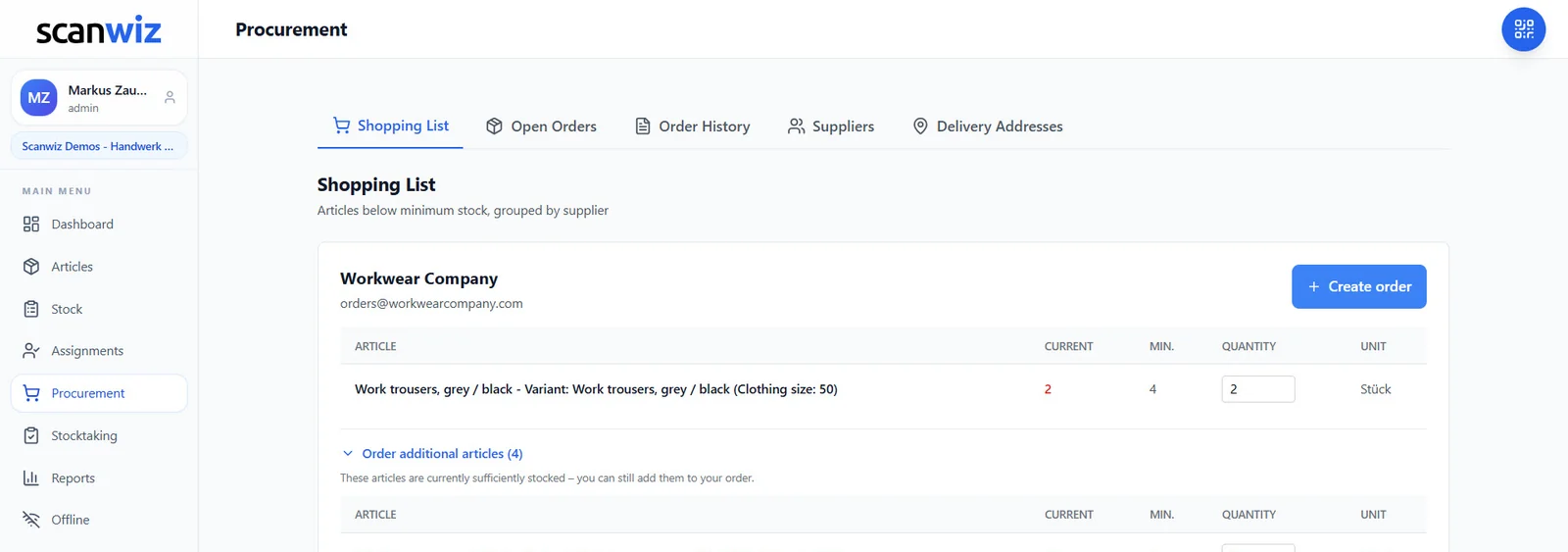
- Minimum stock per item, variant and storage location
- Shopping list by supplier, with the order quantity suggested by Scanwiz
- Every withdrawal booked by scan – so you notice when the reserve is being used
Frequently asked questions about safety stock
What is safety stock?
Safety stock is a reserve kept in the store to absorb usage peaks and delivery delays. Normally it is not touched. It is part of the reorder point at which you reorder.
How do you calculate safety stock?
The simplest way is the rule of thumb: average daily usage times buffer days. More precise are the max method, which covers the worst case so far, and the statistical method with service level: z times the standard deviation of daily usage times the square root of the lead time.
What is the difference between safety stock and reorder point?
Safety stock is the reserve. The reorder point is when you order: usage during the lead time plus safety stock. If you order at the reorder point, the delivery arrives before the reserve is touched.
Is minimum stock the same as safety stock?
Technically, usually yes. In many inventory programs, however, minimum stock is the value that triggers reordering – then it corresponds to the reorder point. What matters is that everyone in the team understands the same thing by it.
How high should safety stock be?
That depends on value and risk. For cheap small parts, generous buffer days are enough; for expensive items, the statistical method with around 95% service level is worthwhile; and for items without a substitute, the max method. Going from 95% to 99% service level increases safety stock by a good 40%.
Can stock fall below safety stock?
Yes, that’s what it’s for. If it is touched, that is a signal: the delivery is late or usage is higher than planned. If this happens often, the reorder point is set too low.
Sources & methodology
- Wikipedia: Safety stock. en.wikipedia.org, accessed 10 Nov 2026.
- Safety factors z: quantiles of the standard normal distribution for the stated service levels, rounded.
- Worked example: Scanwiz’s own calculation with realistic values from a GP practice; price per box and carrying cost rate assumed.
Updated November 2026 · Scanwiz editorial team
More from the glossary
Related to safety stock.
Reorder point formula
→When to order, with formula, examples from trades and medical practices and an online calculator.
ABC analysis
→Which items tie up the most capital – and where a tight reserve pays off. With tool.
Stocktaking at a medical practice
→What to check and when – from the fridge to the emergency kit, with inspection plan and template.
Over 250 customers already trust Scanwiz
Reorder before the reserve is needed.
Minimum stock per item, variant and storage slot, a shopping list by supplier and withdrawals by scan. Try Scanwiz free for 14 days – no credit card required. Or let us show you everything in a personal demo.


