
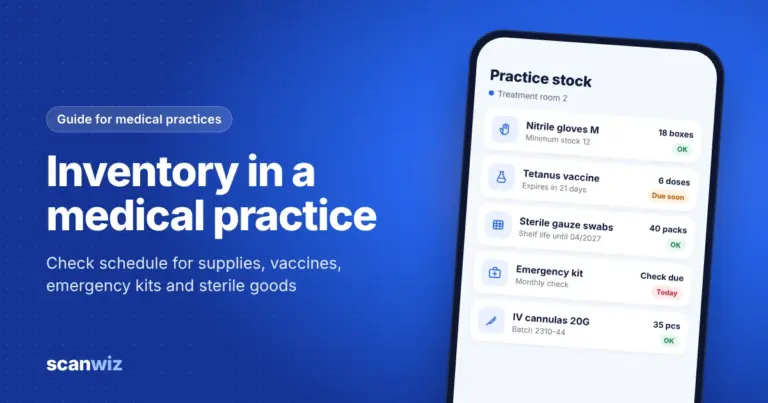
Stocktaking in a medical practice rarely means counting everything once a year and calling it done. For most practices, an annual stocktake is not even a legal requirement. What is required – and expensive when it goes wrong – is something else: expired vaccines, an incomplete emergency kit, a fridge that ran too cold overnight. A paediatric practice in Magdeburg, Germany, had to pay for around €24,400 worth of vaccine out of its own pocket after a fridge fault – and the Federal Social Court upheld the claim (case B 6 KA 14/21 R).
This guide shows you whether your practice has to do a stocktake, what to check daily, monthly, quarterly and yearly, how to count room by room without disrupting surgery hours, and how to keep expiry dates under control for good. It comes with a check schedule, a checklist and a free Excel template.
Key takeaways
- In Germany, a single-handed or group practice using cash-basis accounting does not have to do a statutory stocktake. A medical centre run as a limited company (GmbH) does.
- More important than a year-end date is a fixed check schedule: fridge daily, emergency kit, controlled drugs and sterile goods monthly, expiry dates quarterly, full stocktake once a year.
- Controlled drugs carry a genuine duty: in Germany, the records have to be checked at the end of every calendar month (§ 13 BtMVV).
- With FEFO (first expired, first out), an expiry traffic light and a named person in charge, almost nothing expires unnoticed.
Contents: Does a practice have to do a stocktake? · Check schedule · Stocktake in 7 steps · Expiry dates and FEFO · Vaccines, emergency kit, controlled drugs, sterile goods · Checklist and template · Common mistakes · With Scanwiz · FAQ
Does a medical practice have to do a stocktake?
The short answer: it depends on the legal form. In Germany, the statutory stocktake under § 240 of the Commercial Code (HGB) applies to merchants. Doctors are self-employed professionals and usually calculate their profit on a cash basis, so the duty does not apply to them. It is different if the practice is run as a limited company, for example a medical care centre (MVZ) organised as a GmbH: a GmbH always counts as a merchant, has to prepare a balance sheet and therefore an inventory.
| Type of practice | Statutory stocktake? | What applies anyway |
|---|---|---|
| Germany: single-handed or group practice (partnership) with cash-basis accounting | No | Controlled-drug records, medical device records, hygiene, cold chain |
| Germany: medical care centre or practice run as a GmbH | Yes, § 240 HGB: at the end of every financial year | Everything in the row above, plus an inventory for the balance sheet |
| Switzerland: practice run as an AG or GmbH, sole proprietorship with revenue of CHF 500,000 or more | Stock must be evidenced by an inventory or in another way (Art. 958c CO) | Cantonal rules; with self-dispensing, the practice pharmacy as well |
| Switzerland: practice that dispenses medicines | Depending on the canton, inspections ask for an annual stock check | Cooling, expiry dates, controlled drugs |
The deciding column is the one on the right. Even without a legal stocktake obligation, every practice needs to know which controlled drugs, vaccines, emergency medicines and medical devices it holds and whether they are fit for use. Swiss cantonal inspection forms, for instance, explicitly ask whether a dispensing practice has an annual stock check on file. A well-run stocktake is therefore less an accounting chore than part of your quality management. If you practise outside Germany and Switzerland, check your national rules – the check schedule below works everywhere.
Note: this guide gives a practical overview and is not legal or tax advice. Regional requirements from your medical association or health authority take priority.
The check schedule: what to check and when
Stock in a practice goes out of date at very different speeds. A fridge can fail overnight; gloves last for years. That is why a single annual stocktake works poorly in a practice. A check schedule with fixed intervals works better: critical areas are checked often, everything else rarely.
| Area | How often? | What to check | Basis |
|---|---|---|---|
| Vaccine and medicine fridge | Daily before surgery opens | Read the min/max temperature, log it, reset the thermometer | Manufacturer instructions, DIN 58345 in Germany |
| Emergency kit and emergency medicines | Monthly and after every use | Completeness, expiry dates, function of the devices | Practice quality management, professional body guidance |
| Controlled drugs | At the end of every calendar month | Check stock and records, confirm with initials and date | § 13(2) BtMVV in Germany |
| Sterile goods | Monthly | Storage period, intact packaging, labelling | DIN 58953-8 |
| Practice supplies and consumables | Ongoing via minimum stock, expiry check quarterly | Stock level, expiry and opening dates | Cost control, hygiene |
| Reimbursed practice supplies | Quarterly | Reconcile consumption with orders | Rules of your payer or physicians’ association |
| Medical devices | Yearly and by inspection deadline | Reconcile the device inventory list, dates for safety and metrological checks | MPBetreibV in Germany |
| All stock | Once a year | Full count of every storage location, clear out slow movers | Statutory for a GmbH, otherwise quality management |
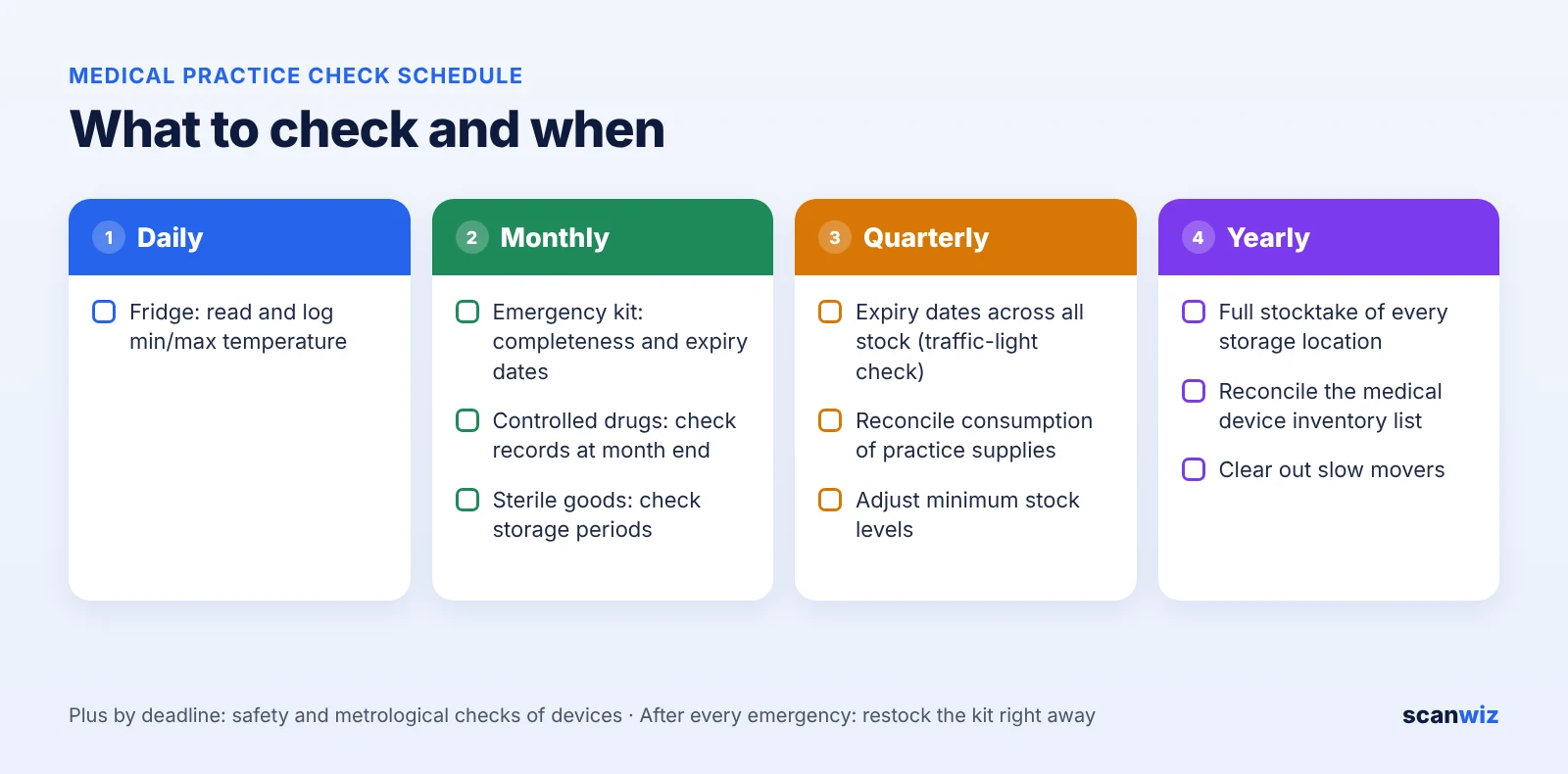
Name one person and a deputy for every row. A schedule nobody feels responsible for is the first thing to be forgotten during holidays and flu season – exactly when consumption is highest.
Medical practice stocktake in 7 steps
The annual full stocktake is when you go through every storage location once, clear out old stock and reset minimum levels. Here is how to do it without disrupting surgery hours.
1. List every storage location
A practice rarely has just one store. Typical locations are the main store room, every treatment room, the lab, the vaccine fridge, the emergency kit, the home-visit bag and often a basement with bulk packs. Write them all down and give each a clear name. Anything that does not exist as a location will not be counted later – and then seems to be missing.
2. Define items and counting units
Decide for each item whether you count pieces, packs or boxes. Gloves in four sizes are four stock items, not one; the guide to variant management shows how to keep them apart. And flag the items where batch and expiry date matter: vaccines, medicines, sterile goods, lab reagents, test strips.
3. Count room by room instead of all in one day
A practice can rarely close for a whole day. Spread the count across quiet times, such as an afternoon without appointments, and tackle one or two rooms per session. What matters is that every room has been counted exactly once by the end and that you know when.
4. Check expiry dates while you count
Since you are holding every shelf’s contents anyway, check the expiry dates at the same time: expired items come out straight away, items with a short shelf life move to the front, new stock goes to the back. It takes seconds per shelf and saves a separate round.
5. Remove and document expired items properly
Expired medicines and vaccines do not belong in the normal bin. Record what was removed and with which expiry date. Next time you will see which items you regularly over-order, and you have proof if anyone asks.
6. Review variances and consumption
Compare the counted stock with what you expected. Larger variances almost always have a cause: material that moved between rooms, withdrawals nobody recorded or duplicate orders. Use the figures to adjust minimum stock levels. The guide on how to calculate the reorder point includes an example for gloves in a medical practice.
7. Record the result and responsibilities
Record who counted what and when, and set responsibilities for the coming year. If the stocktake is part of your quality management, this is also your evidence. For a GmbH, the count sheets belong to the records that must be kept for ten years.
Keeping expiry dates under control: FEFO and the expiry traffic light
The biggest losses in a practice store rarely come from theft but from stock that expires unnoticed. The classic case: the new delivery goes to the front of the shelf, and the older pack behind it is only found once it has long expired. Two simple rules prevent this.
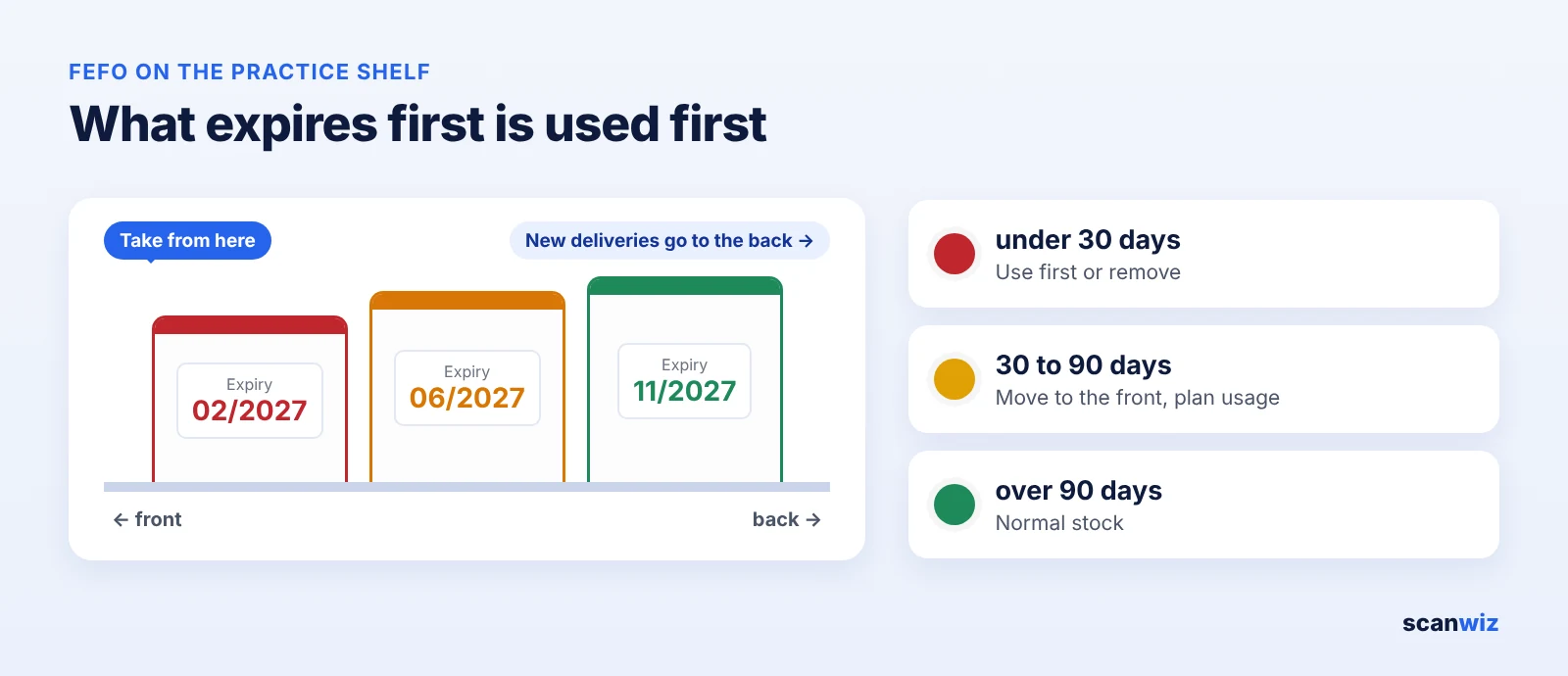
FEFO – first expired, first out: whatever expires first is used first. This is not the same as FIFO (first in, first out), because a later delivery can have an earlier expiry date. New stock therefore always goes to the back, and every delivery is worth a quick look at the date. More on batches, FEFO and recalls in the guide batch management in practices, labs and production.
The expiry traffic light: split your stock into three groups by remaining shelf life. During the quarterly check, you will see straight away where action is needed.
- Red, under 30 days: use first, move to other rooms or remove.
- Amber, 30 to 90 days: move to the front and plan usage, do not reorder.
- Green, over 90 days: normal stock.
An underrated point is opening dates. Multi-dose containers, disinfectants, test strips and some reagents only keep for a limited time once opened, regardless of the printed expiry date. Write the opening date on the pack and include these items in the monthly check.
Special cases: vaccines, emergency kit, controlled drugs and sterile goods
Vaccines and the cold chain
Vaccines are usually stored at 2 to 8 °C. The minimum is a min/max thermometer that is read, logged and reset every morning before surgery opens. A temperature alarm with notifications is better, because it also works at weekends. The Magdeburg case shows what is at stake: a faulty controller made the fridge run too cold for hours, the vaccine had to be destroyed, and the practice was left with a bill of around €24,400. Among other things, the court pointed out that the practice could have reduced the risk through maintenance, checks and smaller order quantities.
For your stocktake this means: keep only as much vaccine as you will use in the foreseeable future, record batches and expiry dates, and move packs with a short shelf life to the front.
Emergency kit and emergency medicines
What exactly belongs in the emergency kit is not uniformly regulated and depends on the specialty. The recommendations agree, however, that the kit is checked regularly for completeness, expiry dates and function – usually monthly – and restocked immediately after every use. Treat the emergency kit as a storage location of its own in your stock records, and you will always know what is in it and when it expires.
Controlled drugs
This is where the duty is spelled out most clearly. In Germany, § 13 BtMVV requires the whereabouts and stock of controlled drugs to be documented without gaps on the official form. The physician has to check the entries at the end of every calendar month and, if the stock has changed, confirm the check with initials and date. For practice use, stock of each controlled drug should not exceed a month’s requirement. Other countries have comparable registers. Inventory software can track the stock as well, but it does not replace the official record.
Sterile goods
With sterile goods, storage time matters as much as quantity. Under the German standard DIN 58953-8, sterile barrier systems stored unprotected should only be kept ready for 48 hours at most, and up to six months when stored protected in closed cabinets or drawers. Only with an additional protective packaging are up to five years possible, unless the manufacturer specifies a shorter period. In a typical practice, sterile goods therefore belong in closed cabinets, with the storage period on every pack.
Reimbursed practice supplies
In Germany, practices obtain certain supplies for acute and emergency use with several patients through a special arrangement with their physicians’ association (Sprechstundenbedarf). Errors can lead to recovery claims. Many practices therefore keep these supplies as a separate stock and reconcile consumption with orders every quarter, so they can show what the material was used for if asked.
Checklist: stocktaking in a medical practice
Print the checklist or use the Excel template below, where the checks are already set up as a schedule with due dates.
Every day
- ☐ Fridge: min/max temperature read, logged and reset
- ☐ Withdrawals recorded, reorders triggered
Every month
- ☐ Emergency kit: completeness, expiry dates and function checked and signed off
- ☐ Controlled drugs: records checked and signed at month end
- ☐ Sterile goods: storage periods and packaging checked
- ☐ Opened packs: opening dates checked
Every quarter
- ☐ Expiry traffic light across all locations: red removed or redistributed, amber moved to the front
- ☐ Reimbursed supplies: consumption and orders reconciled
- ☐ Minimum stock levels adjusted to current consumption
Once a year
- ☐ Full stocktake of every location, room by room
- ☐ Slow movers and duplicate stock cleared out
- ☐ Medical device list reconciled, inspection dates checked (see equipment inspection intervals)
- ☐ Responsibilities and deputies set for the coming year
Free Excel template: stocktake and check schedule for medical practices
Stock list with expiry traffic light and reorder flag, check schedule with automatic due dates, emergency kit checklist and fridge temperature log. No sign-up needed.
7 common stocktaking mistakes in a practice
- Trying to count everything in one day: the stocktake runs into surgery hours, gets abandoned and is never finished. Room by room is more realistic.
- New stock placed at the front: the older pack behind it expires. New deliveries always go to the back.
- Stock in every room but no overall view: each room orders for itself, and in the end the same material is in the building three times.
- Opening date not recorded: multi-dose containers, disinfectants and test strips are used for longer than allowed.
- Emergency kit not restocked after use: at the next emergency, exactly what was used last time is missing.
- Bulk packs “just in case”: the unit price drops, but part of it expires before it is used. For vaccines and medicines in particular, this rarely pays off.
- No fixed responsibility: when “everyone” is responsible, nobody checks the fridge during the holidays.
Medical practice stocktaking with Scanwiz
Spreadsheets and paper lists work as long as one person keeps everything in their head. Once several rooms, several staff members and expiry dates come into play, it gets tedious. Scanwiz is inventory software that lets practices manage their stock by scanning with a phone:
- Every room a storage location: treatment rooms, lab, fridge, emergency kit and home-visit bag each get their own stock. Storage locations and users are unlimited in every plan.
- Batches and expiry dates: every delivery with batch and expiry date, and Scanwiz shows what is about to expire (from the Growth plan).
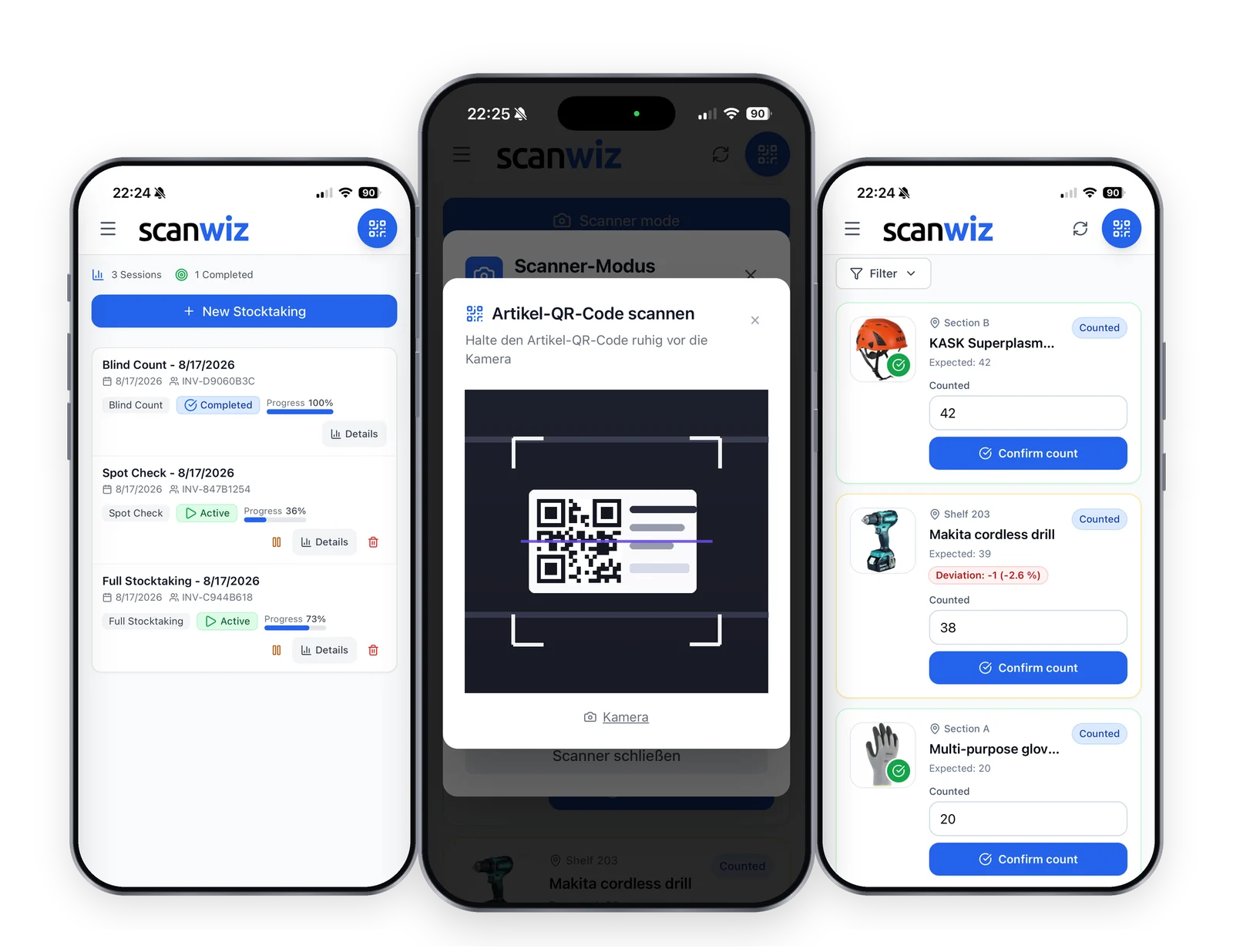
- Stocktake by scanning: full stocktake, cycle count, spot check – for example for the monthly emergency kit check – and blind count. Can be paused and run by several people at once.
- Reordering without searching: minimum stock per item, and anything that falls below it lands on the shopping list, grouped by supplier. Glove sizes are managed as variants with their own stock.
- Medical devices with inspection dates: with the maintenance and inspections module, Scanwiz reminds you in good time of safety checks, calibrations and servicing. Which devices need to be recorded is explained in our guide to the medical device inventory list.
- No patient data needed: Scanwiz manages material and bookings, not patients. EU hosting, GDPR compliant.
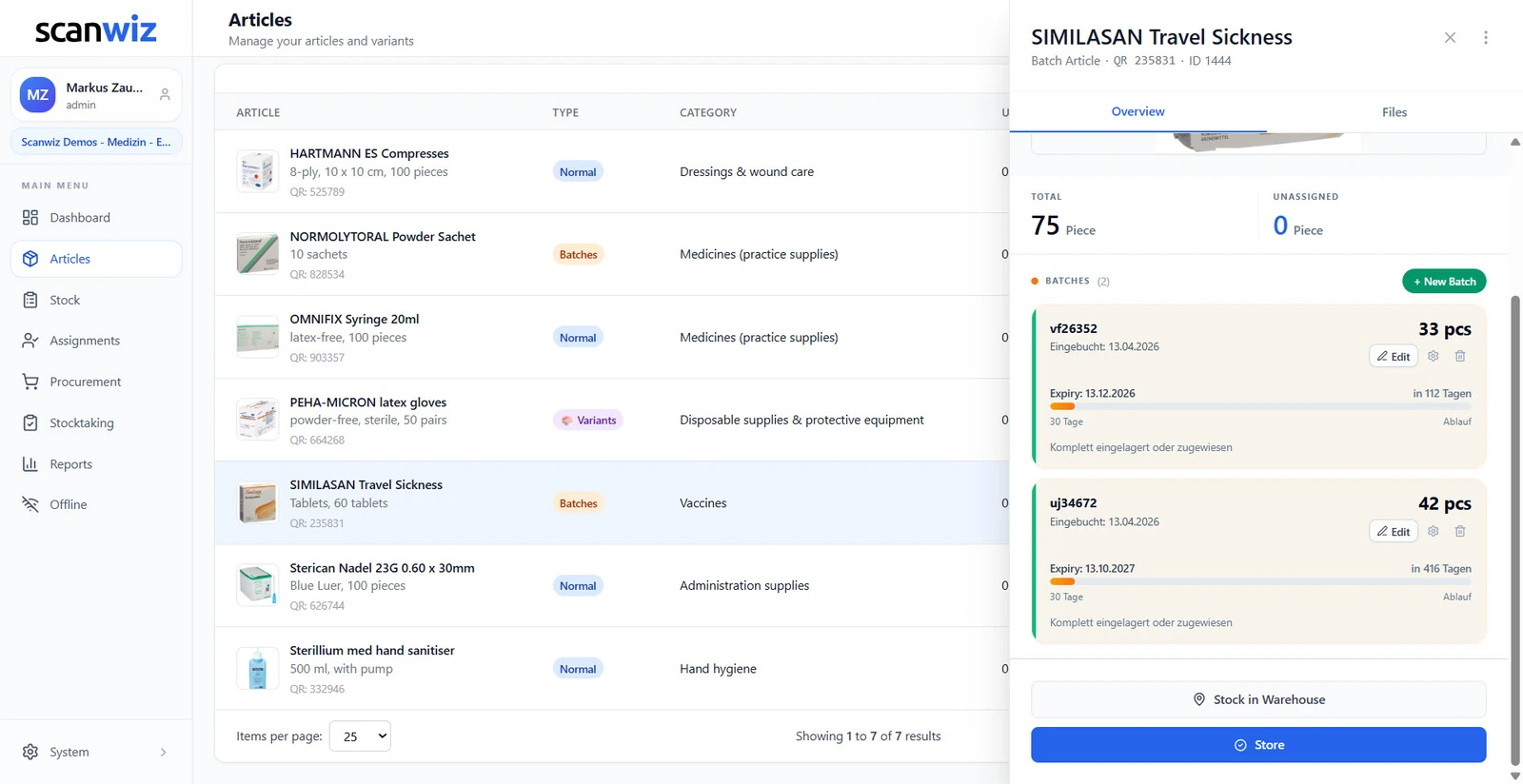
To be honest: Scanwiz does not replace the official controlled-drug record or the temperature monitoring of your fridge. For those you still need the official form and a thermometer or data logger. Everything else in this guide you can manage in Scanwiz. What it looks like in day-to-day practice is shown on the page medical inventory management; all details on counting are on the stocktaking software page. The general stocktake process for any store is covered in how to do a stocktake.
Frequently asked questions about stocktaking in a medical practice
Does a medical practice have to do a stocktake?
In Germany, a single-handed or group practice that uses cash-basis accounting is not required to do a statutory stocktake. A medical care centre or practice run as a GmbH, on the other hand, must prepare an inventory at the end of every financial year under § 240 HGB. Regardless of that, rules on controlled drugs, medical devices, hygiene and the cold chain apply.
How often should the emergency kit be checked?
A monthly check for completeness, expiry dates and function is common, documented with date and initials. In addition, the kit is restocked immediately after every use. What exactly goes into it is decided by the responsible physician depending on the specialty.
How often should the vaccine fridge be checked?
Daily, ideally before surgery opens: read the min/max temperature, log it and reset the thermometer. Vaccines are usually stored at 2 to 8 °C. A temperature alarm adds protection at weekends and on public holidays.
How often do controlled drugs have to be checked in a practice?
In Germany, § 13 BtMVV requires the records on whereabouts and stock to be checked at the end of every calendar month. If the stock has changed, the physician confirms the check with initials and date. Other countries have comparable rules.
How long can sterile goods be stored in a practice?
Under DIN 58953-8, unprotected for no more than 48 hours, protected in closed cabinets or drawers for up to six months and with additional protective packaging for up to five years, unless the manufacturer specifies a shorter period.
What does FEFO mean in a medical practice?
FEFO stands for first expired, first out: whatever expires first is used first. New deliveries go to the back, packs with a short shelf life to the front. That way, hardly any material expires unused.
How long does a stocktake in a medical practice take?
It depends on the number of items and storage locations. A realistic approach is to spread the full stocktake room by room across several quiet sessions rather than closing the practice for a whole day. Counting by scanning saves typing up count sheets and shows variances immediately.
Conclusion: in a practice, the rhythm matters more than the year-end date
Most medical practices do not need an annual stocktake for the balance sheet. They still need an overview of their stock – continuously: the fridge is checked daily, the emergency kit, controlled drugs and sterile goods monthly, expiry dates quarterly, and once a year every room is counted in full. Practise FEFO, record opening dates and name a responsible person for every check, and you will lose hardly any material and have your records ready for every inspection.
Updated November 2026.
Over 250 customers already trust Scanwiz
Your practice stock, always up to date. No paper.
Book practice supplies by scanning, keep an eye on expiry dates and count room by room on your phone. Start for free or let us show you in a personal demo how it works in your practice.


