
Glossary · Equipment & inspections
What is a competent person?
Ladders, electrical devices, slings: recurring inspections cannot be done by just anyone. The German Ordinance on Industrial Safety and Health (BetrSichV) requires a “person qualified to carry out inspections”. Here you will learn what they need to know, who in your own business can take on the role and how it differs from a qualified electrician and an expert.
In brief
Under § 2 (6) of the German Ordinance on Industrial Safety and Health (BetrSichV), a person qualified to carry out inspections – in English usually called a competent person – is someone who, through vocational training, professional experience and recent relevant work, has the knowledge required to inspect work equipment. The requirements are specified in the technical rule TRBS 1203. The employer decides who carries out which inspections.
Competent person: definition
The German Ordinance on Industrial Safety and Health obliges employers to have work equipment inspected regularly if its safety depends on installation, condition or wear. The inspection may be carried out by a “person qualified to carry out inspections” – a competent person for short.
Important: the qualification always applies to a specific inspection task. Someone allowed to inspect ladders is not automatically allowed to inspect electrical devices. There is also no general course that “makes someone a competent person” – training is one building block, but it does not replace education and experience.
Requirements for a competent person
Vocational training
- Completed training related to the inspection task
- For example a technical apprenticeship, master craftsman, degree
Professional experience
- Practical experience with the work equipment
- Can recognize and assess defects
Recent relevant work
- Currently works in the field
- Keeps knowledge up to date through further training
In addition, under TRBS 1203 the competent person is not bound by instructions when inspecting and must not be disadvantaged because of their inspection results. A foreman who is supposed to wave a ladder through under deadline pressure is therefore not a good inspector.
Competent person, qualified electrician, expert
| Term | Source | Typical task |
|---|---|---|
| Person qualified to carry out inspections | BetrSichV, TRBS 1203 | Umbrella term for recurring inspections of work equipment |
| Qualified electrician | DGUV Regulation 3, DIN VDE 1000-10 | Inspection of electrical installations and equipment |
| Electrically instructed person | DGUV Regulation 3 | Inspection of portable devices with a suitable tester, under the direction of a qualified electrician |
| Expert (Sachkundiger) | Older term, still in many DGUV rules | For example forklifts, vehicles, fall protection PPE, fire extinguishers |
| Approved inspection body | BetrSichV | Inspection of installations requiring monitoring, such as lifts or certain pressure equipment |
For electrical inspection under DGUV V3, the competent person in practice is the qualified electrician. For ladders and step stools, it can be an internally trained employee.
Example: inspections at a roofing business
The business divides the inspections by qualification:
- Ladders: master roofer, 12 years in the trade, trained as a competent person for ladders
internal, annually - Safety harnesses and lanyards: expert with manufacturer training
internal, annually - Power tools on site: qualified electrician
external, every 3 months - Company vehicles (UVV): car repair shop
external, annually
The owner records the appointment in writing – with names, inspection tasks and qualifications. There is no employee with suitable training for electrical inspection, so it stays external.
Inspection interval finder
Choose a piece of equipment and the date of the last inspection. The finder shows the usual interval, the legal basis and who may inspect – and creates a calendar entry with a reminder.
The inspection interval finder needs JavaScript. Please enable JavaScript in your browser.
4 typical mistakes
- Trained once, never refreshed. Recent relevant work is a requirement in its own right. Anyone who has not worked in the field for years loses the qualification.
- One person for everything. The qualification applies per inspection task. The ladder inspector does not automatically inspect electrical devices too.
- No written appointment. In the event of damage, it must be provable whom the employer entrusted with which inspection.
- Result not documented. An inspection is only worth as much as its proof. Records must be kept at least until the next inspection (§ 14 BetrSichV).
Organizing inspections with Scanwiz
In Scanwiz you create inspection templates with interval and checklist and apply them to individual devices or entire groups. Each inspection has a responsible person who is reminded in good time. The competent person inspects point by point on their phone, records defects with a photo and locks the device if needed. Every result ends up in the device’s logbook.
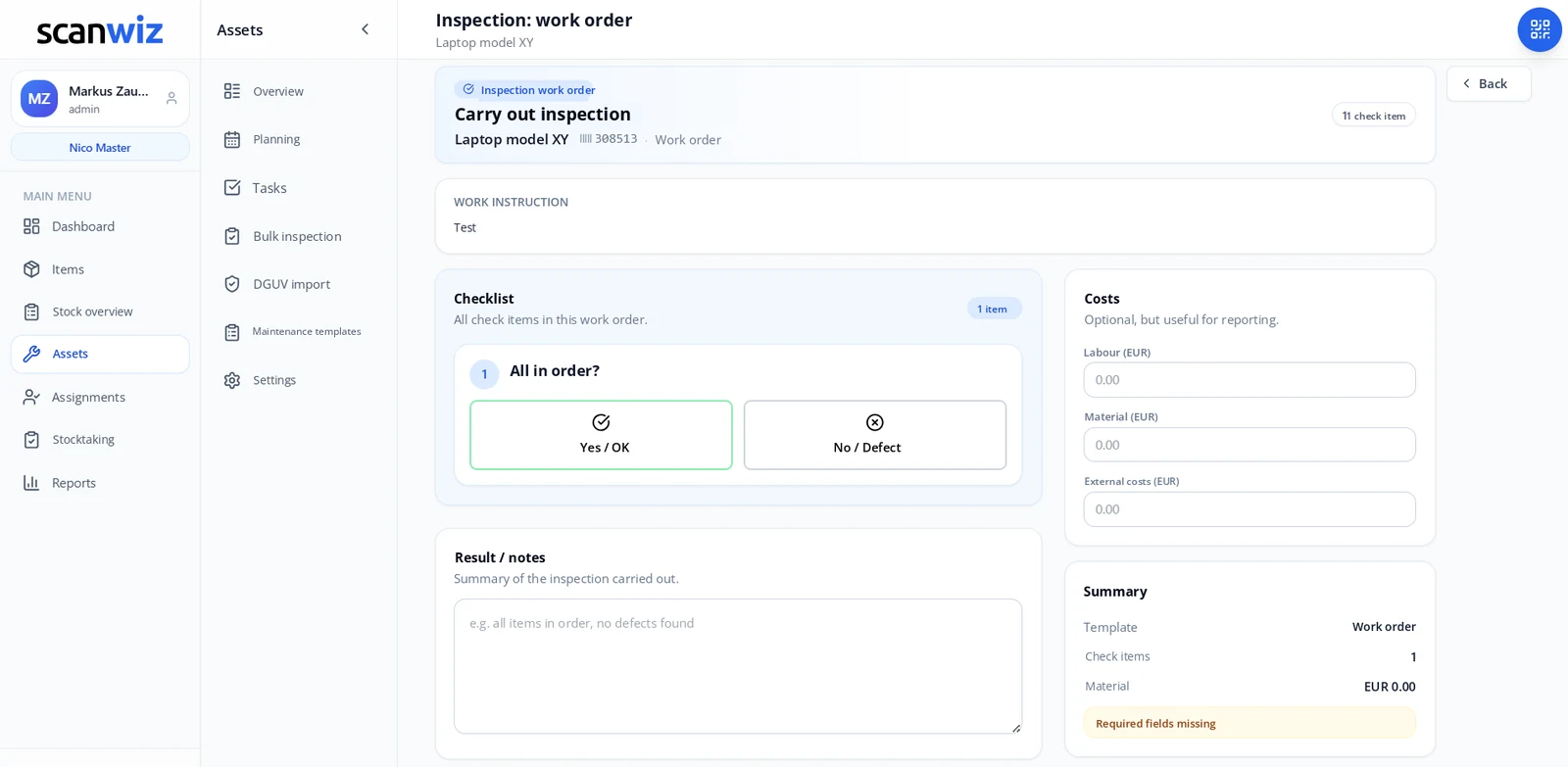
- Inspection templates with interval and checklist
- Responsible person with reminder and lead time
- Bulk inspection for ladders or harnesses
- Logbook per device, printable for audits and the accident insurer
Learn more: Maintenance and inspections with Scanwiz · guide Equipment inspection intervals.
Frequently asked questions about the competent person
What is a competent person?
A person who, through vocational training, professional experience and recent relevant work, has the knowledge required to inspect work equipment (§ 2 (6) BetrSichV, Germany).
How do you become a competent person?
There is no standard qualification. What is needed is suitable vocational training, experience with the work equipment and current work in the field. Training courses, for example for ladders, deepen the knowledge. The appointment is made by the employer.
Can one of my own employees inspect ladders?
Yes, if they meet the requirements and are appointed by the employer. Many businesses train an experienced employee for this.
Is a qualified electrician a competent person?
For the inspection of electrical installations and equipment, yes – in that area they are the competent person. Other inspections, such as of slings, require the corresponding qualification.
Sources & methodology
- § 2 BetrSichV – Definitions (German Ordinance on Industrial Safety and Health). gesetze-im-internet.de, accessed 10 November 2026.
- § 14 BetrSichV – Inspection of work equipment. gesetze-im-internet.de, accessed 10 November 2026.
- TRBS 1203 – Persons qualified to carry out inspections. German Federal Institute for Occupational Safety and Health (BAuA).
- Example: model business, created by Scanwiz.
Updated November 2026 · Scanwiz editorial team · not legal advice
More from the glossary
Related to the competent person.
Over 250 customers already trust Scanwiz
From the glossary to your warehouse – Scanwiz does the rest.
Minimum stock, stocktakes, inspection intervals and batches run automatically in Scanwiz as part of your daily work. Try it free for 14 days with your whole team – no credit card required. Or let us show you everything in a personal demo.


