
Glossary · Barcodes & labeling
What is RFID?
One reader captures hundreds of items at once, without anyone hunting for a code – that is the promise of RFID. Here you’ll learn how the technology works, which variants exist and who it actually pays off for.
In brief
RFID (radio-frequency identification) is a technology in which data is transmitted by radio from a transponder – the RFID tag – to a reader, without line of sight. Depending on the frequency, the range is anywhere from a few centimetres to several metres. Warehouses mainly use UHF RFID because it can capture many tags at once and at a distance.
RFID: definition
An RFID system consists of three parts: the tag with chip and antenna, the reader with its own antenna, and the software that processes the IDs read. Passive tags have no battery; they are powered by the reader’s radio field. Active tags have their own battery and transmit over longer distances – they are much more expensive and tend to be used on containers or vehicles.
The key difference from a barcode: an RFID reader doesn’t have to “see” the tag. It also captures tags inside boxes, behind panels or in a stack – and many of them in a single pass.
The frequency bands
| Band | Frequency | Range | Typical use |
|---|---|---|---|
| LF (low frequency) | 125–134 kHz | a few centimetres | Animal identification, access control |
| HF (high frequency) | 13.56 MHz | up to about 1 m, as NFC a few centimetres | ID cards, libraries, smartphones |
| UHF (ultra-high frequency) | 865–868 MHz in Europe | up to several metres | Logistics, retail, bulk reading |
Example: is RFID worth it for 300 tools?
Rough cost comparison for the labelling, using typical assumptions and excluding software:
- QR labels on film, self-printed
≈ €30 - NFC tags, some on-metal, ≈ €1.50 each
≈ €450 - UHF tags for metal, ≈ €1 each
≈ €300 - Plus UHF handheld reader
≈ €1,500–3,000
With 300 tools issued one at a time, bulk reading brings hardly any benefit – every item goes over the counter individually anyway. QR codes or NFC with a smartphone are much cheaper here. RFID pays off when thousands of items have to be captured regularly in one pass, such as scaffolding parts, rental equipment or laundry.
Note: Prices are rough guide values and depend heavily on quantity, form factor and supplier.
When RFID pays off – and when it doesn’t
Tends to pay off
- Very many identical items moved in bulk
- Capture while passing gates or shelves
- Items in crates, boxes or behind panels
- Stocktaking thousands of items in a short time
Tends not to pay off
- Items are issued one at a time anyway
- Staff should work with their own phones
- A few hundred items or devices
- No budget for readers and integration
You will find the detailed comparison with costs and use cases in the guide Barcode, QR code, NFC or RFID.
4 common misconceptions about RFID
- “Then I’ll always know where everything is.” Passive RFID is not location tracking. A tag is only captured when a reader is nearby.
- “My phone can do that.” Smartphones read NFC, but not UHF RFID. That requires dedicated readers.
- “Every tag gets read.” Metal and liquids interfere. Without suitable tags and testing, there will be gaps.
- “A tag replaces the process.” Even with RFID, you still have to define who books what and when.
Labelling with Scanwiz
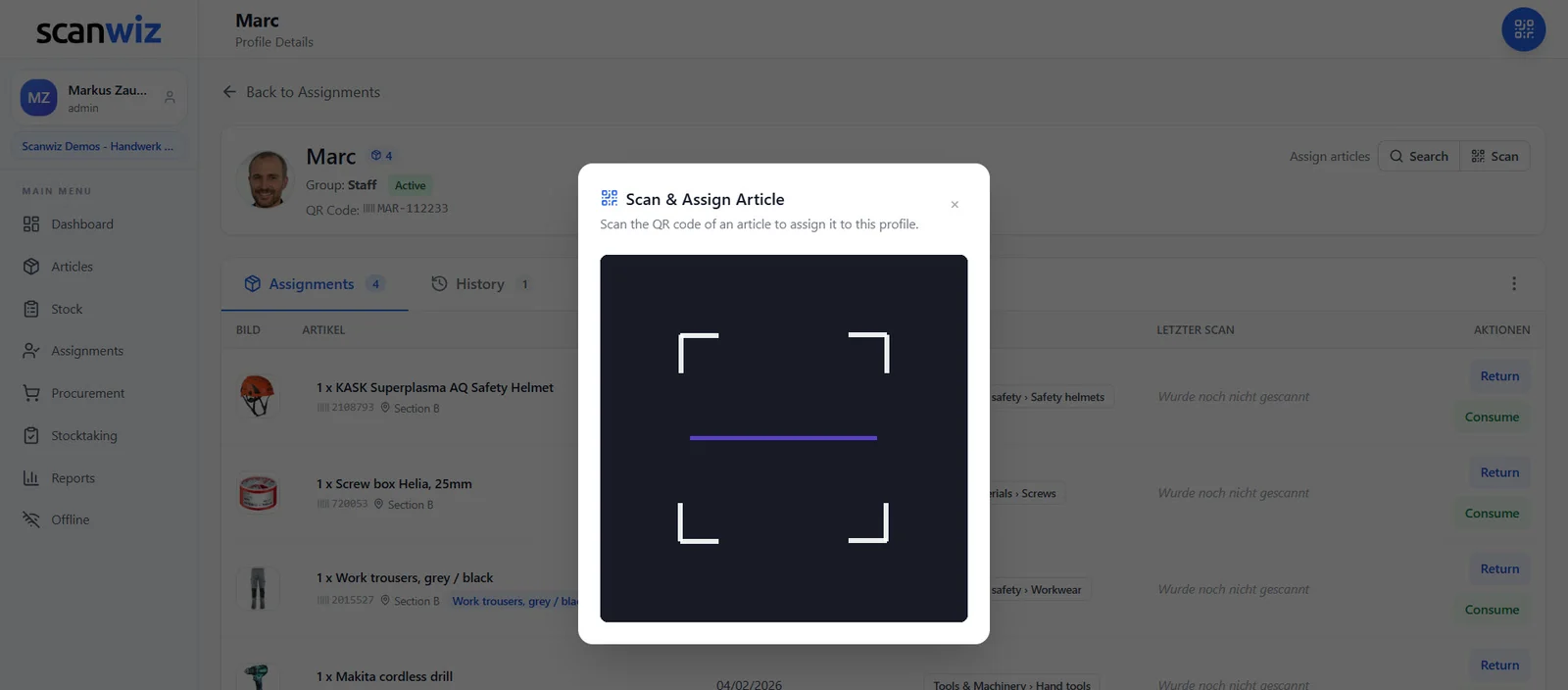
Scanwiz relies on the technologies that work with a smartphone without extra hardware: barcode, QR code, Data Matrix and NFC. For most stores in trades, construction, practices and workshops, that is the cheapest and fastest solution. If you want to speed up issuing, add a USB or Bluetooth handheld scanner.
- QR code, Data Matrix, Code 128 and EAN
- NFC tags for equipment in the app
- USB and Bluetooth handheld scanners
Frequently asked questions about RFID
What is RFID?
RFID (radio-frequency identification) transmits data by radio from a tag to a reader, without line of sight. Depending on the frequency, from a few centimetres to several metres.
What is the difference between RFID and NFC?
NFC is a form of HF RFID with a very short range that smartphones can read. UHF RFID reads over several metres and many tags at once, but needs dedicated readers.
How much does RFID cost?
Simple UHF labels cost a few cents in large quantities, rugged tags for metal more like one euro. On top of that come readers – handhelds usually cost four figures – plus integration and testing.
Can you locate tools with RFID?
Passive RFID does not locate anything; it only captures tags within range of a reader. Locating requires active tags, Bluetooth trackers or GPS – with their own infrastructure.
Sources & methodology
- Wikipedia: Radio-frequency identification – how it works and frequency bands. en.wikipedia.org, accessed 10 Nov 2026.
- Cost comparison: rough market prices as of November 2026, Scanwiz’s own research.
Updated November 2026 · Scanwiz editorial team
Over 250 customers already trust Scanwiz
From the glossary to your warehouse – Scanwiz does the rest.
Minimum stock, stocktakes, inspection intervals and batches run automatically in Scanwiz as part of your daily work. Try it free for 14 days with your whole team – no credit card required. Or let us show you everything in a personal demo.


