
Glossary · Warehouse organisation
What do FIFO and FEFO mean?
First come, first out – or first to expire? The picking order decides whether material spoils on the shelf. Here you’ll learn the difference between FIFO and FEFO, when each rule applies and how to put it into practice day to day.
In brief
FIFO (first in, first out) and FEFO (first expired, first out) are rules for the order in which stock is picked. With FIFO, what was put away first is picked first. With FEFO, what expires first is picked first – regardless of the date of receipt. FEFO is the standard for anything with an expiry or best-before date.
FIFO and FEFO: definition
In most cases, what was delivered first also reaches its expiry date first. Then FIFO and FEFO lead to the same result. The difference shows when a later delivery has a shorter shelf life – for example because the dealer sent older remaining stock. FIFO would then use up the fresher goods first, and the older ones expire.
So the rule is: for material with an expiry or best-before date, FEFO is the right rule. For everything without a date, FIFO is enough to make sure nothing is forgotten at the back of the shelf.
FIFO, FEFO and LIFO compared
| Rule | What goes out first | Typical for |
|---|---|---|
| FIFO | The oldest delivery | Spare parts, packaging, material that ages or goes out of fashion |
| FEFO | The goods with the earliest expiry date | Medicines, sterile goods, food, adhesives, silicone, paints |
| LIFO | The newest delivery | Bulk material on a stockpile, stacked goods with no shelf life |
Don’t confuse: in accounting, FIFO and LIFO are also inventory valuation methods. There, it is about which purchase price is applied – not about which goods are actually picked.
Example: tile adhesive at a fit-out business
There are two pallets of tile adhesive in the store. The second delivery came later, but was remaining stock with a shorter shelf life.
- Delivery 1: received March, usable until December
30 sacks - Delivery 2: received May, usable until October
30 sacks - Usage until October
≈ 40 sacks - With FIFO: used from delivery 2 by October
only 10 sacks
With FIFO, 20 sacks from delivery 2 would have expired in October. With FEFO, delivery 2 is used up completely by October. That leaves 20 sacks of delivery 1 – with two more months to go. The business postpones its next order until they are used up.
How to put FIFO and FEFO into practice on the shelf
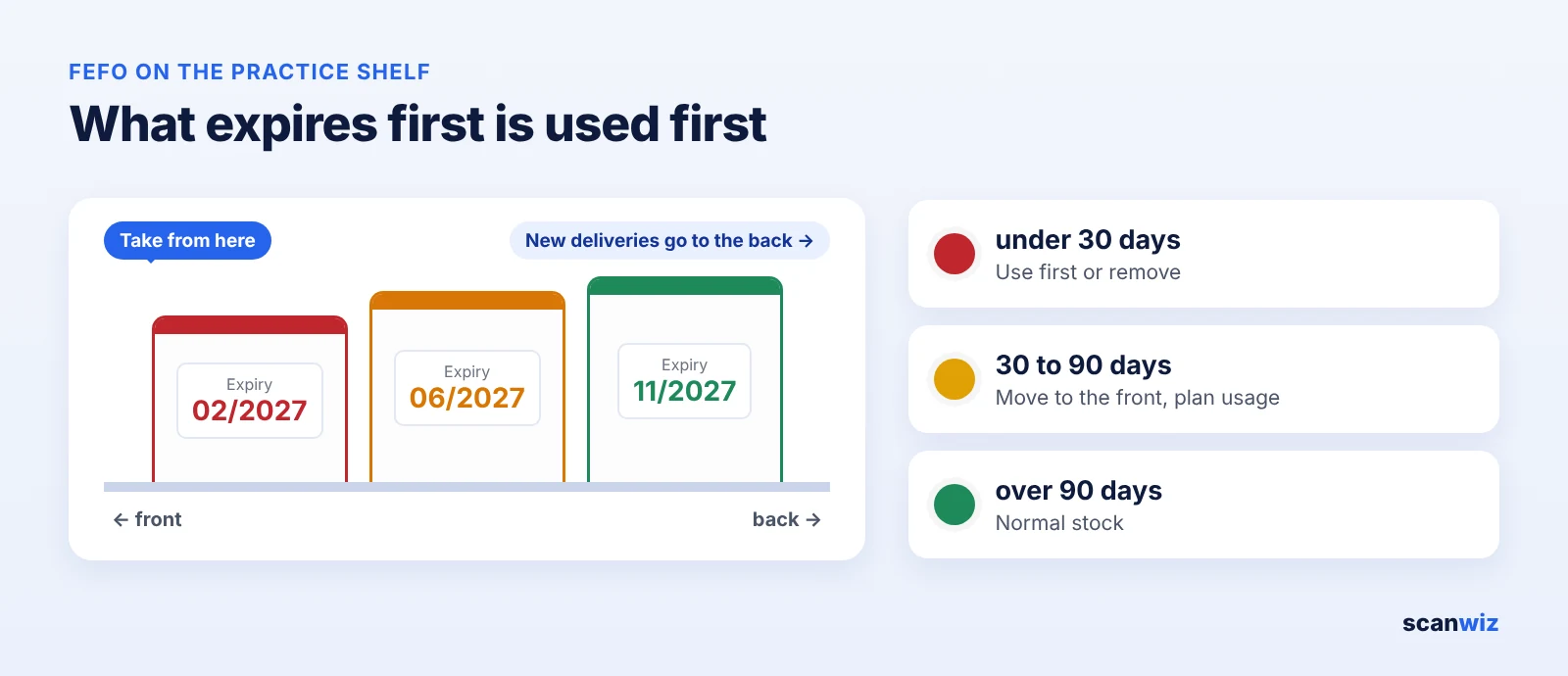
- Fill from the backNew stock to the back, old stock to the front.
- Date visibleExpiry date in large print on the front or on the bin.
- Keep batches separateDon’t top up opened boxes.
- Flow rackWith high usage, the oldest stock rolls to the front automatically.
- Check regularlySpot goods that are about to expire before they do.
4 common mistakes with FIFO and FEFO
- Putting new stock at the front. The most common reason goods expire at the back.
- FIFO for perishable goods. Only works as long as every delivery is fresher than the last.
- Date only on the carton. Once the carton is gone, nobody knows what has to go out first.
- Checking only once a year. At the stocktake it’s too late – the goods have already expired.
FEFO with Scanwiz
With batches in Scanwiz – from the Growth plan – every delivery has its own expiry date. The item always shows the batch that expires next, with remaining shelf life in days and a traffic light. When picking, the date is shown next to each batch, and expiry warnings appear on the dashboard before it’s too late.
- Expiry date per batch
- Remaining shelf life in days with traffic light
- Warning threshold adjustable per batch
- Expiry warnings on the dashboard
Frequently asked questions about FIFO and FEFO
What is the difference between FIFO and FEFO?
FIFO picks first what was put away first. FEFO picks first what expires first. They differ when a later delivery has a shorter shelf life.
When should I use FEFO?
For anything with an expiry or best-before date: medicines, medical devices, food, but also adhesives, silicone, paints and other construction chemicals.
What does LIFO mean?
Last in, first out: the goods put away last go out first. This only suits goods with no shelf life, such as bulk material on a stockpile.
How do I implement FIFO on the shelf?
Put new stock in from the back and pick from the front. With high usage, flow racks help, as the oldest stock slides to the front automatically.
Sources & methodology
- Wikipedia: FIFO and LIFO accounting. en.wikipedia.org, accessed 10 Nov 2026.
- Example: model business, created by Scanwiz.
Updated November 2026 · Scanwiz editorial team
More from the glossary
Related to FIFO and FEFO.
Over 250 customers already trust Scanwiz
From the glossary to your warehouse – Scanwiz does the rest.
Minimum stock, stocktakes, inspection intervals and batches run automatically in Scanwiz as part of your daily work. Try it free for 14 days with your whole team – no credit card required. Or let us show you everything in a personal demo.


