
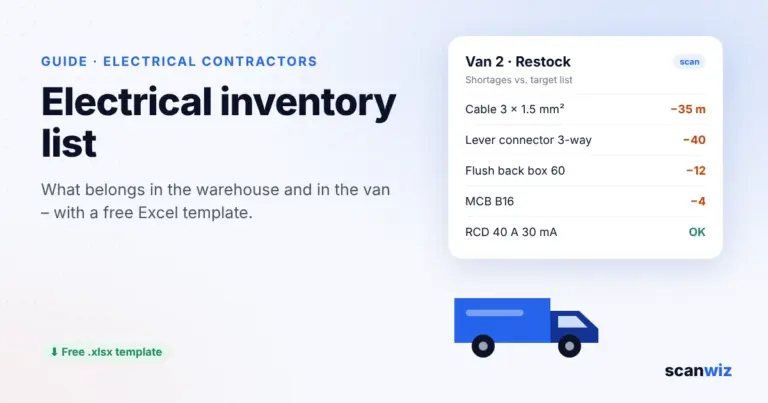
An electrical inventory list decides whether your electrician heads straight to the job in the morning or makes a detour to the wholesaler first. If a back box or an RCBO is missing on site, it quickly costs an hour of working time for two people plus the drive. At the same time, many service vans carry several thousand euros of material that nobody can account for.
In this guide you’ll find every category that belongs on an electrical inventory list, the data you need per item and a clear split between warehouse and van. There is also a calculator that shows how much capital is tied up in your vans and a free Excel template with around 55 pre-filled items, a van restock list and inspection dates for tools and test equipment.
Key takeaways
- A good electrical inventory list is organised into 10 categories – from cables and protection devices to solar PV parts and PPE.
- For each item you need at least item number, unit, bin location, stock and minimum stock, plus supplier and price for reordering.
- Each service van gets a fixed target list and is restocked weekly. Bulk packs and special parts stay in the warehouse.
- Tools and test instruments are kept on a separate list with asset numbers and inspection dates, for example for electrical safety testing and calibration.
Contents: Why you need a list · 10 categories · Data per item · Service van · Capital calculator · Excel template · 6 steps · Tools and test equipment · Common mistakes · With Scanwiz · FAQ
Why electrical contractors need an inventory list
Electrical material is unusually small and varied. A typical range spans cable sold by the metre, hundreds of small parts and expensive protection devices, spread across the warehouse, vans and job sites. Without a list, the same problems keep coming up:
- Trips to the wholesaler: whatever is missing from the van gets bought on the way, often at worse prices and at the expense of working time.
- Duplicate stock: every van has its own supplies, and the warehouse holds the same again. The money is tied up without helping anyone.
- No data for purchasing: without usage figures you order by gut feeling and have little to negotiate with when talking to suppliers.
- Inspections slip: test instruments, power tools and ladders need regular checks. Without a list nobody knows what is due when.
An inventory list is not an end in itself. It is the basis for minimum stock levels, consistent van stock and reorders that happen before the shelf is empty.
The 10 categories of an electrical inventory list
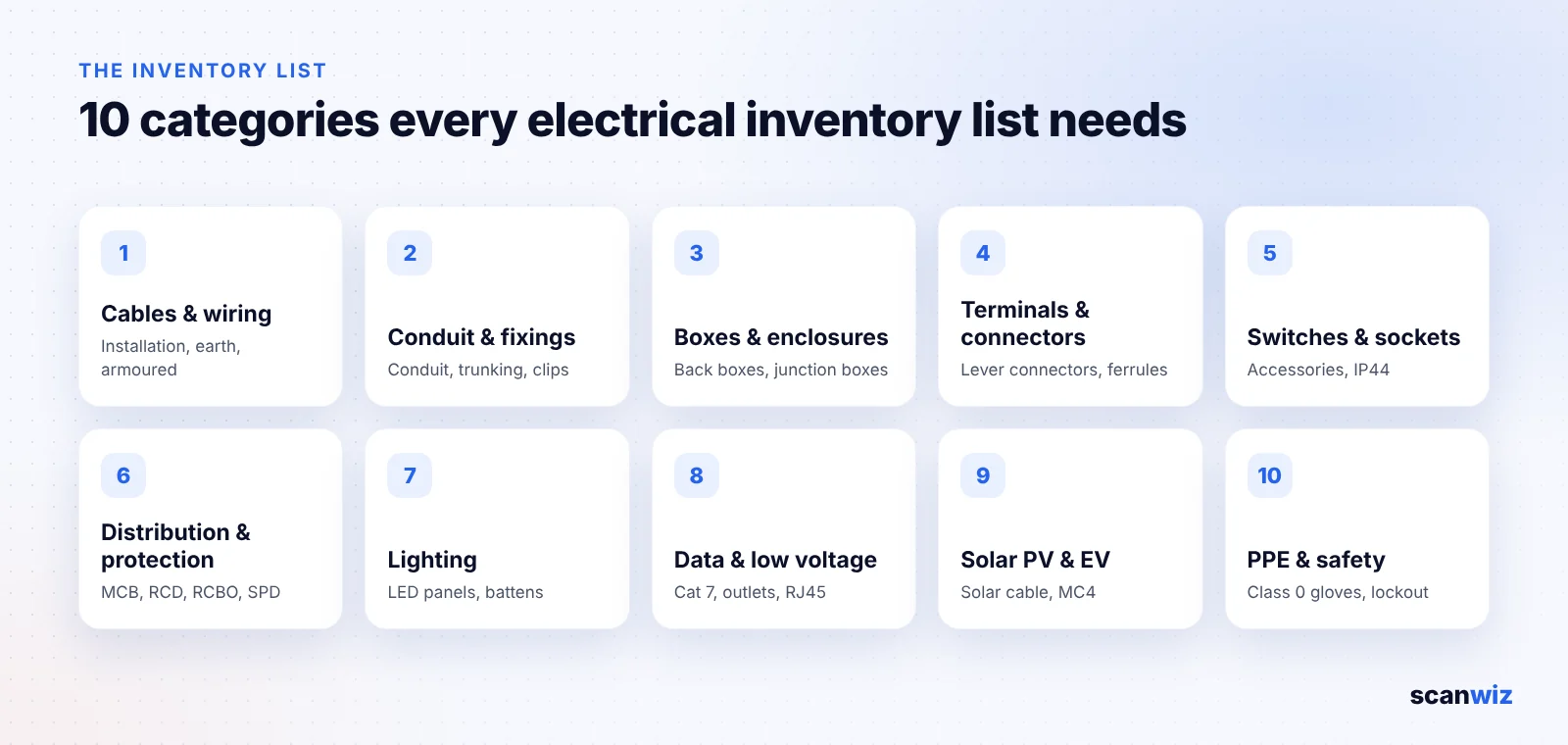
| Category | Typical items | Where to store |
|---|---|---|
| Cables and wiring | Installation cable 3 × 1.5 and 3 × 2.5 mm², 5-core cable, single cores, earth cable, armoured or underground cable, signal cable | Coils in the van, drums in the warehouse |
| Conduit, trunking and fixings | Flexible conduit 20 and 25 mm, trunking, cable clips, cable ties, wall plugs, screws | Both |
| Boxes and enclosures | Flush back boxes, dry-lining boxes, IP54 junction boxes | Van |
| Terminals and connectors | Lever connectors, ferrules, cable lugs, heat shrink, insulating tape | Van |
| Switches and sockets | Sockets, one-way and two-way switches, double switches, frames, weatherproof sockets | Base stock in the van, ranges in the warehouse |
| Distribution and protection | MCBs B10 and B16, RCD 40 A 30 mA Type A, RCBOs, surge protection devices, DIN rails, busbars | A few in the van, the rest in the warehouse |
| Lighting | LED panels, LED lamps, weatherproof battens, motion sensors | Warehouse, per job |
| Data and low voltage | Cat 7 installation cable, Cat 6A outlets, RJ45 connectors, patch cables | Both |
| Solar PV and EV charging | Solar cable 6 mm², MC4 connectors, wallbox accessories | Warehouse, per job |
| PPE and safety | Work gloves, safety glasses, class 0 insulating gloves, lockout devices and warning signs | Per person and van |
Test instruments and tools don’t belong on the same list as consumables. They are not used up but issued and returned, and they have inspection dates. Keep them on a separate list with asset numbers, as described in the section on tools and test equipment.
The data you need for each item
| Field | Purpose | Example |
|---|---|---|
| Item number | Unique identification, basis for labels and scanning | EL-001 |
| Description and category | Find, filter, analyse | Cable 3 × 1.5 mm² · Cables |
| Unit | Avoids confusion between pieces, packs and metres | m |
| Bin location | Where the item is, in the warehouse and in each van | Rack A, bin 12 |
| Stock | Current quantity per location | 120 m in the warehouse, 40 m in van 1 |
| Minimum stock | When to reorder | 150 m |
| Target per van | Fixed stock level for the service van | 50 m |
| Supplier and part number | Fast reordering | Electrical wholesaler, supplier part no. |
| Unit cost | Stock value and tied-up capital | €0.62 per m |
| Lead time | For the right minimum stock | 2 working days |
| Photo, data sheet | Tell similar items apart | Photo of the packaging |
You calculate the right minimum stock from usage and lead time. Our guide to the reorder point formula shows how, with a free calculator.
Warehouse or van: what goes where?
The service van is an electrical contractor’s most important stockroom and usually its messiest. To make it work, it needs clear rules: what is needed every day travels with the van. What is rarely needed, expensive or comes in bulk stays in the warehouse and is picked per job.
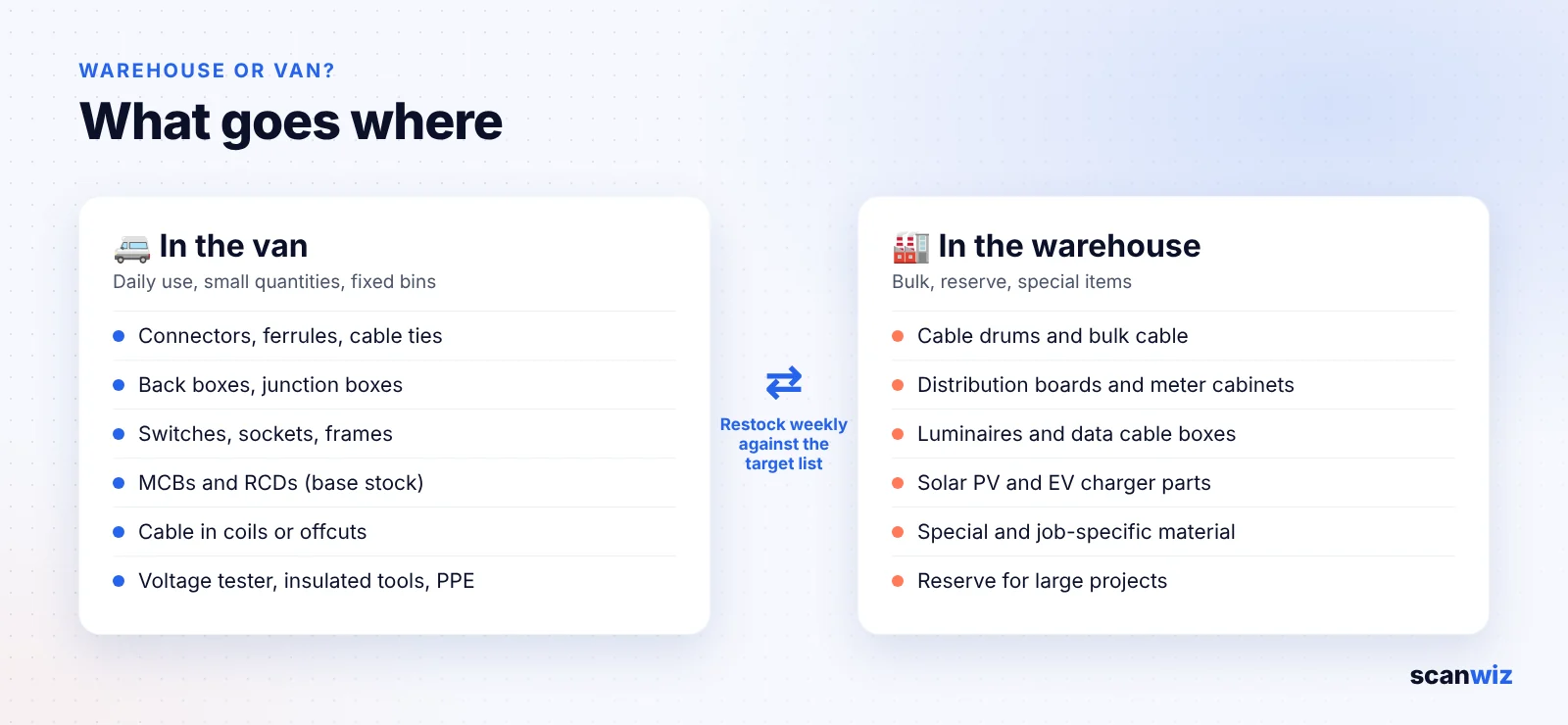
- A fixed target list per van type: all vans of one type carry the same stock. Every electrician knows what is where, even in a colleague’s van.
- Fixed bins: every item has its place in the organiser or rack. Label the bins so empty spaces stand out at once. More on this in our guide on how to organise a warehouse.
- Restock weekly: a fixed slot, for example Friday afternoon. Restock to the target quantity, not by feel.
- Record withdrawals: whatever goes from the van to the job is recorded. Otherwise stock levels are wrong within a week.
- Clear out regularly: once a quarter, bring leftovers, special parts and duplicates back to the warehouse.
Calculator: how much capital is tied up in your vans?
Material in a van is tied-up capital. It costs interest and insurance, it goes missing or becomes obsolete. Use the calculator to estimate how much money sits in your vans and what leaner van stock would save. We explain the carrying cost rate in our glossary.
Material, not tools – a rough estimate is fine
Typically leftovers, special parts, duplicates
Capital, space, shrinkage – often 15 to 30%
With a fixed target list and weekly restocking
Capital tied up in your vans
–
- Carrying cost per year–
- Of which not moved–
- Capital released (one-off)–
- Savings per year–
The leaner and more consistent your van stock, the less capital drives around unused – and the faster your team finds what it needs.
Example values, replace them with your own · Carrying cost = tied-up capital × carrying cost rate · Savings = released capital × carrying cost rate
Free Excel template: electrical inventory list
So you don’t have to start from scratch, we built a template you can use straight away. It contains around 55 typical items in ten categories, minimum stock levels with automatic reorder quantities, stock for three vans with a restock list and a separate sheet for tools and test equipment that calculates the next inspection dates for you.
Free Excel template: electrical inventory list
Inventory list with 10 categories, reorder quantities, restock list for three service vans and inspection dates for tools and test equipment. No sign-up needed.
Build your electrical inventory list in 6 steps
- Adapt the template: delete items you don’t stock and add your standard items. Better 80 well-kept items than 500 neglected ones.
- Count the warehouse: do one full count and enter the stock. Work category by category so you don’t lose track.
- Count the vans: empty each van once, count and tidy up at the same time. This is usually where the biggest surprises are.
- Set the target list: define the target quantity per item in the van, based on a typical week’s usage.
- Set minimum stock levels: for the warehouse, set a minimum per item that covers the weekly usage of all vans plus lead time.
- Agree the routine: who restocks when, who orders, who counts once a year? A regular stocktake keeps the list honest.
Tools and test equipment: asset numbers and inspection dates
Power tools, extension leads and cable reels are portable electrical equipment and need regular inspection. The interval depends on your country and risk assessment. In Germany, DGUV Regulation 3 gives a guide value of six months, three months on construction sites. In the UK, the HSE takes a risk-based approach to portable appliance testing. Test instruments such as installation testers are also calibrated according to the manufacturer, and ladders are checked regularly by a competent person.
To keep track, each device gets an asset number and a label. Our guide to barcode tool tracking explains how to label tools properly, and you’ll find all intervals in our guide to equipment inspection intervals.
Common mistakes with electrical inventory lists
- Too many items at once: if you start with 600 lines, you’ll stop maintaining them after three weeks. Begin with the items you use regularly.
- Mixed units: metres, coils, packs and pieces get mixed up. Define exactly one stock unit per item.
- Vans not treated as locations: the list then shows only part of your stock, and purchasing orders what is already in a van.
- Every van stocked differently: without a target list, each van grows its own range and restocking becomes guesswork.
- Withdrawals entered in batches: whatever is filled in from memory on Friday is inaccurate. Record withdrawals when they happen.
- Test instruments on the material list: tools and testers need asset numbers and inspection dates, not minimum stock.
Manage electrical stock with Scanwiz
A spreadsheet is a good start. It gets hard when five electricians take material at the same time and nobody has time to update lists. Scanwiz is inventory management for trades and industry that lets your team record material straight from their phones:
- Warehouse and vans as locations: main warehouse, outside storage and every service van are set up as separate locations with racks and bins.
- Withdrawals by scan: scan the item, enter the quantity, done. Material can be booked to a person, a van or a job site.
- Minimum stock per location: when an item drops below its minimum, it automatically lands on the shopping list, sorted by supplier.
- Tools and test equipment: asset numbers, assignment to employees and inspection dates with reminders.
- Excel import: take over the items from the template via Excel import instead of typing them in.
- Works offline: in basements or new builds without signal, the app keeps scanning and syncs later.
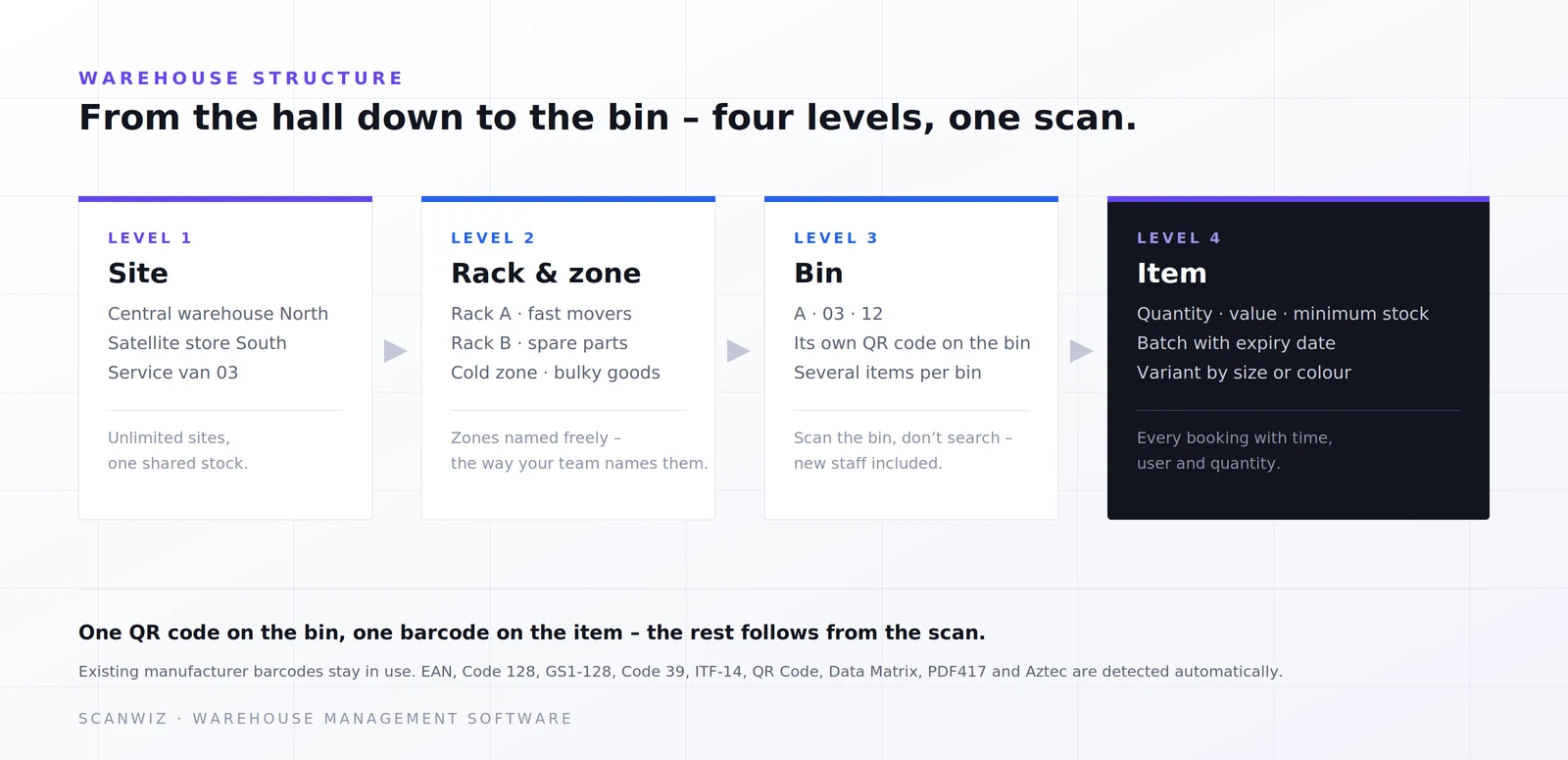
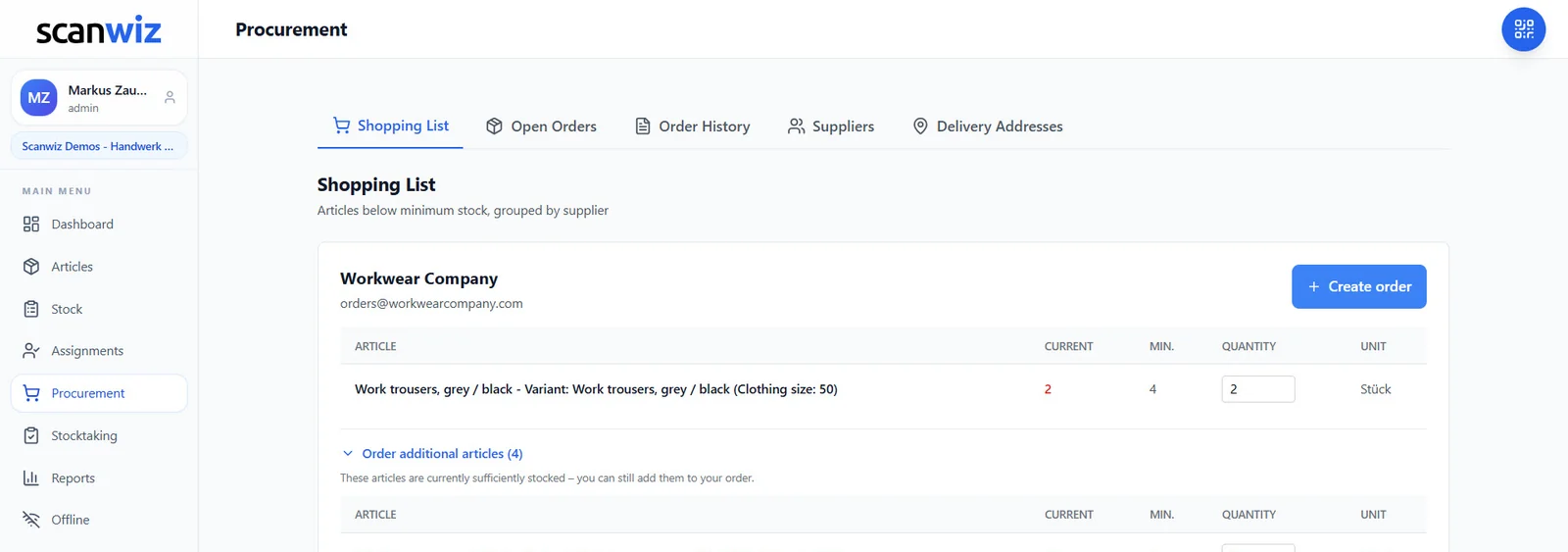
If you want to know when it pays to move away from spreadsheets, our comparison Excel inventory management vs. Scanwiz helps.
Frequently asked questions about electrical inventory lists
What should an electrical inventory list include?
An electrical inventory list usually covers ten areas: cables and wiring, conduit and fixings, boxes, terminals and connectors, switches and sockets, distribution and protection devices, lighting, data cabling, solar PV and EV charging parts, and PPE. For each item, record the item number, unit, bin location, stock, minimum stock, supplier and unit cost.
How much stock should an electrician keep in the van?
Enough for a typical week of jobs, but no more. A fixed target list per van type with minimum quantities per bin, restocked once a week, works well. Bulk packs, special parts and job-specific material stay in the warehouse and are picked per job.
Which data do I need for each item on an electrical inventory list?
At least item number, description, unit, bin location, current stock and minimum stock. For reordering, add supplier, supplier part number, unit cost and lead time. Photos and data sheets help avoid mixing up similar items.
How often do power tools and test instruments need inspection?
It depends on the country and your risk assessment. In Germany, DGUV Regulation 3 gives a guide value of six months for portable electrical equipment and three months on construction sites. In the UK, the HSE takes a risk-based approach to portable appliance testing. Test instruments are calibrated according to the manufacturer, usually once a year.
Is a spreadsheet enough for an electrical stockroom?
For a small business with one stockroom and a few vans, a spreadsheet can work if one person maintains it consistently. As soon as several electricians take material from vans, it becomes inaccurate, because withdrawals are entered late or not at all. That is when an app where every withdrawal is scanned pays off.
Can I import the template into Scanwiz?
Yes. Scanwiz offers an Excel import for items, so you can take over the items from the template instead of typing them in. Set up your warehouse and each service van as separate locations and add the minimum stock levels there.
Conclusion
A good electrical inventory list is short enough to be maintained and complete enough to avoid trips to the wholesaler. Organise it in ten categories, treat the warehouse and each van as separate locations, give every van a fixed target list and keep tools with inspection dates apart from consumables. With the template from this guide, the structure is ready – you only need to add your numbers.
Updated November 2026. Inspection intervals are guide values. Your risk assessment, local regulations and the manufacturer’s instructions take precedence.
More than 250 customers already rely on Scanwiz
Your stockroom and every van. Always up to date.
Record material by scan, restock vans and prepare reorders automatically. Start for free or book a personal demo to see how it works in your business.


