
How to do a stocktake comes down to this: at a defined point in time, you count, measure or weigh everything your business holds in materials, goods and supplies, and record the result in a way others can verify. For most businesses this is a legal obligation once a year – and often a day when the warehouse grinds to a halt, paper lists go round and the numbers still don’t add up at the end.
This guide shows you who is required to take stock (in Germany and Switzerland), which types of stocktake are allowed, how to prepare and carry out a stocktake in seven steps and which mistakes cause most stock discrepancies. You also get a checklist you can tick off.
Key points at a glance
- The stocktake is the process; the inventory is the result: a list of all assets and liabilities on a reporting date.
- In Germany, section 240 of the Commercial Code (HGB) requires a stocktake when a business starts and at the end of every financial year; small sole traders can be exempt under section 241a HGB. In Switzerland, Art. 958c of the Code of Obligations requires balances to be evidenced by an inventory or in another way.
- You don’t have to count on 31 December: counting close to the date (±10 days), shifted (three months before to two months after) or continuously throughout the year is also allowed.
- Most discrepancies don’t arise while counting but while typing up lists, from withdrawals nobody booked and from material sitting in a van or on a job site.
Contents: Stocktake vs. inventory · Who has to? · Types of stocktake · 7 steps · Checklist · Trades and construction · Common mistakes · Discrepancies · With Scanwiz · FAQ
What is a stocktake? Stocktake and inventory explained
A stocktake is a complete count of a company’s assets and liabilities on a specific reporting date. Anything you can touch – goods, materials, spare parts, tools – is recorded physically: counted, measured or weighed. Anything you can’t touch – receivables, bank balances, liabilities – is determined as a book inventory from records and statements.
| Term | What it means | Example |
|---|---|---|
| Stocktake | The process of counting stock | Counting every screw, cable and glove in the warehouse |
| Inventory | The result: a list of all stock with quantity and value | A list of 1,240 lines with a total value |
| Stock discrepancy | Difference between the counted quantity and the booked quantity | Expected 60 boxes of wall plugs, counted 54 |
| Reporting date | The date the inventory refers to | 31 December for a calendar financial year |
This article focuses on the part that creates the work in the warehouse: raw materials, consumables, goods for resale and spare parts. Tools, machines and equipment usually count as fixed assets and are kept in an asset register – how to track them with an asset number and location is covered on the asset inventory page. For the basics of managing stock items, read What is item-level inventory management?
Who has to do a stocktake?
Germany: stocktaking under the Commercial Code (HGB)
Under section 240 HGB, every merchant must draw up an inventory when starting the business and for the end of every financial year. This applies in particular to GmbHs, UGs, AGs, partnerships (OHG, KG) and registered merchants. Through the German Fiscal Code, the obligation also applies for tax purposes.
Under section 241a HGB, sole traders are exempt if, on two consecutive reporting dates, they have no more than EUR 800,000 in revenue and EUR 80,000 in net profit; for a new business, the first reporting date is enough. Freelancers and small businesses using cash-basis accounting are not required to take stock either. The inventory must be kept for ten years under section 257 HGB.
Switzerland: inventory under the Code of Obligations
In Switzerland, legal entities as well as sole proprietorships and partnerships with revenue of at least CHF 500,000 in the previous financial year must keep accounts and file financial statements (Art. 957 CO). Under Art. 958c para. 2 CO, the balance of each item on the balance sheet must be evidenced by an inventory or in another way. Accounting records and vouchers – including stocktake documents – must be kept for ten years (Art. 958f CO). Smaller sole proprietorships may use simplified bookkeeping; even then, a properly counted stock is the most reliable basis for the statement of assets.
| Germany | Switzerland | |
|---|---|---|
| Legal basis | Sections 240, 241 HGB | Art. 957, 958c CO |
| Who is required? | Merchants and trading companies | Legal entities; sole proprietorships and partnerships from CHF 500,000 revenue |
| Exemption | Sole traders up to EUR 800,000 revenue and EUR 80,000 profit | Simplified bookkeeping below CHF 500,000 revenue |
| Retention | 10 years (section 257 HGB) | 10 years (Art. 958f CO) |
Rules in other countries differ in the details, but the principle is the same almost everywhere: the stock in your accounts has to be backed by a count. And even without a legal obligation, it pays to do a stocktake regularly: it uncovers shrinkage and missing stock, makes minimum stock levels reliable and gives you solid figures for insurers and lenders.
Note: This article is a practical overview and does not replace tax or legal advice. Please discuss valuation questions and special cases with your tax adviser or accountant.
Types of stocktake: when are you allowed to count?
Good news first: the annual stocktake doesn’t have to happen on New Year’s Eve. Section 241 HGB and the German income tax guidelines (R 5.3 EStR) allow several methods that can spread the effort considerably.
| Type of stocktake | When do you count? | Works well for | Watch out for |
|---|---|---|---|
| Reporting-date stocktake | On the balance sheet date | Small and medium-sized warehouses | Operations usually stop while counting |
| Close-to-date stocktake | Up to 10 days before or after the date | Most SMEs | Movements between count day and reporting date are added or deducted using records |
| Shifted stocktake | Up to 3 months before or 2 months after | Seasonal businesses, construction with a quiet winter | Stock value is rolled forward or back to the reporting date |
| Perpetual stocktake | Throughout the year, every item at least once | Businesses with complete stock records | All receipts and withdrawals must be booked promptly |
| Sample-based stocktake | Extrapolated from a sample | Very large ranges | Only with recognised statistical methods |
Important: for perishable items, items prone to shrinkage or particularly valuable stock, perpetual and shifted stocktakes are not permitted under R 5.3 (3) EStR. You keep counting these items around the reporting date.
Which type of stocktake suits your business?
- Up to about 500 items, one location: A close-to-date stocktake on a quiet day between Christmas and New Year is usually the simplest option.
- Several locations, vans or job sites: Spread the count over several days or count areas one after another – with clean cut-off of stock movements.
- Digital stock control with booked withdrawals: A perpetual stocktake using cycle counts avoids the year-end state of emergency. One shelf a week, and the reporting date is already done.
- A few expensive items, many cheap ones: Count expensive A items more often and cheap C items once a year – that puts the attention where discrepancies really cost money.
How to do a stocktake in 7 steps
A good stocktake is two-thirds preparation and only one-third counting. If you want to do a stocktake without working through the night, follow these seven steps.
1. Set the date, type and person in charge
Plan four to six weeks ahead. Fix the count day, choose the type of stocktake and name one person to lead it. They assign areas, answer questions on the day and approve discrepancies. If you plan a shifted stocktake, agree the method with your tax adviser beforehand.
2. Tidy up the warehouse and define count zones
Split the warehouse into clearly separated count zones – shelf, bin, van, container – and number them. Tidy up first: empties, packaging waste and damaged goods don’t belong in the count. Clearly label or separate third-party property such as consignment stock, rental equipment or customer material.
3. Check item data and labels
Every item needs a clear name, a number and above all a single counting unit: piece, pack or carton. Print missing labels in advance – with the QR code label generator that takes a few minutes. Clean up duplicates and discontinued items now, not on count day.
4. Freeze or cleanly separate stock movements
While a zone is being counted, nothing should go in or out. Set a clear cut-off time: all receipts and withdrawals before it are booked, everything after it is collected separately and recorded after the count. Delivery notes arriving on count day get their own pile.
5. Count in pairs – without the expected quantity
The four-eyes principle works best: one person counts, the other records. Do not show counting teams the expected quantity. Anyone who knows that 60 boxes should be on the shelf is more likely to confirm than to count. Opened packs are recorded according to a rule agreed beforehand, and counted zones are visibly marked.
6. Recount and investigate discrepancies
Set a tolerance in advance, for example two percent or two units. Anything above it is recounted by a second team. If the difference remains, look for the cause: wrong unit, an unbooked withdrawal, a delivery note without a goods receipt – or material that is currently on a job site.
7. Close, value and document
Adopt the counted quantities as your new stock and book the discrepancies. For the inventory, quantities are valued at cost; write-downs for slow movers or damaged goods should be agreed with your tax adviser. Finally, archive count sheets, protocols and the discrepancy list – they are part of the records you must retain.
Stocktake checklist: prepare, count, close
Use this checklist to do your next stocktake without missing a step. Best of all, print it out and pin it up in the warehouse.
Four to six weeks before
- ☐ Count day, type of stocktake and stocktake lead agreed
- ☐ Tax adviser or accountant informed about date and method
- ☐ Count zones defined and numbered, warehouse plan up to date
- ☐ Item data cleaned up: duplicates, old items, counting units
- ☐ Missing labels or QR codes printed
- ☐ Counting teams assigned and briefed
The day before
- ☐ Warehouse tidied, empties and waste removed
- ☐ Third-party property and damaged goods separated and labelled
- ☐ All open receipts and withdrawals booked
- ☐ Material in vans, containers and with employees recorded or brought back
- ☐ Devices charged, app or count sheets ready
On count day
- ☐ Stock movements stopped, cut-off time noted
- ☐ Counted in pairs without visible expected quantities
- ☐ Counted zones marked, no zone counted twice
- ☐ Deliveries during the count collected separately
After the count
- ☐ Discrepancies above tolerance recounted
- ☐ Causes of the largest differences investigated and noted
- ☐ Quantities adopted, discrepancies booked
- ☐ Count sheets, protocol and discrepancy list archived
- ☐ Lessons learned recorded for the next stocktake
Stocktaking in trades and construction: what isn’t in the warehouse
In trade and construction businesses, a good share of stock isn’t in the warehouse at all but in a service van, a site container or a locker. If that share is forgotten, it shows up as missing stock – even though nothing is lost. Three rules help:
- Treat vans as separate locations: Every vehicle is a count zone with its own stock. That way it gets counted instead of estimated.
- Separate installed material: Material already installed on site is no longer warehouse stock but part of work in progress. How it is valued is something to clarify with your tax adviser.
- Record tools separately: Cordless drills, measuring devices and ladders are usually fixed assets and belong in tool management with an asset number and current assignment – not in the quantity count. How to stop devices from disappearing is covered in the guide Stop tool loss.
How material and tools stay traceable between warehouse, van and job site without paperwork is shown on the page Scanwiz in craft and industry.
7 common stocktaking mistakes
- Expected quantity on the count sheet: Anyone who sees the expected number confirms it. Small differences get rounded away without anyone noticing.
- Typing up paper lists: Between clipboard and spreadsheet come transposed digits, illegible numbers and swapped rows.
- Mixed-up units: 12 cartons are counted, the system expects pieces. 12 stays 12 instead of 600.
- Zones counted twice or not at all: Without clear zones, two teams count the same shelf and the outdoor store is missed.
- Movements during the count: A fitter quickly grabs some material, a delivery gets put away – and nobody books it.
- Third-party property counted: Consignment stock, rental equipment or customer material inflate the stock.
- Writing off differences without a cause: If you only correct and never ask why, next year will show the same gaps.
Many of these mistakes are tied directly to paper and spreadsheets. How far you can get with an Excel list and where the limits are is covered in our article How to track inventory in Excel.
Stock discrepancies: spotting and preventing the causes
A stocktake without a single difference is rare – and rather suspicious. What matters is whether discrepancies stay within limits and whether you know their causes. The most common patterns:
| Cause | Typical pattern | What helps |
|---|---|---|
| Unbooked withdrawals | The same consumables are always short | Book withdrawals by scan right at the shelf |
| Wrong unit | Difference by a multiple | One counting unit per item |
| Missing goods receipt | Surplus after a delivery | Book deliveries before putting them away |
| Material on the move | Shortfall that reappears later | Count vans and assignments too |
| Shrinkage or theft | Small, expensive items go missing regularly | Count more often, control access |
For consumables, one thing helps more than anything else: book withdrawals immediately. How that works without paper and how to set sensible minimum stock levels is explained in the guide Manage warehouse consumables digitally.
How to do a stocktake with Scanwiz: count, don’t copy
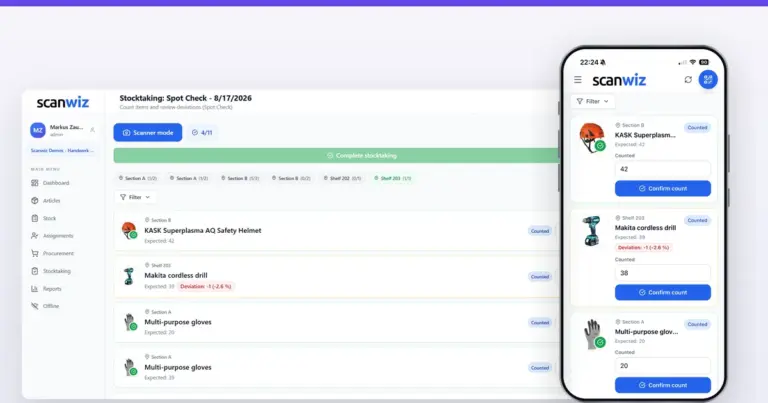
Scanwiz is inventory management software for businesses that manage materials, consumables and tools in their own warehouse. Stocktaking isn’t a year-end project there, but a feature you can start any time:
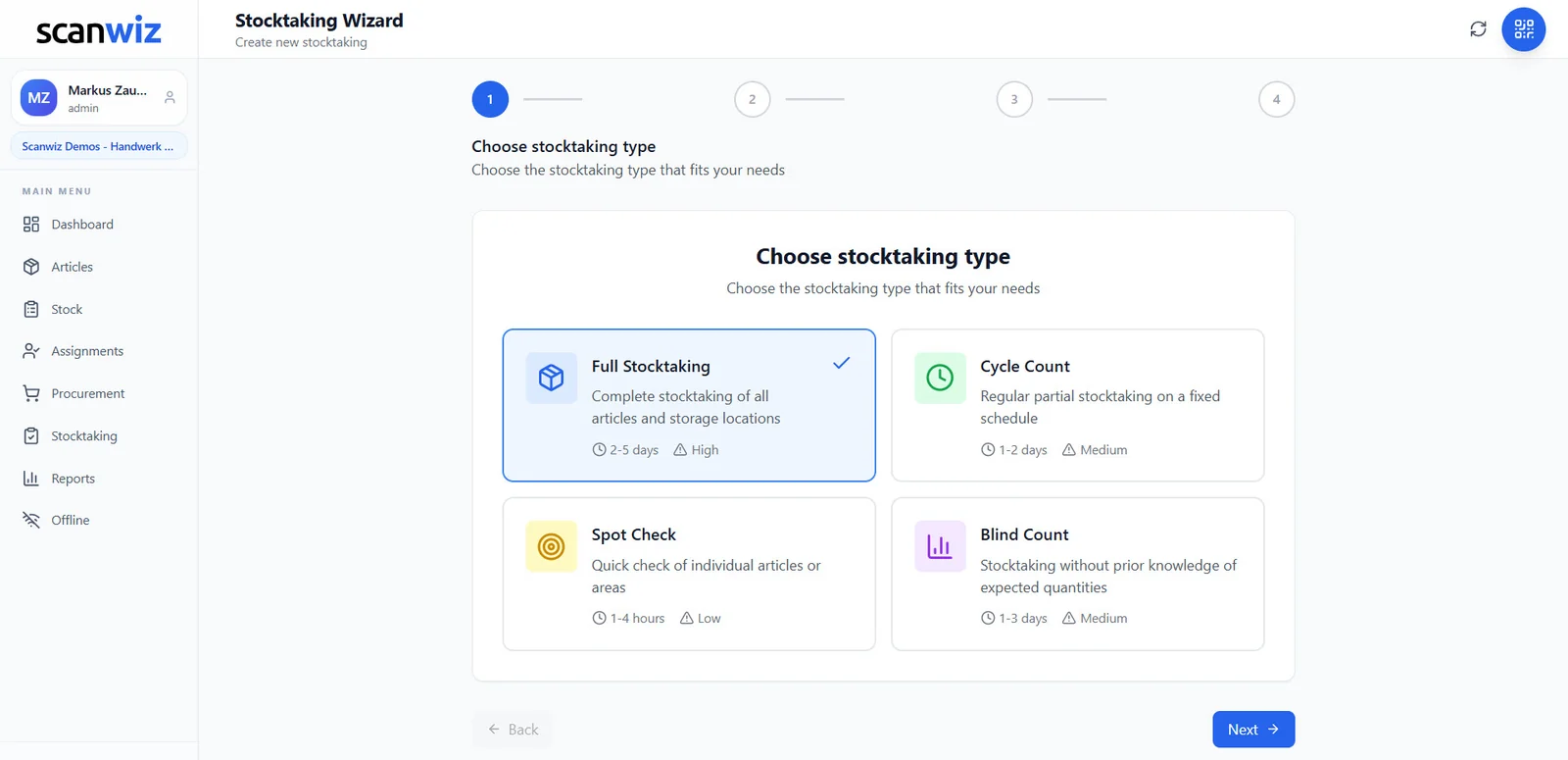
- Four types of stocktake: full count, cycle count for perpetual stocktaking, spot check for quick checks in between and blind count without visible expected quantities.
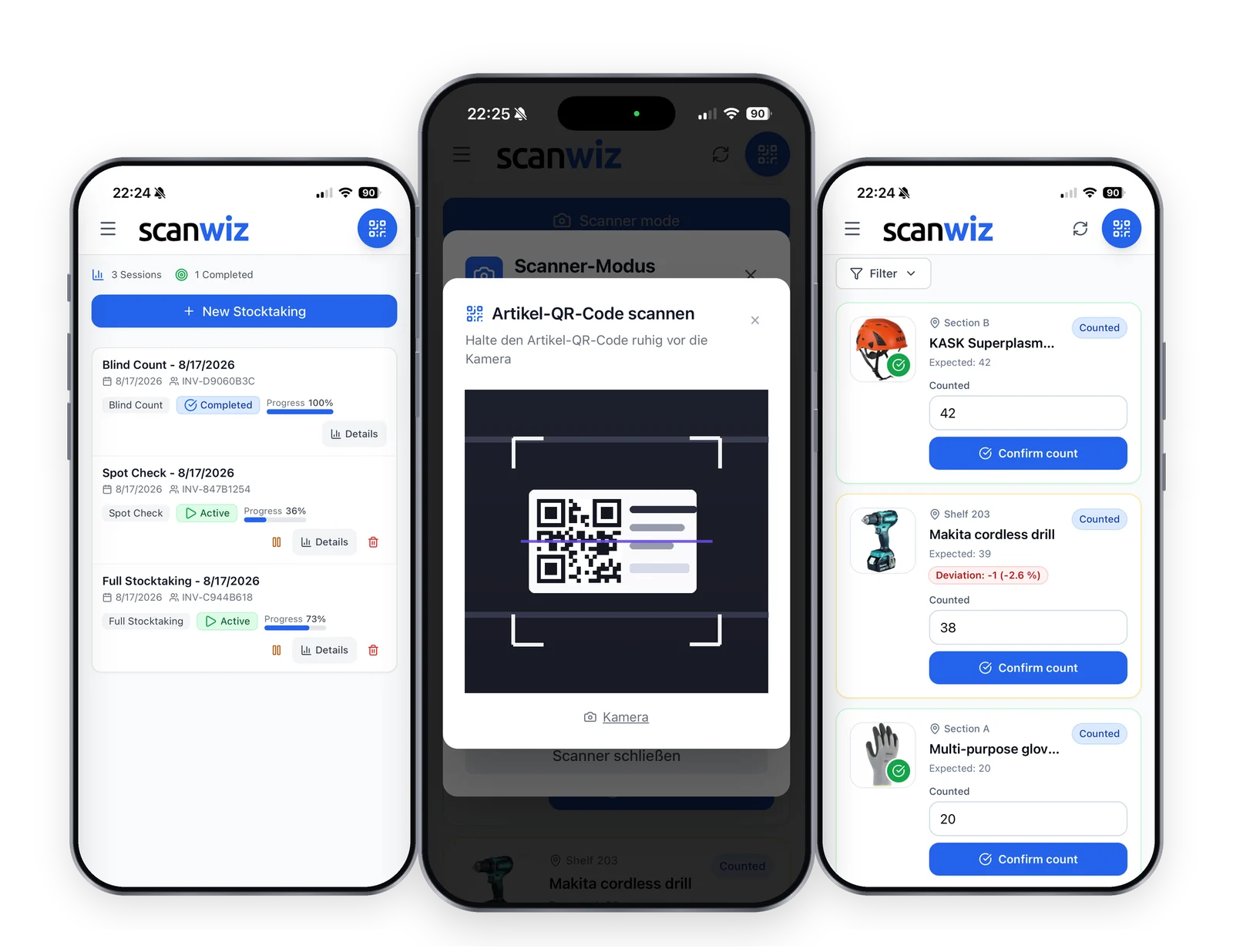
- Count on your phone: choose the location, scan the QR code or barcode, confirm the quantity. No typing up, no transcription errors. Tablets and external scanners work too.
- Tolerance in percent and units: only differences above your limit go for approval; everything else passes through.
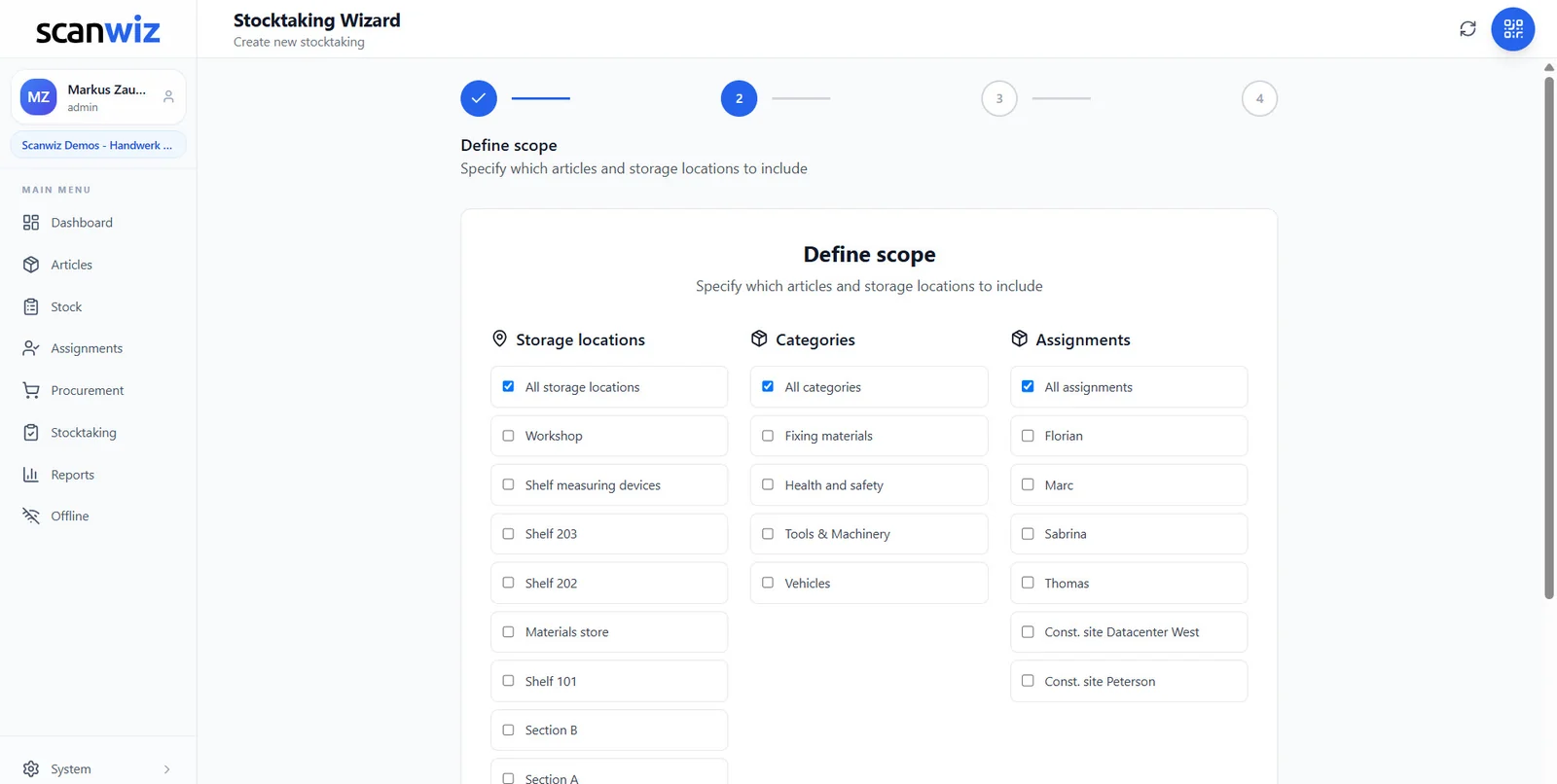
- Including stock on the move: assignments to employees, vehicles and job sites can be included in the count scope.
- Count offline: in the basement or a site container, counts are stored locally and synced automatically later.
- Several teams, pausable: everyone sees the same progress; a stocktake can be paused and resumed the next day.
- Audit-ready records: every stocktake is kept with its number, time period, participants and discrepancy list, and can be exported for accounting.
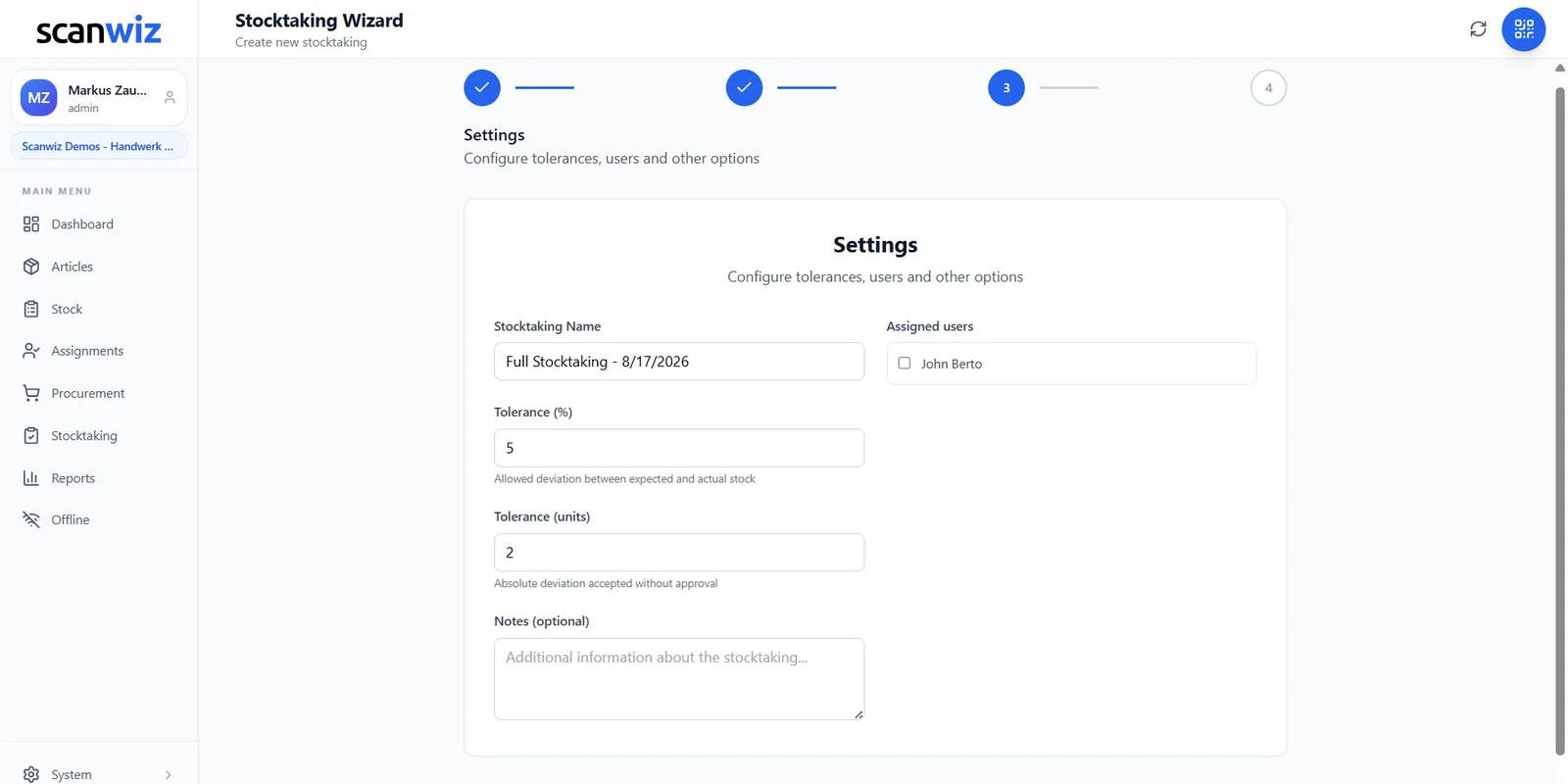
Existing item lists come in via Excel import, and your first count in Scanwiz doubles as your opening stocktake. All details on the feature are on the stocktaking software page, the iOS and Android app under inventory management app. More than 250 businesses use Scanwiz; on review platforms such as Capterra, GetApp and G2 it holds 4.9 out of 5 stars from more than 120 reviews.
Frequently asked questions about stocktaking
When does a stocktake have to be done?
In Germany, when a business starts and at the end of every financial year, usually 31 December. Counting is allowed close to the date within ten days before or after, as a shifted stocktake up to three months before or two months after, or continuously throughout the year as a perpetual stocktake.
Who is exempt from the stocktaking obligation?
In Germany, sole traders with no more than EUR 800,000 in revenue and EUR 80,000 in net profit on two consecutive reporting dates (section 241a HGB), as well as freelancers and small businesses using cash-basis accounting. In Switzerland, sole proprietorships and partnerships with less than CHF 500,000 in revenue may keep simplified accounts.
What types of stocktake are there?
The main types are the reporting-date stocktake, the close-to-date stocktake, the shifted stocktake, the perpetual stocktake and the sample-based stocktake. They differ mainly in when counting happens and what the stock records must provide.
How long does a stocktake take?
It depends on the number of items, locations and how well you prepare. A full count in a medium-sized warehouse typically takes two to five days, a spot check of individual areas a few hours. If you count in small rounds throughout the year, there is hardly anything left to do on the reporting date.
Do I still have to count with a perpetual stocktake?
Yes. With a perpetual stocktake, the stock on the reporting date is taken from the stock records, but every item must be physically counted at least once a year. The benefit: you spread counting over the whole year instead of doing everything in one day.
How long do stocktake records have to be kept?
In Germany, the inventory must be kept for ten years under section 257 HGB; in Switzerland, accounting records and vouchers must also be kept for ten years under Art. 958f CO. This includes the count sheets and protocols the inventory is based on.
Can I do a stocktake with my phone?
Yes. With a stocktaking app such as Scanwiz, you choose the location, scan the item’s barcode or QR code and enter the counted quantity. The difference is calculated immediately, and there is no typing up of count sheets. Scanwiz can be tested free for 14 days, without a credit card.
Conclusion: a good stocktake is prepared, not endured
If you need to do a stocktake, you win most of the time before count day: with clear count zones, clean item data, unambiguous units and frozen stock movements. Count in pairs and without expected quantities, recount and explain discrepancies. And if you count in small rounds throughout the year and book withdrawals immediately, the annual state of emergency becomes a routine of a few hours.
Updated October 2026.
More than 250 customers already trust Scanwiz
The next stocktake is coming. This time without paper.
Count on your phone instead of a clipboard, let discrepancies be checked automatically and close the stocktake with one click. Start for free or let us show you in a personal demo how it would look in your warehouse.


