
Glossary · Equipment & inspections
What is an asset number?
Three identical cordless drills, three different inspection dates, three different colleagues. Without a unique number, nobody knows which is which. Here you will learn how to build asset numbers sensibly and attach them to the device.
In brief
An asset number (also asset tag or inventory number) is a unique number assigned by the business to a single inventory item – such as a tool, a device or a piece of furniture. It distinguishes even identical items from one another and links the physical item to its data: location, holder, inspections and history. On the item, it is usually attached as a label with a QR code or barcode.
Asset number: definition
The asset number is something like an item’s license plate within the business. It is assigned once, when a device is purchased, and stays the same for life – even if it changes location, holder or department.
The number gives you access to everything that belongs to the item: purchase, value, inspection dates, repairs, who had it when. In accounting, it links the device to its entry in the fixed asset register.
Asset number, serial number, item number
| Number | Who assigns it? | What does it identify? |
|---|---|---|
| Asset number | Your business | A specific item in your stock |
| Serial number | The manufacturer | A specific device from the factory – long, inconsistent, often hard to read |
| Item number | Manufacturer, dealer or you | A product or model, not a single item |
| EAN / GTIN | GS1 via the manufacturer | A product in retail, globally unique |
Why not just use the serial number? Because every manufacturer has a different format, some devices have none at all and it is rarely scannable on the device. The serial number still belongs in the device data – for warranty and recalls, for example.
How to build a good numbering scheme
Short prefix plus a sequential number
An abbreviation for the main group (TL for tools, IT, VH for vehicles) and a sequential number. Short, unique, easy to read out.
“Meaningful” number with location
Sounds tidy, but becomes outdated at the first move. Location and category belong in the data, not in the number.
- Unique: each number exists exactly once.
- Unchangeable: the number never changes, not even when moving or transferring to another department.
- Never reuse: when a device is retired, its number stays blocked – otherwise histories get mixed up.
- Fixed length: TL-0042 instead of TL-42 sorts correctly in every list.
Putting the number on the device
You can create labels with sequential numbers free of charge and without signing up using our QR code label generator – as QR code, Data Matrix or barcode, print-ready on A4.
Example: tools at an electrical contractor
The business decides on four prefixes and a four-digit sequential number:
- Power tools
TL-0001 … - Measuring and test equipment
MD-0001 … - Ladders and scaffolding
LD-0001 … - Vehicles
VH-0001 …
The labels are printed on polyester film and attached in a spot that does not get rubbed off during work. One afternoon of labeling – after that, every issue, inspection and stocktake is a scan.
4 typical mistakes with asset numbers
- Reusing numbers. If a new device gets the number of an old one, it suddenly carries someone else’s inspection history.
- Putting the location in the number. At the first move, the number is wrong – or it gets changed and the history breaks.
- Label in the wrong place. On grips or batteries, it becomes unreadable after a few weeks or disappears with the battery.
- A number without a record. A label alone says nothing. Only with location, holder and inspection dates does it become management.
Asset numbers in Scanwiz
In Scanwiz, every device is managed as an individual object with its own asset number – so identical cordless drills stay distinguishable. You print labels for your whole inventory directly from Scanwiz or use numbers you already have. A scan with your phone then shows where the device is, who has it and when it needs to be inspected.
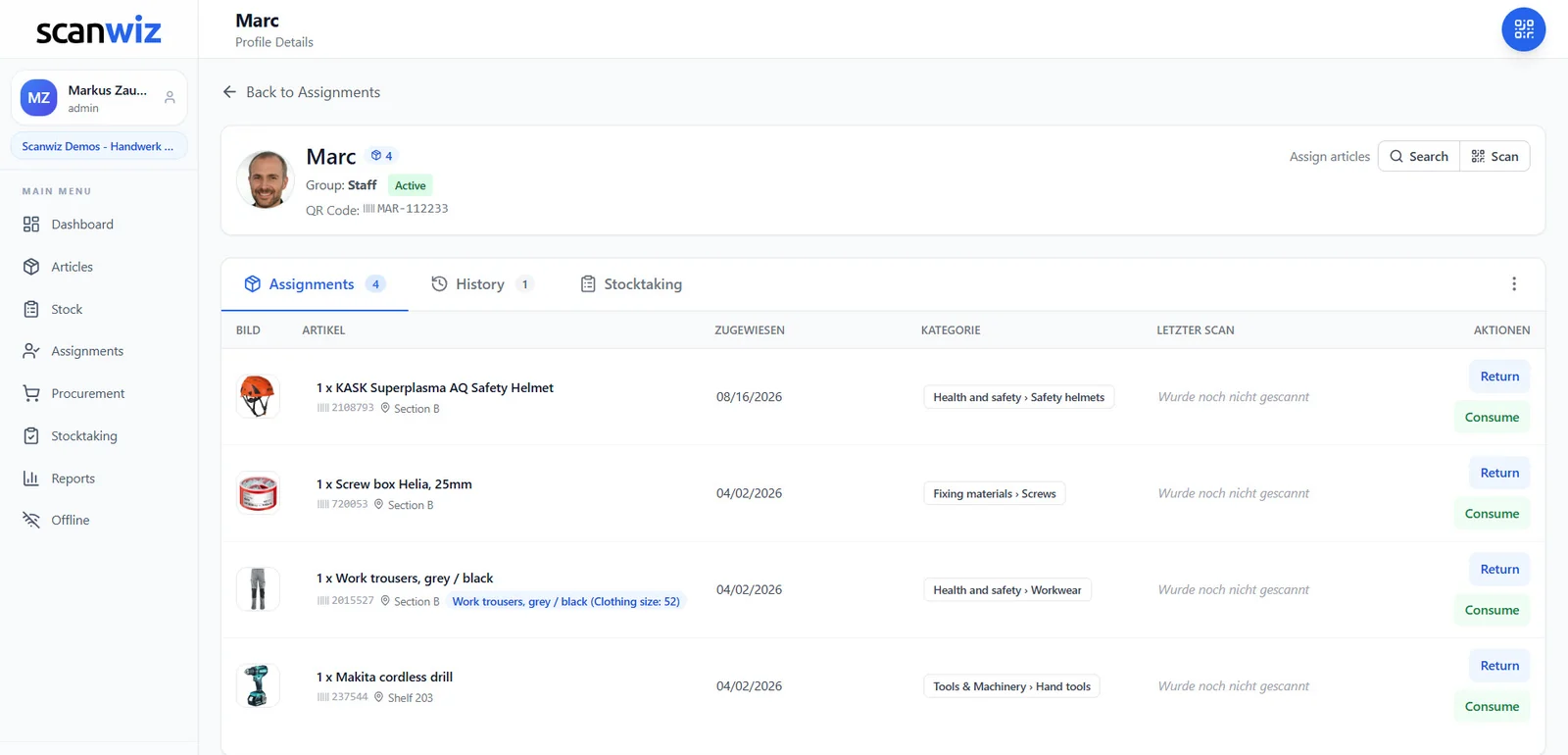
- Own asset number per device
- Print QR code labels directly from Scanwiz
- NFC tags for work equipment
- Scan by phone app, USB or Bluetooth scanner
Frequently asked questions about asset numbers
What is an asset number?
A unique number assigned by the business to a single inventory item. It distinguishes even identical items and links the item to its data such as location, holder and inspections.
How should an asset number be structured?
Short and unique: an abbreviation for the main group and a sequential number with a fixed length, for example TL-0042. Location or department do not belong in the number.
What is the difference from a serial number?
The manufacturer assigns the serial number, your business assigns the asset number. The asset number follows your own consistent scheme and is scannable on the device.
Can an asset number be reused?
Better not. If a number is reassigned after retirement, the histories of two devices get mixed up.
Sources & methodology
- Wikipedia: Serial number – distinction from lot and batch numbers. en.wikipedia.org, accessed 10 November 2026.
- Recommendations on numbering schemes: Scanwiz’s practical experience from customer projects.
Updated November 2026 · Scanwiz editorial team
More from the glossary
Related to the asset number.
Over 250 customers already trust Scanwiz
From the glossary to your warehouse – Scanwiz does the rest.
Minimum stock, stocktakes, inspection intervals and batches run automatically in Scanwiz as part of your daily work. Try it free for 14 days with your whole team – no credit card required. Or let us show you everything in a personal demo.


