
Glossary · Stock & replenishment
What is a reorder point?
The reorder point is the moment you need to reorder – not earlier, so no money sits on the shelf for nothing, and not later, so nothing runs out. Here you will learn what it is made of and how to calculate it in a minute.
In brief
The reorder point – also called reorder level or order point – is the quantity at which an item is reordered. It is made up of the consumption during the lead time plus the safety stock. If you order at the reorder point, the delivery arrives before the reserve has to be touched.
Reorder point: definition
The reorder point is a threshold. As long as stock is above it, nothing happens. Once stock reaches or falls below the reorder point, an order is triggered – traditionally for a fixed quantity. This approach is called the reorder point method and is the most common way to control replenishment in trades, medical practices and warehouses.
The idea behind it is simple: time passes between ordering and delivery, and consumption continues during that time. So the reorder point must be at least as high as the consumption until the delivery arrives. On top of that comes the safety stock in case more is used or the supplier takes longer.
Calculating the reorder point: the formula
The formula
ROP = avg. daily consumption × LT + SS
- Avg. daily consumption
- Average consumption per working day, ideally from the last 3 to 12 months
- LT
- Lead time in working days – from spotting the need until the goods are on the shelf
- SS
- Safety stock as a reserve for peaks and delays
How to determine the safety stock with three methods, and which special cases exist, is covered in the detailed guide Reorder point formula.
Reorder point calculator
Enter consumption, lead time and safety stock – the calculator shows the reorder point and maximum stock. In the first tab you can work out the safety stock first if needed. The values from the example are pre-filled.
The calculator needs JavaScript. Please enable JavaScript in your browser.
Example: connector terminals at an electrical contractor
On average, 6 packs go out per working day. Orders go to the wholesaler twice a week and the delivery arrives two days later – including putting it away, that is up to 5 working days. Two days of consumption should be kept as a reserve.
- Consumption during lead time: 6 × 5
30 packs - Safety stock: 6 × 2 days
12 packs - Reorder point: 30 + 12
42 packs - Maximum stock with an order quantity of 120 packs: 12 + 120
132 packs
Reorder point or fixed ordering cycle?
There are two classic ways to control replenishment. The reorder point is the more precise one, but it needs stock figures you can trust.
Reorder point method
Fixed trigger, fixed quantity.
You order as soon as the reorder point is reached – no matter which day it is. Works best when every withdrawal is recorded and the system always knows the current stock.
Periodic review method
Fixed date, variable quantity.
You order for example every Monday and top up to the maximum stock. Easy without software, but it needs more safety stock because the reserve also has to cover the time until the next order date.
4 typical mistakes with the reorder point
- Leaving out the safety stock. Then the reorder point is only enough if everything goes to plan – and it rarely does.
- Only counting the delivery time. Ordering cycle, weekends and putting goods away are all part of the lead time.
- Never adjusting the value. If consumption rises because more jobs come in, an old reorder point is too low.
- Working with wrong stock figures. If withdrawals are not recorded, the system shows more than is on the shelf – and the reorder point triggers too late.
Reorder point in Scanwiz
In Scanwiz the field is called minimum stock. Enter your reorder point there – per item and, if you like, per variant and storage location. Every withdrawal is recorded by scan, and as soon as an item falls below the value it automatically lands on the shopping list, grouped by supplier.
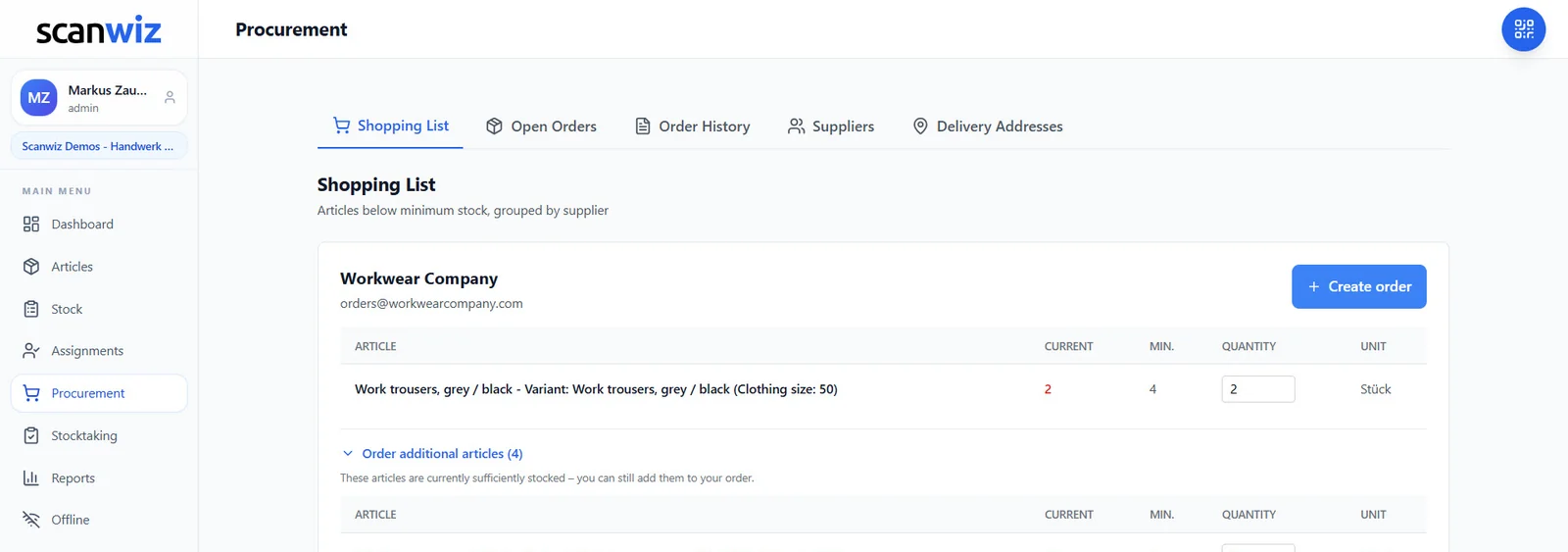
- Reorder point per item, variant and storage location
- Shopping list by supplier, with the order quantity suggested by Scanwiz
- After goods receipt, stock is correct again automatically
Frequently asked questions about the reorder point
What is a reorder point?
The reorder point is the stock level at which an item is reordered. It equals the consumption during the lead time plus the safety stock, so the delivery arrives before the reserve is needed.
How do you calculate the reorder point?
Average daily consumption times lead time in days plus safety stock. With 6 units per day, 5 days of lead time and 12 units in reserve, the reorder point is 42 units.
What is the difference between reorder point and safety stock?
Safety stock is the reserve that is normally left untouched. The reorder point sits above it and marks the moment to order. Safety stock is part of the reorder point.
Is the reorder point the same as minimum stock?
Not quite. Technically, minimum stock is usually just another word for safety stock. In many inventory tools – Scanwiz included – minimum stock is the field that triggers the reorder, though. That is where the reorder point belongs.
What happens if the reorder point is too low?
Then you order too late and the reserve gets used up during the delivery time. If this happens often, consumption or lead time have been set too low and the reorder point should go up.
Sources & methodology
- Wikipedia: Reorder point. en.wikipedia.org, accessed 10 November 2026.
- Scanwiz guide: Reorder point formula – derivation, methods for safety stock and examples.
- Worked example: Scanwiz’s own calculation with realistic figures from an electrical contractor.
Updated November 2026 · Scanwiz editorial team
More from the glossary
Related to the reorder point.
Over 250 customers already trust Scanwiz
From the glossary to your warehouse – Scanwiz does the rest.
Minimum stock, stocktakes, inspection intervals and batches run automatically in Scanwiz as part of your daily work. Try it free for 14 days with your whole team – no credit card required. Or let us show you everything in a personal demo.


