
Glossary · Stock & replenishment
What is lead time?
“Delivery in two days”, says the supplier. But by the time the goods are on your shelf, a lot more time has usually passed. That time is the lead time – and it decides when you need to reorder.
In brief
Lead time (also replenishment lead time) is the time from spotting a need until the reordered goods are ready to use in the warehouse. It includes internal order preparation, processing at the supplier, transport and goods receipt. It is almost always longer than the delivery time quoted by the supplier and determines how high the reorder point needs to be.
Lead time: definition
Lead time starts the moment someone notices that an item needs to be reordered – and ends when the new goods are put away and available again. Consumption continues during this time. The reorder point has to cover this consumption, otherwise the shelf is empty before the delivery arrives.
It is best measured in working days, because consumption is also calculated per working day. If you use calendar days for the delivery and working days for consumption, a weekend quickly throws your numbers off.
The 5 components of lead time
- Spotting the needUntil someone notices that a reorder is needed.
- Placing the orderApproval, writing the order, often only on fixed days.
- ProcessingOrder handling at the supplier, picking, shipping.
- TransportThe actual delivery time to your door.
- Goods receiptChecking, recording, putting away – only then are the goods available.
Suppliers usually only mention steps 3 and 4. Steps 1, 2 and 5 are up to you – and that is exactly where lead time is easiest to shorten.
Example: supplies at a medical practice
On Wednesday, someone notices that needles are running low. The practice collects its orders and places them on Friday. The dealer delivers on Tuesday, and the goods are put away on Wednesday after surgery hours.
- Waiting for order day: Thursday, Friday
2 working days - Delivery by the dealer: Monday, Tuesday
2 working days - Goods receipt and putting away: Wednesday
1 working day - Total lead time
5 working days
If you calculate with the dealer’s two days, your reorder point is three days of consumption too low. At 20 needles a day, 60 are missing – exactly the ones needed in the last week before the delivery.
What lead time means for your reorder point
Change the lead time in the calculator from 5 to 2 days and see how much the reorder point drops. The example with 20 needles a day and 40 in reserve is pre-filled.
The calculator needs JavaScript. Please enable JavaScript in your browser.
Shortening lead time
- Detect the need automatically: if stock in the system is correct, it flags itself instead of relying on someone happening to look at the shelf.
- Order more often: ordering only once a week adds several days to the lead time on average.
- Suppliers with firm commitments: better two reliable days than “usually two, sometimes five” – variation costs safety stock.
- Same-day goods receipt: goods sitting in a box in the hallway are not yet in stock.
4 typical mistakes with lead time
- Only using the supplier’s delivery time. Ordering cycle and goods receipt are missing – the reorder point is too low.
- Mixing calendar and working days. Delivery time in calendar days, consumption per working day: that does not add up.
- Only calculating with the average. If delivery time varies a lot, that has to go into the safety stock.
- Never measuring it again. Suppliers get slower or faster. A look at your last orders shows the real time.
Replenishment with Scanwiz
Scanwiz takes care of the first step for you: because every withdrawal is recorded by scan, the system detects the need itself – if an item falls below its minimum stock, it is on the shopping list right away. Orders are grouped by supplier, and after goods receipt the stock is correct by itself.
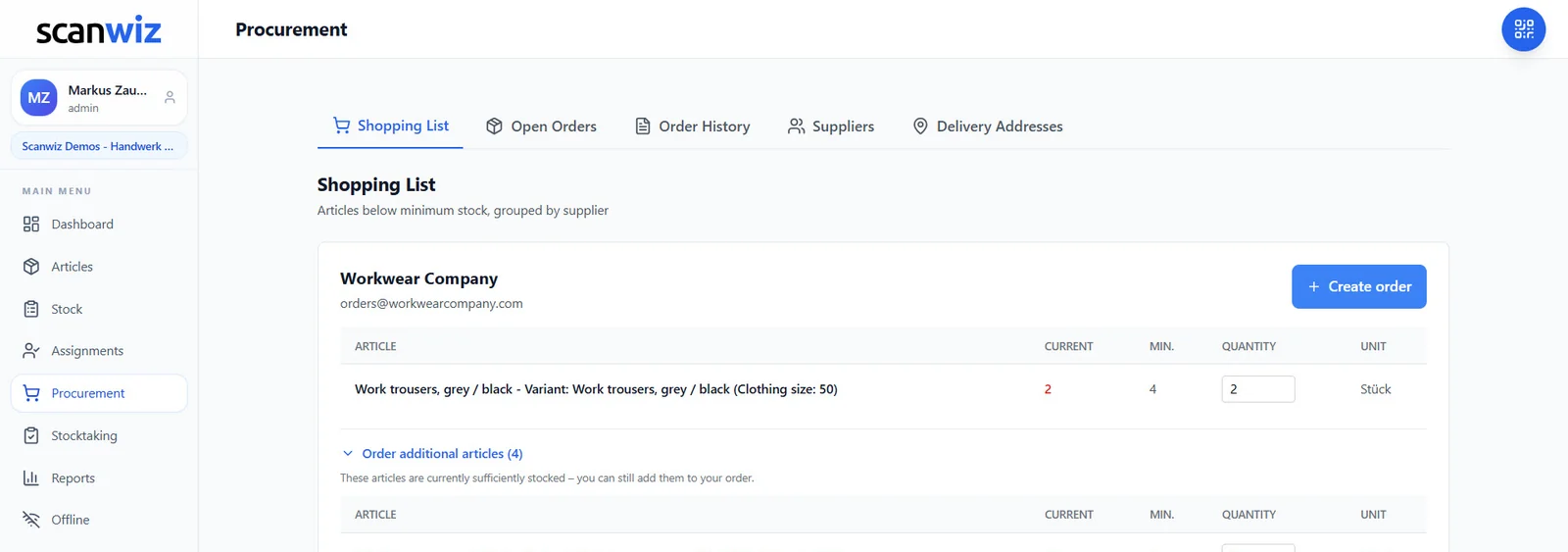
- Need is detected automatically as soon as stock falls below minimum stock
- Orders grouped by supplier
- Goods receipt by scan, stock updated immediately
Frequently asked questions about lead time
What is lead time?
The time from spotting a need until the reordered goods are ready to use in the warehouse – including order preparation, processing at the supplier, transport and goods receipt.
What is the difference between delivery time and lead time?
Delivery time only covers processing at the supplier and transport. Lead time also includes the time until the order is placed and goods receipt in your own business.
How do you calculate lead time?
By adding up the stages: time until the order, processing and transport at the supplier, goods receipt and putting away. The most accurate way is to look at real orders: from the date of the need to the date the goods were put away.
Why is lead time important?
It determines the reorder point. The longer the lead time, the earlier you need to order and the more material has to be in stock.
Sources & methodology
- Wikipedia: Lead time – term and components. en.wikipedia.org, accessed 10 November 2026.
- Worked example: Scanwiz’s own calculation with realistic processes at a GP practice.
Updated November 2026 · Scanwiz editorial team
Over 250 customers already trust Scanwiz
From the glossary to your warehouse – Scanwiz does the rest.
Minimum stock, stocktakes, inspection intervals and batches run automatically in Scanwiz as part of your daily work. Try it free for 14 days with your whole team – no credit card required. Or let us show you everything in a personal demo.


