
Glossary · Stock & replenishment
What is Kanban in the warehouse?
An empty bin is the order – nothing more is needed. Kanban is one of the simplest and most robust replenishment systems for small parts. Here you will learn how the two-bin system works, how big a bin needs to be and where Kanban reaches its limits.
In brief
Kanban is a replenishment method in which consumption itself triggers the reorder: when a bin is empty or a card is freed, exactly that quantity is refilled. In the warehouse, the simplest form is the two-bin system – items are taken from one bin, while the second stands behind it as a reserve. The method comes from the Toyota Production System.
Kanban: definition
“Kanban” is Japanese and roughly means card or sign. The principle was developed at Toyota, where Taiichi Ohno used it to control production. The idea: it is not a plan that decides what gets replenished, but actual consumption. What has been taken is replaced – no more and no less.
In the stores of trade businesses, workshops and medical practices, Kanban usually appears in its simplest form as a two-bin system for small parts: screws, wall plugs, cable ties, gloves. Nothing is counted. The empty bin is the signal.
How the two-bin system works
- Two binsEvery item has two bins of the same size, one behind the other on the shelf.
- TakeItems are only taken from the front bin.
- Empty = signalWhen it is empty, the rear bin moves to the front and the card goes to purchasing.
- ReorderExactly the contents of one bin are ordered.
- RefillThe refilled bin goes to the back – as the new reserve.
For this to work, one bin must hold enough to last until the delivery arrives. The second bin therefore takes on the role of the reorder point.
Calculating the bin size
Contents per bin
Avg. daily consumption × LT + safety margin
- LT
- Lead time in working days
- Margin
- Reserve for peaks, often 10 to 30% – or a fixed safety stock
The calculator works out exactly this value as the reorder point: enter consumption, lead time and reserve. The example below is pre-filled.
The calculator needs JavaScript. Please enable JavaScript in your browser.
Example: nuts in assembly
Around 400 nuts are used per working day. The supplier delivers three working days after the order. The business plans a 20% margin for peaks.
- Consumption until delivery: 400 × 3
1,200 units - Safety margin: 20%
240 units - Minimum contents per bin
1,440 units - Rounded up to pack sizes: 3 × 500
1,500 units
Advantages and limits of Kanban
Strengths
Simple, visible, robust.
No counting, no list, no system required. Everyone can see at the shelf what is missing. For cheap small parts with steady consumption, this saves a lot of effort.
Limits
Not suitable for everything.
With fluctuating consumption the bins are sometimes too small, sometimes too big. The contents of two bins are permanently in stock. And the system stands or falls with the discipline to actually pass on the card.
Rule of thumb: Kanban suits C items with steady consumption – in the XYZ analysis these are X items. For expensive or irregularly used parts, more precise control pays off.
4 typical mistakes with Kanban
- Bins too small. If one bin does not last until delivery, the second is empty too before the replenishment arrives.
- Taking from both bins. Then neither gets empty, the signal comes too late – and suddenly both are almost empty.
- Cards get lost. A card in someone’s pocket is an order that never arrives.
- Never adjusting the bin size. If consumption rises, the contents have to grow with it.
The Kanban principle with Scanwiz
The two-bin principle can be mapped digitally without a card ever getting lost: every storage location gets a QR code and its own minimum stock. If withdrawals are recorded by scan, the minimum stock takes over the role of the card – when stock falls below it, the item automatically lands on the shopping list.
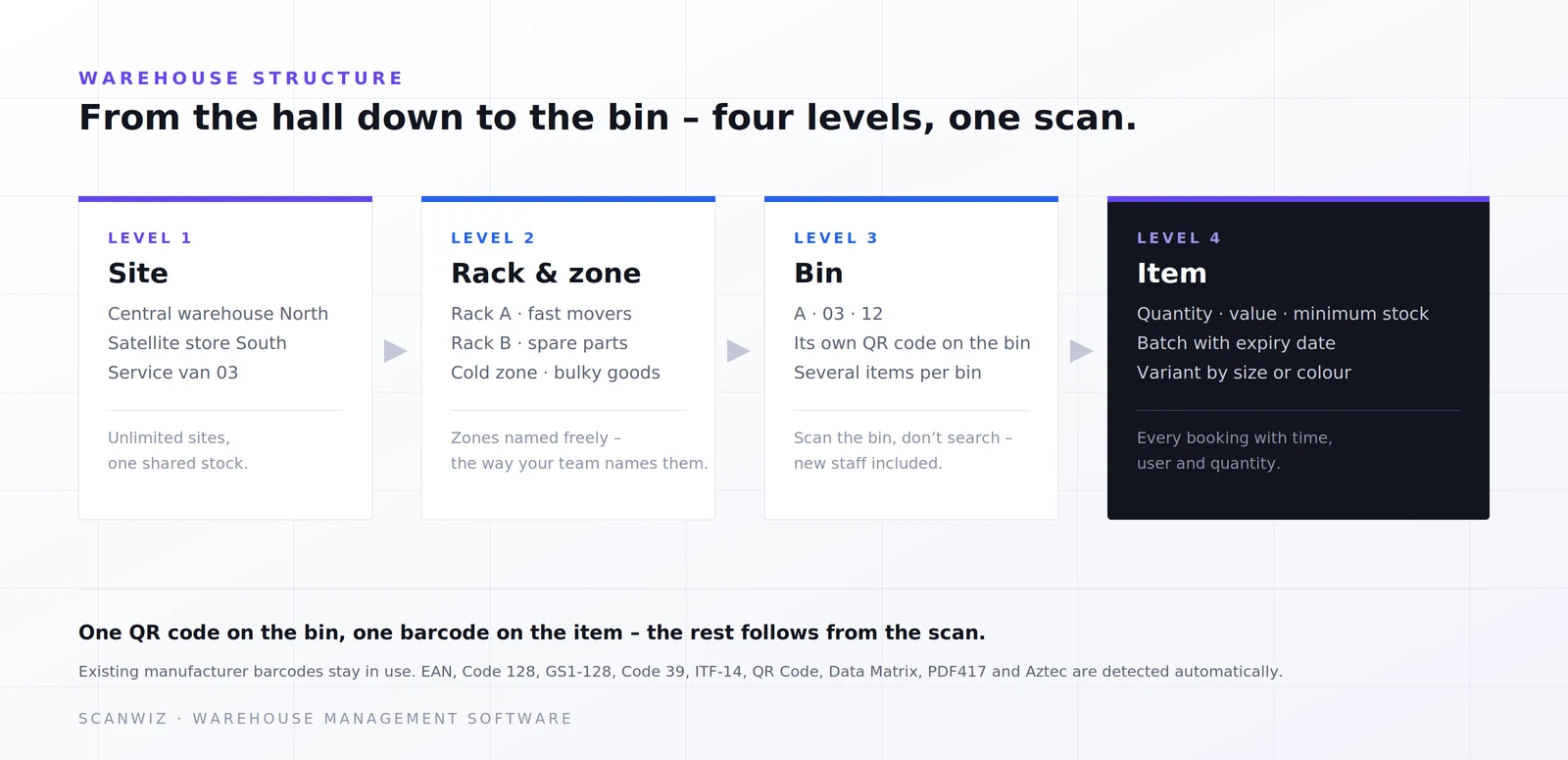
- QR code on the bin, withdrawal by scanning with your phone
- Minimum stock per item and storage location
- Shopping list by supplier instead of a stack of cards
Frequently asked questions about Kanban
What is Kanban in the warehouse?
Kanban is a replenishment method in which consumption triggers the reorder. In the warehouse it is usually a two-bin system: when one bin is empty, its contents are reordered while picking continues from the second.
How big does a Kanban bin need to be?
Big enough to hold the consumption during the lead time plus a safety margin. With a daily consumption of 400 units, three days of delivery time and a 20% margin, that is 1,440 units.
Which items is Kanban suitable for?
For cheap small parts with steady consumption such as screws, wall plugs, cable ties or gloves. For expensive or irregularly used items, more precise control via reorder point and order quantity is better.
Where does the term Kanban come from?
Kanban is Japanese and means card or sign. The method was developed in the Toyota Production System and is mainly associated with Taiichi Ohno.
Sources & methodology
- Wikipedia: Kanban – origin, principle and variants. en.wikipedia.org, accessed 10 November 2026.
- Worked example: Scanwiz’s own calculation with realistic figures from a metalwork business.
Updated November 2026 · Scanwiz editorial team
Over 250 customers already trust Scanwiz
From the glossary to your warehouse – Scanwiz does the rest.
Minimum stock, stocktakes, inspection intervals and batches run automatically in Scanwiz as part of your daily work. Try it free for 14 days with your whole team – no credit card required. Or let us show you everything in a personal demo.


