
Glossary · Stocktaking
What is a stocktake?
Once a year, you count what is really there – and compare it with what should be there. A stocktake is mandatory for most businesses, but it is also the best opportunity to find shrinkage, slow movers and booking errors. Here is the overview.
In brief
A stocktake (German: Inventur) is the physical count of all of a company’s assets and liabilities at a given point in time – for stock, by counting, measuring or weighing. Under Section 240 of the German Commercial Code (HGB), merchants must take inventory when they start trading and at the end of each financial year. The result of the stocktake is the inventory list, from which the balance sheet is derived.
Stocktake: definition
The German word comes from the Latin “invenire” – to find. That is exactly the point: recording what is actually there. In the store, that means counting, measuring or weighing every item and comparing the result with the stock in the system.
Three terms are often mixed up:
| Term | What it is | Day to day |
|---|---|---|
| Stocktake | The activity: physical count | Counting at the shelf |
| Inventory list | The result: list by type, quantity and value | The finished, valued list |
| Balance sheet | The condensed comparison of assets and capital | What the tax adviser makes of it |
Who has to do a stocktake?
- Merchants under the HGB – i.e. GmbH, UG, AG, GmbH & Co. KG, OHG and registered sole traders – must draw up an inventory list at the end of each financial year (Section 240 HGB).
- Small sole traders are exempt if, on two consecutive balance sheet dates, they each have no more than €800,000 in turnover and €80,000 in annual profit (Section 241a HGB).
- For tax purposes, Sections 140 and 141 of the German Fiscal Code (AO) also extend the obligation to traders who exceed the tax thresholds.
- Freelancers using cash-basis accounting are generally not required to carry out an HGB stocktake. They still need a register of fixed assets.
Note: This is an overview of German rules, not legal or tax advice. Whether and how your business has to take inventory is best clarified with your tax adviser.
Types of stocktake at a glance
Besides the classic count on the reporting date, the law provides several simplifications (Section 241 HGB). Which one fits depends on how big your store is and how reliably you book stock.
| Type | When counting happens | Suits |
|---|---|---|
| Year-end stocktake | On the balance sheet date; for tax purposes usually up to ten days before or after | Small and medium-sized stores |
| Deferred stocktake | Up to three months before or two months after the reporting date; stock value is rolled forward or back | Businesses for which the turn of the year is inconvenient |
| Perpetual inventory | Spread over the year, every item at least once; continuous updating in between | Stores with accurate stock booking |
| Sample-based stocktake | Only a statistical sample is counted and extrapolated | Large stores with many items |
How to prepare and carry out a stocktake step by step, including a checklist, is explained in our guide Carrying out a stocktake.
Example: year-end stocktake at a plumbing and heating business
As of 31 December, the business has to record its inventories. According to the system, there are materials and spare parts worth €86,000 in the store and in the vehicles.
- Divide the store into counting zones, plan in the vehicles
Preparation - Count in pairs, record quantities directly
2 days - Recount items with discrepancies
37 items - Confirmed discrepancy, valued at cost price
−€1,150 - Stock discrepancy relative to stock value
−1.3%
The biggest single item: 16 metres of copper pipe that were installed on a job site but never booked. The business corrects the stock, hands the inventory list to its tax adviser – and introduces scan-based withdrawals for the new year so that job-site material is booked immediately.
Calculate the stock discrepancy per item
Enter the expected and actual quantity of an item. The calculator shows the discrepancy in units, euros and percent – and whether it is within your tolerance or should be recounted. The copper pipe from the example is pre-filled.
The calculator needs JavaScript. Please enable JavaScript in your browser.
A stocktake is more than year-end closing
Even if you don’t have to prepare a balance sheet, counting regularly pays off:
- Work equipment: tools, measuring devices and machines are rarely lost in the store, but on the road. A stocktake shows what is really still there and who has it.
- Medical practices: medical devices, consumables and medicines with an expiry date need regular checks. More on this in our article Stocktaking at a medical practice.
- Reordering: reorder points and automatic shopping lists only work if the stock in the system is correct.
5 common stocktake mistakes
- Forgetting material outside the store. What is in vans, on job sites or in treatment rooms counts too. If it is missing from the count, a discrepancy appears even though nothing is missing.
- Counting with the expected quantity shown. If the expected number is on the list, people tend to confirm rather than count. Blind counting is better.
- Booking during the count. Receipts and issues in the area being counted distort the result. Either lock the area or cleanly cut off movements.
- Typing up paper sheets. A good share of the errors only arise after counting, when transferring from paper into the system.
- Simply writing off discrepancies. If you don’t ask about the cause, you’ll have the same discrepancy next year.
Stocktaking with Scanwiz
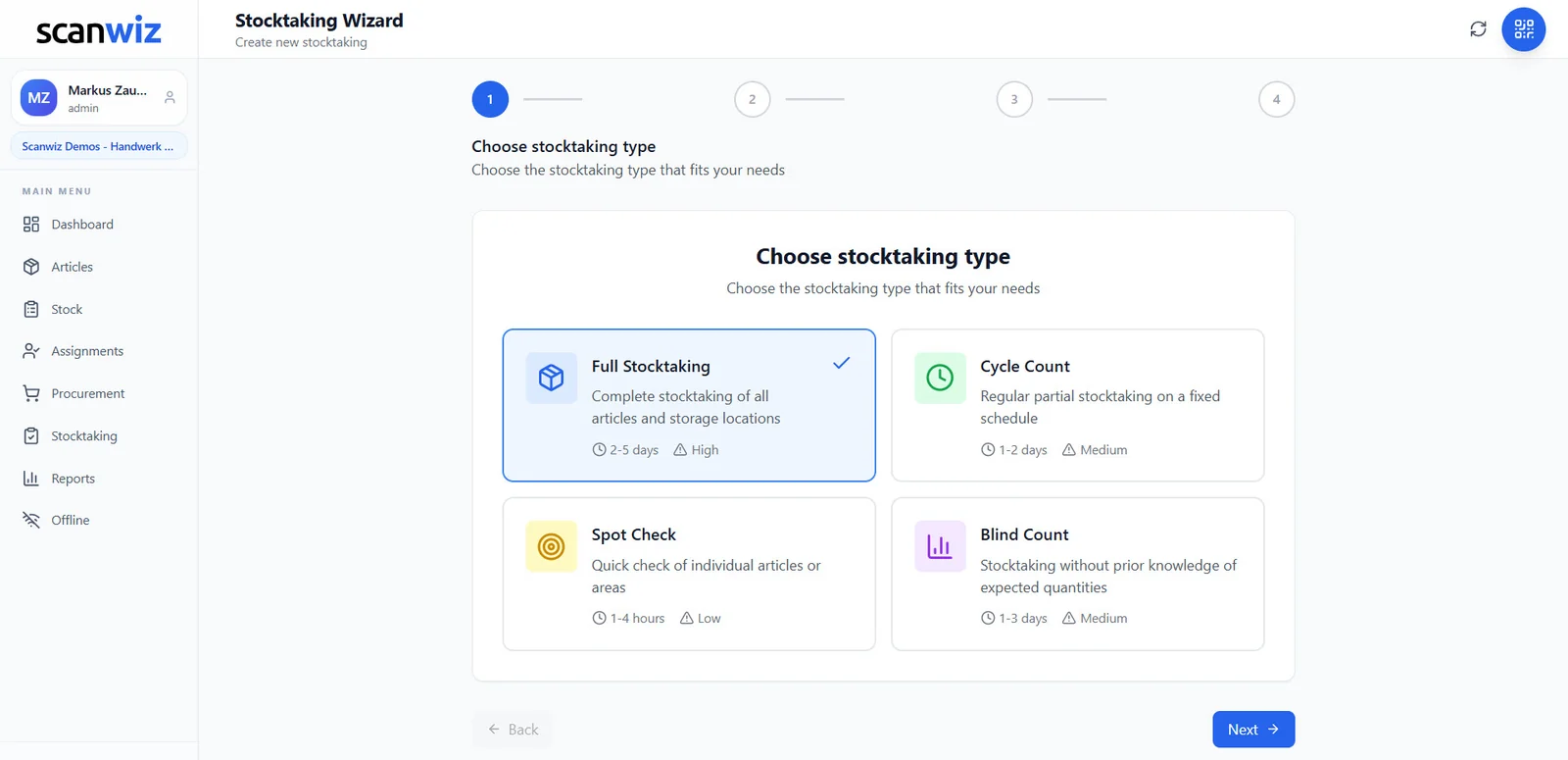
In Scanwiz, you create a stocktake as a separate session and choose one of four types: full count, cycle count, spot check or blind count. Counting is done on your phone – choose a location, scan the item, confirm the quantity, even without an internet connection. Material assigned to employees, vehicles or job sites can be counted at the same time.
- Tolerance in percent and units, approval only for larger discrepancies
- Blind count with the expected quantity hidden
- Several people count in parallel, even offline
- Every stocktake documented with number, period, participants and discrepancy list
All features in detail: Scanwiz stocktake software.
Frequently asked questions about stocktaking
What is a stocktake?
A stocktake is the physical count of all of a company’s assets and liabilities at a given point in time. Stock is counted, measured or weighed. The result is the inventory list.
Who is required to do a stocktake?
In Germany, all merchants under the HGB, such as GmbH, UG, KG and registered sole traders, must take inventory at the end of each financial year under Section 240 HGB. Small sole traders below the thresholds of Section 241a HGB are exempt.
What is the difference between a stocktake and an inventory list?
The stocktake is the activity, i.e. counting and recording. The inventory list is the result: the valued list of all assets and liabilities by type, quantity and value.
When does the stocktake have to take place?
For a year-end stocktake, on the balance sheet date – for tax purposes usually within ten days before or after. A deferred stocktake allows a window from three months before to two months after the reporting date; with perpetual inventory, counting is spread over the whole year.
What happens to stock discrepancies?
Confirmed discrepancies are corrected in the system and booked as an expense or income. It is important to recount first and clarify the cause so that the error doesn’t repeat.
Sources & methodology
- § 240 HGB – Inventory list (German Commercial Code). gesetze-im-internet.de, accessed 10 November 2026.
- § 241 HGB – Simplified stocktaking methods (German Commercial Code). gesetze-im-internet.de, accessed 10 November 2026.
- Section 241a HGB – exemption from the obligation to keep books and draw up an inventory list. gesetze-im-internet.de, accessed 10 Nov 2026.
- R 5.3 EStR (German income tax guidelines) – physical count of inventories (time window for the year-end stocktake).
- Worked example: Scanwiz’s own calculation with realistic figures from a plumbing and heating business.
Updated November 2026 · Scanwiz editorial team · not legal or tax advice
Over 250 customers already trust Scanwiz
From the glossary to your warehouse – Scanwiz does the rest.
Minimum stock, stocktakes, inspection intervals and batches run automatically in Scanwiz as part of your daily work. Try it free for 14 days with your whole team – no credit card required. Or let us show you everything in a personal demo.


