
Glossary · Equipment & inspections
What are consumables?
Screws, gloves, cable ties, disinfectant: individually they cost almost nothing, in total a lot – and when they run out, work stops. Here you will learn what counts as consumables and how to manage them so they are always there without the warehouse overflowing.
In brief
Consumables are material that gets used up at work and is no longer available afterwards – such as screws, wall plugs, gloves, tape, cleaning agents or disinfectant. Unlike work equipment, they are not returned and not tracked individually, but as a quantity. They are managed via minimum stock and reorder points.
Consumables: definition
Consumables are everything that is “gone” after a job. They are built in, used up, worn out or disposed of. That distinguishes them from work equipment, which is used many times and is therefore tracked individually with an asset number.
In accounting, consumables usually appear as supplies or operating materials:
- Supplies become a minor part of the result: screws, wall plugs, glue, sealing tape.
- Operating materials are needed for the work but do not become part of the result: lubricants, cleaning agents, grinding discs, gloves.
Examples by industry
| Industry | Typical consumables |
|---|---|
| Construction and interior finishing | Wall plugs, screws, silicone, expanding foam, drill bits, cutting discs, masking film |
| Electrical | Cable ties, terminals, insulating tape, conduit, wire end ferrules |
| Plumbing & heating | Press fittings, seals, plumbing hemp, solder, pipe clamps |
| Car repair shop | Oils, filters, brake cleaner, small parts, workshop rags |
| Medical practice | Gloves, syringes, needles, swabs, disinfectant |
| Facility management | Lamps, filters, cleaning agents, bin bags |
| Occupational safety | Disposable ear plugs, safety glasses, disposable coveralls, respirator filters |
How to always have enough – but not too much
- Fixed locationsEvery item has a labeled bin.
- Minimum stockSet for each item when to reorder.
- Record withdrawalsBy scan, so stock is correct.
- Shopping listAnything below the reorder point is added automatically.
- Group by supplierFew orders instead of many individual purchases.
For items with very steady consumption – gloves, screws, cable ties – the two-bin Kanban principle is often even simpler. You will find the detailed guide with the minimum stock formula in Manage warehouse consumables digitally.
Example: small material at a construction company
Until now, small material was bought by gut feeling. Each site foreman took what he needed and reordered when a box was empty. An analysis of the invoices shows:
- Spending on small material per year
€38,000 - Number of individual orders
≈ 410 - Emergency purchases at the local builders’ merchant
≈ 90 - Material not allocated to any site
100%
The business sets minimum stock levels for the 120 most important items and records withdrawals to the site by scan. This puts material consumption into each site’s post-calculation, and the shopping list bundles reorders by supplier.
Calculate the reorder point for consumables
At what quantity do you need to reorder? Enter daily consumption, delivery time and safety stock.
The calculator needs JavaScript. Please enable JavaScript in your browser.
4 typical mistakes with consumables
- Not managing them at all because they are cheap. Emergency purchases, double orders and downtime cost more than the material itself.
- Not recording withdrawals. Then the system shows stock that was used up long ago.
- Treating everything the same. Gloves need a different reserve from expensive special drill bits. An ABC analysis shows where precision pays off.
- Ignoring expiry dates. Silicone, adhesive, disinfectant and medical devices expire. FEFO applies here.
Consumables with Scanwiz
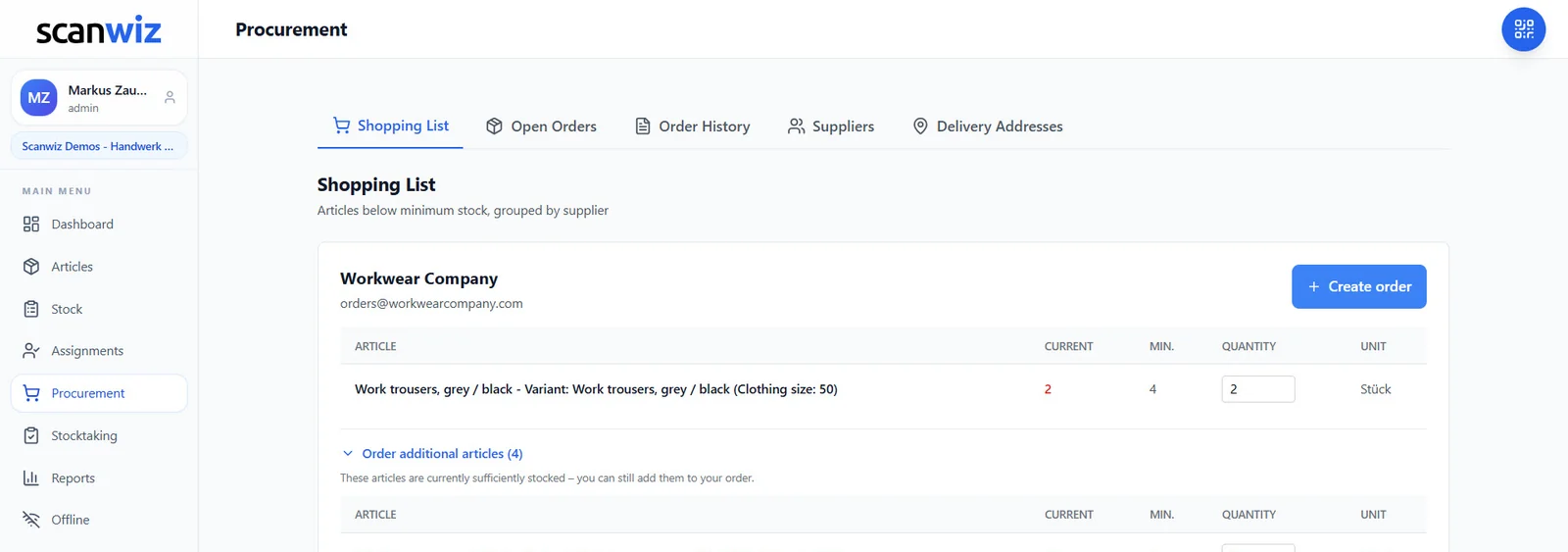
In Scanwiz you track consumables as a quantity per item, variant and storage location. Everyone records withdrawals themselves by scan – to a person, a vehicle or a site, with no return. If an item falls below its minimum stock, it lands on the shopping list, sorted by supplier. From the Growth plan, you can manage batches with expiry dates.
- Minimum stock per item, variant and storage location
- Shopping list by supplier with order suggestions
- Withdrawal by scan to a person, vehicle or site
- Excel import to start with existing lists
Frequently asked questions about consumables
What are consumables?
Material that gets used up at work and is no longer available afterwards, such as screws, gloves, tape or cleaning agents.
What is the difference from work equipment?
Work equipment is used many times and tracked individually, such as tools and devices. Consumables are used up and tracked as a quantity.
What is the best way to manage consumables?
With fixed storage locations, a minimum stock per item, recorded withdrawals and a shopping list that collects everything that needs to be reordered.
Do consumables have to be counted at the stocktake?
Yes, if they are part of inventories. For low-value supplies and operating materials that are replaced regularly, a fixed value may be used in some cases under German law – best clarified with your tax advisor.
Sources & methodology
- Wikipedia (German): Hilfsstoff (accounting). de.wikipedia.org, accessed 10 November 2026.
- Wikipedia (German): Betriebsstoff. de.wikipedia.org, accessed 10 November 2026.
- § 240 (3) HGB – Fixed value (German Commercial Code). gesetze-im-internet.de, accessed 10 November 2026.
- Example: model business, created by Scanwiz.
Updated November 2026 · Scanwiz editorial team
More from the glossary
Related to consumables.
Over 250 customers already trust Scanwiz
From the glossary to your warehouse – Scanwiz does the rest.
Minimum stock, stocktakes, inspection intervals and batches run automatically in Scanwiz as part of your daily work. Try it free for 14 days with your whole team – no credit card required. Or let us show you everything in a personal demo.


